 Librería Samer Atenea
 Kálamo Books
 Librería Elías (Asturias)
 Librería Kolima (Madrid)
 Librería Proteo (Málaga)
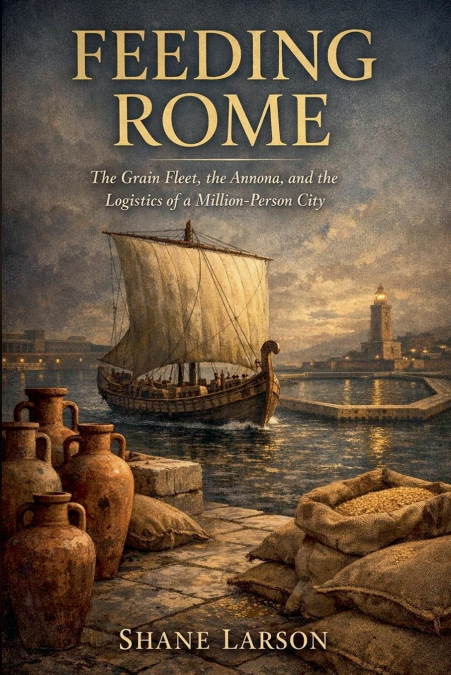
There is a hill in Rome made of roughly fifty-three million broken jars. Many of them are labeled.Monte Testaccio stands thirty-five meters high and runs seven hundred meters around, and from base to summit it is nothing but smashed olive-oil amphorae, stacked in engineered courses and dusted with lime against the smell. Painted on the sherds, still legible after eighteen centuries, are the shipper’s name, the weight, the origin, and the date an inspector signed off on the contents. It is a rubbish dump that is also an archive - and it is among the best evidence anywhere for how the largest city of the ancient world got fed.Rome held somewhere near a million people at a time when a large city meant fifty thousand. It could not feed itself from the land around it and never tried to. The grain came by sea - from Sicily, then Africa, then above all Egypt - roughly two hundred thousand metric tons a year, which works out to a loaded ship arriving about every eight hours, every day the sea was open, some two hundred and thirty days a year, for four centuries. A single giant Alexandrian carrier could hold over a thousand tons. At the river mouth the cargo moved to barges, towed up the Tiber against the current by men and oxen. In the city, roughly two hundred thousand registered citizens collected a fixed grain ration every month, free, at the state’s expense. The apparatus was called the annona, and the official who ran it held one of the most dangerous jobs in the empire, because his failure would be visible to a million people at once - and hungry.Feeding Rome follows the grain from an Egyptian threshing floor to a Roman bakery: the tax assessed in wheat, the Nile barges, the fleet at Alexandria, the ships and their wrecks, the hexagonal harbor basin at Portus, the towpath, the warehouse districts, the mills, the ovens, and the ration queue. And it ends where the system ended: in 439 the Vandals took Carthage, the African grain stopped, and Rome shrank to a fraction of its size within two generations. The city was always exactly as large as its supply lines allowed.This is a book that shows its working. The tonnage is derived in front of you, from the population and the ration, and every figure is labeled by what it is - a measurement, an ancient count, an author’s claim, or a modern reconstruction with its assumptions stated. Where the honest answer is a range, you get the range.What you’ll learn:How scholars estimate Rome’s population - five independent methods, converging from different directions on the same enormous answerWhy shipping grain a thousand miles by sea cost less than carting it a hundred miles overlandHow the grain dole actually worked: who qualified, what five modii a month meant, and why the entitlement could be inherited and soldWhat an eyewitness description of the giant grain ship Isis implies about her cargo - and how naval architects worked it outHow much grain the city held in reserve, and why that buffer was the difference between a shortage and a riotHow to read a broken amphora, field by field, the way an excavator doesThis book is for you if:You read history for how things actually worked, not only for who wonYou want an ancient city treated as a working operation - measured, staffed, scheduled - rather than as a backdrop for emperorsYou like numbers that arrive with their assumptions attachedYou suspect 'bread and circuses' is a phrase standing where a system should beRome’s greatest achievement was not a building.