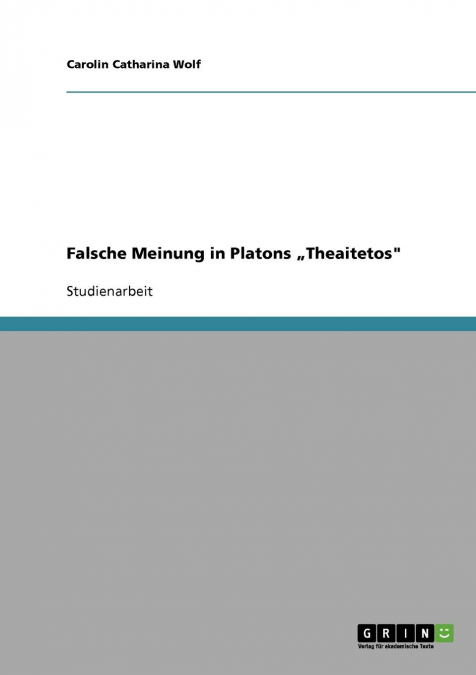

Falsche Meinung in Platons „Theaitetos'

Falsche Meinung in Platons „Theaitetos'

Carolin Catharina Wolf

15,25 €
IVA incluido
Disponible
Editorial:
GRIN Publishing
Año de edición:
2008
Materia
Filosofía occidental: antigua, hasta c. 500
ISBN:
9783638920728
15,25 €
IVA incluido
Disponible

Selecciona una librería:

  • Librería Samer Atenea
  • Librería Aciertas (Toledo)
  • Kálamo Books
  • Librería Perelló (Valencia)
  • Librería Elías (Asturias)
  • Donde los libros
  • Librería Kolima (Madrid)
  • Librería Proteo (Málaga)

Studienarbeit aus dem Jahr 2007 im Fachbereich Philosophie - Philosophie der Antike, Note: 1,7, Ruprecht-Karls-Universität Heidelberg, 8 Quellen im Literaturverzeichnis, Sprache: Deutsch, Abstract: Platons Spätdialog ‚Theätet' behandelt die Frage ‚Was ist Wissen?' . Die Dialogpartner Sokrates und Theätet besprechen, prüfen und verwerfen bei der Untersuchung dieser Frage drei Thesen: 1. Wissen ist Wahrnehmung 2. Wissen ist wahre Meinung 3. Wissen ist wahre begründete Meinung... Wenn der Vorschlag gemacht wird, dass es sich bei Wissen (beziehungsweise Erkenntnis) um wahre Meinung handelt, stellt sich die Frage ‚Was ist falsche Meinung'? Sokrates und sein Gesprächspartner Theätet gehen davon aus, dass es solches ‚falsches Meinen' gibt. Zu ersehen ist dies schon aus der Art und Weise, wie die Frage formuliert ist: „Mich beunruhigt jetzt und auch sonst oft, und es bringt mich in große Verlegenheit mir selbst und einem anderen gegenüber, dass ich nicht erklären kann, was das eigentlich für ein Zustand in uns ist und wie er zustande kommt.' (187d) An anderer Stelle wir dies noch einmal explizit ausgesprochen: „Sokrates: [...] Behaupten wir, dass es jeweils eine falsche Meinung gibt [...]? Theätet: Ja, das behaupten wir.' (187e) Es wird also keineswegs daran gezweifelt, dass falsche Meinung möglich sei. Dennoch soll zu erklären versucht werden, wie diese zustande kommen kann. Die anschließende Untersuchung ist für den späteren Verlauf des ‚Theätet' nicht von Bedeutung- es handelt sich um einen Exkurs, für dessen Ausführung nicht nur Muße, sondern vor allen Dingen innere Gründe ausschlaggebend sind. Entscheidend für die Ausführung ist auch die Tatsache, dass philosophische Wahrheit nicht das Wahre an sich ist, sondern zugleich die Auflösung des Falschen. Um zu einer richtigen Meinung zu gelangen, muss also erst die falsche Meinung bestimmt und überwunden werden oder wie Spinoza es ausdrückt: „Est enim verum index sui et falsi.' Wie also löst die richtige Meinung die ihr

Artículos relacionados

  • The Nature of Things
    Lucretius Lucretius
    De rerum natura (On the Nature of Things) is a 1st century BC didactic poem by the Roman poet and philosopher Lucretius with the goal of explaining Epicurean philosophy to a Roman audience. Lucretius presents the principles of atomism; the nature of the mind and soul; explanations of sensation and thought; the development of the world and its phenomena; and explains a variety o...
  • Pompeii
    Fergus Mason
    Pompeii was one of most advanced cities of its time; it had a complex water system, gymnasium, and an amphitheater. Despite it's advancements, there was one thing it wasn't ready for: Mount Vesuvius—the volcano that led to its ultimate doom.  The 79 AD eruption of Mount Vesuvius was one of the worst disasters in all of European history. In a near instant, over 15,000 p...
    Disponible

    10,36 €

  • Middle Platonism and Neoplatonism, Volume 1
    Stephen Gersh
    'It is generally agreed that those types of philosophy that are loosely called ’Platonic’ and ’Neoplatonic’ played a crucial role in the history of European culture during the centuries between antiquity and the Renaissance. However, until now no scholar has attempted to describe the evolution of these forms of thought in a single comprehensive academic study.' So writes Stephe...
  • Middle Platonism and Neoplatonism, Volume 2
    Stephen Gersh
    It is generally agreed that those types of philosophy that are loosely called 'Platonic' and 'Neoplatonic' played a crucial role in the history of European culture during the centuries between antiquity and the Middle Ages. However, until now no scholar has attempted to describe the evolution of these forms of thought in a single comprehensive academic study. Middle Platonism a...
  • Porphyry’s Commentary on Ptolemy’s Harmonics
    Andrew Barker
    ...
    Disponible

    77,17 €

  • The Roots of Platonism
    John Dillon
    ...
    Disponible

    25,29 €