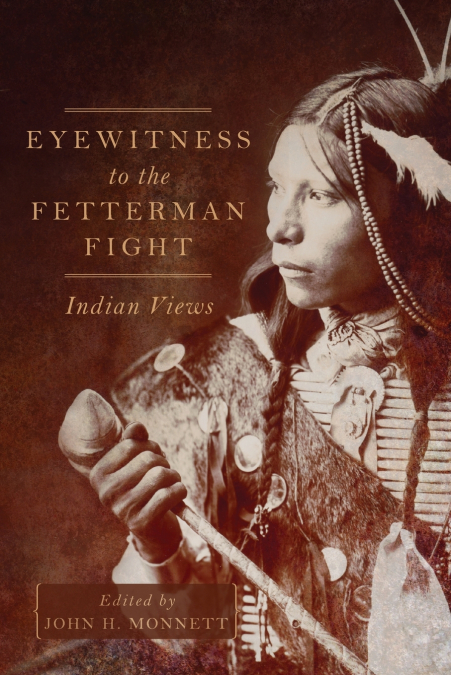

Eyewitness to the Fetterman Fight

Eyewitness to the Fetterman Fight

Eyewitness to the Fetterman Fight


31,10 €
IVA incluido
Disponible
Editorial:
University of Oklahoma Press
Año de edición:
2018
Materia
Historia de América
ISBN:
9780806161884
31,10 €
IVA incluido
Disponible

Selecciona una librería:

  • Librería Samer Atenea
  • Librería Aciertas (Toledo)
  • Kálamo Books
  • Librería Perelló (Valencia)
  • Librería Elías (Asturias)
  • Donde los libros
  • Librería Kolima (Madrid)
  • Librería Proteo (Málaga)

The Fetterman Fight ranks among the most crushing defeats suffered by the U.S. Army in the nineteenth-century West. On December 21, 1866—during Red Cloud’s War (1866–1868)—a well-organized force of 1,500 to 2,000 Oglala Lakota, Northern Cheyenne, and Arapaho warriors annihilated a detachment of seventy-nine infantry and cavalry soldiers—among them Captain William Judd Fetterman—and two civilian contractors. With no survivors on the U.S. side, the only eyewitness accounts of the battle came from Lakota and Cheyenne participants. In Eyewitness to the Fetterman Fight, award-winning historian John H. Monnett presents these Native views, drawn from previously published sources as well as newly discovered interviews with Oglala and Cheyenne warriors and leaders.Supplemented with archaeological evidence, these narratives flesh out historical understanding of Red Cloud’s War. Climate change in the mid-nineteenth century made the resource-rich Powder River Country in today’s Wyoming increasingly important to Plains Indians. At the same time, the discovery of gold in Montana encouraged prospectors to pass through the Powder River region on their way north, and so the U.S. Army began to construct new forts along the Bozeman Trail. In the resulting conflict, the Lakotas and Cheyennes defended their hunting ranges and trade routes.Traditional histories have laid the blame for Fetterman’s 1866 defeat and death on his incompetent leadership—and thus implied that the Indian alliance succeeded only because of Fetterman’s personal failings. Monnett’s sources paint another picture. Narratives like those of Miniconjou Lakota warrior White Bull suggest that Fetterman’s actions were not seen as rash or reprehensible until after the fact. Nor did his men flee the field in panic. Rather, they fought bravely to the end. The Indians, for their part, used their knowledge of the terrain to carefully plan and execute an ambush, ensuring them victory.Critical to understanding the nuances of Plains Indian strategy and tactics, the firsthand narratives in Eyewitness to the Fetterman Fight reveal the true nature of this Native victory against regular army

Artículos relacionados

  • Pan-Africanism and Education
    Kenneth J. King / Kenneth JKing
    This is an analysis of the complex links between Black America and Africa in the period of 1880 to 1945. It examines an extended white attempt to pattern politics and education in colonial Africa upon the example of the U.S. South. This export of United States race relations to Africa was resisted by Black intellectuals in the United States and many of the early nationalists in...
    Disponible

    24,60 €

  • The Native American Cookbook Recipes From Native American Tribes
    G.W. Mullins
    Light Of The Moon Publishing along with Author G.W. Mullins and Illustrator / Artist C.L. Hause have joined together to explore Native American Indian Cooking.  More than just a cookbook, this Native American recipe collection offers a look into a forgotten past.  'The Native American Cookbook Recipes From Native American Tribes,' offers a large collection of recipes from and i...
    Disponible

    24,56 €

  • A Public Spirit
    George H. Atkinson
    George Henry Atkinson (1819-89) was a son of New England who arrived in the Oregon Territory in 1848, sent by the American Home Missionary Society. Although his commission from the Society specified that his work was to be ecclesiastical and educational, he took an approach to that assignment which went well beyond his mandate. Well-informed and energetic, he made an impact on ...
    Disponible

    10,45 €

  • North Carolina Women of the Confederacy
    Lucy London Anderson
    Long out of print, this volume of recollections, stories, and verse provides a glimpse of women's lives on the home front-and sometimes in the thick of battle-during the War between the States. Nearly fifty years after the American Civil War, Lucy Worth London Anderson (Mrs. John Huske Anderson) of Fayetteville, N.C., compiled one of the first memorial collections honoring the...
    Disponible

    17,20 €

  • Freedom by a Thread
    Freedom by a Thread: The History of Quilombos in Brazil brings together some of the best scholars in the world working on the history of quilombos (maroon societies) in Brazil from a variety of perspectives and approaches. Over 40 percent of the total volume of captive Africans arrived in Brazil during a 400-year period of legal and contraband transatlantic slaving. If slavery ...
    Disponible

    36,71 €

  • Nashville Baseball History
    Bill Traughber
    Nashville is a Big League city despite never having been home to a major league team. From the Civil War era, to star-studded exhibitions, to outstanding Negro Leagues teams, to some of the great minor league franchises of all time, few cities have as rich a baseball tradition as Nashville, Tennessee.Nashville sports historian Bill Traughber, who has been writing about baseball...
    Disponible

    13,15 €