Connie Kubo Della-Piana / Gabriel M. Della-Piana / Gabriel MDella-Piana / Michael K. Gardner / Michael KGardner
 Librería Samer Atenea
 Kálamo Books
 Librería Elías (Asturias)
 Librería Kolima (Madrid)
 Librería Proteo (Málaga)
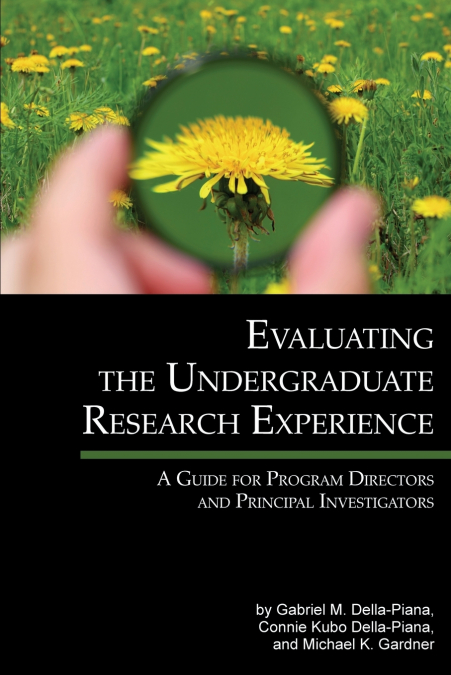
The current movement toward more and better research experiences forundergraduates has spread across disciplines in the arts, humanities, science,mathematics, and engineering beyond the 'research university' to the full rangeof post-secondary institutions of higher education. Along with this spread ofpractice is the need to take stock of the programs and make use of evaluation toinform program improvement and to communicate an understanding of theworth of the program to funders, institutional administrators, faculty/mentors, and students.The main aim of the book is to provide a practical guide for planning an evaluation of an undergraduateexperience program. The intent is to enable a program director to plan with a team consisting of an internalevaluator and program staff, a systematic and rigorous study of the program (processes, products, organizationaldynamics, etc.) including the gathering and analysis of information that is context-sensitive, and connected to anargument and justification for descriptive, causal, and practice-useful claims. It is useful for a program director tocontract with an evaluator. It is specific to the field of undergraduateresearch experience while being useful for other fields. It places strongemphasis on how to find and specify evaluation questions that yieldinformation that has high leverage for program improvement anddemonstrating the effectiveness and worth of the program. A measure ofattitude toward evaluation allows you to reflect on your leanings evaluationorientations such as formative/summative, process/product, preordinategoals/emergent goals, and other characteristics of approaches to andconfidence in evaluation.The main readership is targeted to directors and developers of undergraduateresearch experience programs. While the examples are mainly in theundergraduate research experience, it will be found useful for instructors ofcourses in project evaluation and beginning level evaluators. The usefulnessof the book is enhanced by a checklist in the final chapter that integrates theapproaches from throughout the book referencing the earlier discussions.