Inicio > Sociedad y ciencias sociales > Sociedad y cultura: general > Evaluating Ethical Frameworks for the Assessment of Human Cognitive Enhancement Applications
Evaluating Ethical Frameworks for the Assessment of Human Cognitive Enhancement Applications

Evaluating Ethical Frameworks for the Assessment of Human Cognitive Enhancement Applications

Clare Shelley-Egan / Ellen-Marie Forsberg / Erik Thorstensen

66,64 €
IVA incluido
Disponible
Editorial:
Springer Nature B.V.
Año de edición:
2017
Materia
Sociedad y cultura: general
ISBN:
9783319538228
66,64 €
IVA incluido
Disponible

Selecciona una librería:

  • Librería Samer Atenea
  • Librería Aciertas (Toledo)
  • Kálamo Books
  • Librería Perelló (Valencia)
  • Librería Elías (Asturias)
  • Donde los libros
  • Librería Kolima (Madrid)
  • Librería Proteo (Málaga)

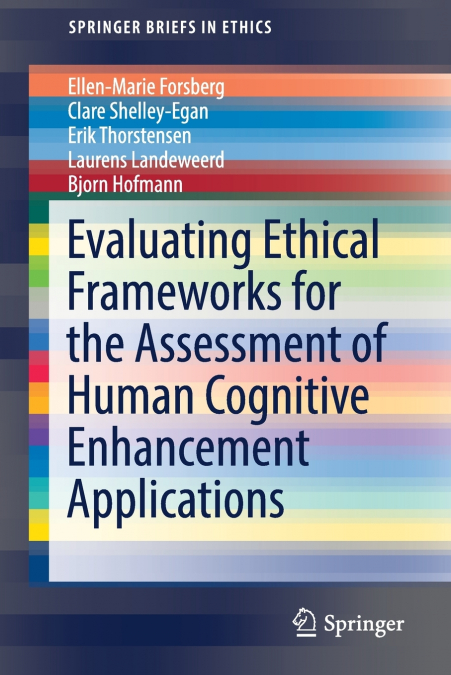
This book offers the policy-maker or decision-maker key insights and practical information regarding the features of ethics frameworks best suited to the ethical assessment of human cognitive enhancement (HCE) applications, such as pharmaceutical cognitive enhancers and noninvasive brain stimulation techniques. This book takes as its departure point the entrenched philosophical debate between opponents and proponents of HCE and the increased feasibility of some applications of HCE. Recent calls for policy-making in the area of human enhancement reflect the need to find a balance between addressing current ethical issues and issues that are more speculative in nature or are underpinned by abstract philosophical concepts. Practical ethical approaches for policy or decision-making should enable the development of an evidence base for the risks and benefits of HCE applications. Moreover, such practical approaches should also incorporate a broader range of value bases that would facilitate convergence regarding certain decisions and judgements. This book identifies and evaluate tools that help us to go beyond polarised philosophical debates in order to assist practical decision makers in concrete ethical deliberation and decision-making. The focus is on systematic methods with which to identify relevant ethical values and assess the impacts of an HCE application on those values in order to facilitate decision-making regarding the ethical acceptability or desirability of the application. 

Artículos relacionados

  • The Gandhian Iceberg
    Chris D Moore-Backman
    The Gandhian Iceberg presents a bold, new interpretation of Gandhian nonviolence from the rare perspective of an author who is equal parts writer, scholar, and frontlines practitioner. The book faces the current crisis of climate change and the intensification of social unrest around the world, and calls for a new convergence of serious, spiritually-rooted US nonviolence activi...
    Disponible

    11,52 €

  • Contemporary Developments in Child Protection
    Nigel Parton
    Volume 1 "Policy Changes and Challenges" takes as its central theme the ongoing and challenging issues which child protection agencies have to address and the policy and practice initiatives that are developed to try and address these. The volume includes papers on: the relationship between the decline in the rate of ‘unnatural’ deaths and the growth of concern about child abus...
  • Diversity in Information Technology Education
    Goran Trajkovski
    ...
  • Model-Driven Software Development
    Model-driven software development (MDSD) drastically alters the software development process, characterized by a high degree of innovation and productivity. However, quality assurance application in the domain of software models and model-driven software development is still in an emergent phase. Model-Driven Software Development: Integrating Quality Assurance provides in-depth...
  • Evidence-Based Practice in Nursing Informatics
    Andrew Chasin
    Because of the constant advances and dynamics within the nascent field of nursing informatics, many nurses struggle in practice as they continue to try and apply habitual communication practices in the new environment without any critical reflection on, and adaptation of, those practices. Evidence-Based Practice in Nursing Informatics: Concepts and Applications serves as a valu...
  • Actor-Network Theory and Technology Innovation
    Arthur Tatnall
    About 25 years ago, the first developments of ANT (Actor-Network Theory) took place, but it wasn’t until much later that researchers began to take it seriously. In the late 1990s, ANT began to take hold in the scientific community as a new and exciting approach to socio-technical research and social theory. Actor-Network Theory and Technology Innovation: Advancements and New Co...