
Inicio > Economía, finanzas, empresa y gestión > Economía > Economía internacional > European Yearbook of International Economic Law 2014
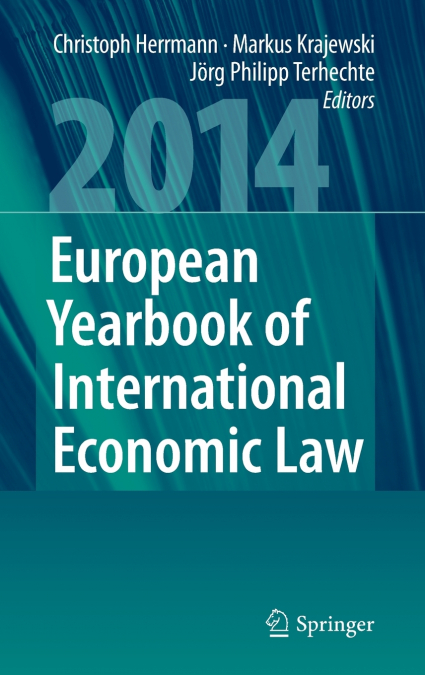
European Yearbook of International Economic Law 2014

European Yearbook of International Economic Law 2014


205,08 €
IVA incluido
Consulta disponibilidad
Editorial:
Springer Nature B.V.
Año de edición:
2014
Materia
Economía internacional
ISBN:
9783642409127

Selecciona una librería:

  • Librería Samer Atenea
  • Librería Aciertas (Toledo)
  • Kálamo Books
  • Librería Perelló (Valencia)
  • Librería Elías (Asturias)
  • Donde los libros
  • Librería Kolima (Madrid)
  • Librería Proteo (Málaga)

In 2014, the global economic system celebrates two anniversaries: Seventy years ago, on 22 July 1944 at Bretton Woods, New Hampshire, the Articles of Agreement of the International Monetary Fund (IMF) and the Articles of Agreement of the International Bank for Reconstruction and Development (Worldbank) were adopted. Since then the global financial and monetary system underwent significant policy changes, but the institutional framework remained the same. More recently, twenty years ago, on 15 April 1994, the Final Act of the Uruguay Round of Multilateral Trade Negotiations was signed and its key component, the Agreement establishing the World Trade Organization, entered into force on 1 January 1995. Even though the beginning of the multilateral trading system dates back to the late 1940s, the founding of the WTO constitutes a significant institutional reform which marks the beginning of a new era. Anniversaries are usually moments of celebration. However, even a superficial observer will notice that neither the current international financial and monetary regime nor the international trade regime is in a stage which invites celebration. Instead, both are facing difficult and fundamental challenges to their very existence from the outside but also from within. So while there may be no time to celebrate, anniversaries are also often used for reflection about the past and the future. Hence, EYIEL 5 (2014) considers these two anniversaries ample moments to reflect on the legacy and the current status of the main two pillars of International Economic Law in its Part one. Part two of EYIEL 5 (2014) brings together contributions on the EU’s Deep Trade Agenda, on Current Approaches to the International Investment Regime in South America, on the Multilayered System of Regional Economic Integration in West Africa and on the Tripartite Free Trade Area, as well as on India and her Trade Agreements. Part three contains treatises of developments in the World Customs Organization, the World Intellectual Property Organization and in International Investment Law. After the book reviews in Part four, EYIEL 5 (2014) is complemented with an Annex containing the Case (on exchange-rate manipulation and crisis-caused guarantees to financial institutions) and the Best Submissions of the 11th EMC2 ELSA WTO Moot Court Competition (of the Harvard team for the complainant and the Leuven team for the respondent). The case not only addresses issues of current interest but also links the subjects of our two special focusses nicely together.
Artículos relacionados

  • Regional Economic Integration and the Global Financial System
    Engin Sorhun / Hasan Dinçer / Unit Hacioglu
    In theory, regionalism and globalization are intended to be viewed as two separate concepts. However, as long as the approaches complement each other, considering these paradigms in tandem can have significantly positive effects on the overall status of the world economy. Regional Economic Integration and the Global Financial System addresses recent trends in regional integrati...
  • Handbook of Research on Impacts of International Business and Political Affairs on the Global Economy
    The growth of global commerce depends on many different factors and strategies in order for multinational corporations to efficiently compete and thrive in the international marketplace. In addition to business strategies, corporations must also be aware of political affairs that may impact their global economic status. The Handbook of Research on Impacts of International Busin...
  • NEXT CONVERGENCE
    MICHAEL SPENCE
    ...
    Disponible

    17,21 €

  • Interest and Prices
    Michael Woodford
    With the collapse of the Bretton Woods system, any pretense of a connection of the world’s currencies to any real commodity has been abandoned. Yet since the 1980s, most central banks have abandoned money-growth targets as practical guidelines for monetary policy as well. How then can pure 'fiat' currencies be managed so as to create confidence in the stability of national unit...
  • War, Wine, and Taxes
    John V.C. Nye
    In War, Wine, and Taxes, John Nye debunks the myth that Britain was a free-trade nation during and after the industrial revolution, by revealing how the British used tariffs-notably on French wine-as a mercantilist tool to politically weaken France and to respond to pressure from local brewers and others. The book reveals that Britain did not transform smoothly from a mercantil...
  • The Social Construction of Free Trade
    Francesco Duina
    This book offers a compelling new interpretation of the proliferation of regional trade agreements (RTAs) at the end of the twentieth century. Challenging the widespread assumption that RTAs should be seen as fundamentally similar economic initiatives to pursue free trade, Francesco Duina proposes that the world is reorganizing itself into regions that are highly distinctive an...
    Disponible

    54,25 €