
Inicio > > Ciencias de la computación > Inteligencia artificial > Essential Principles for Autonomous Robotics
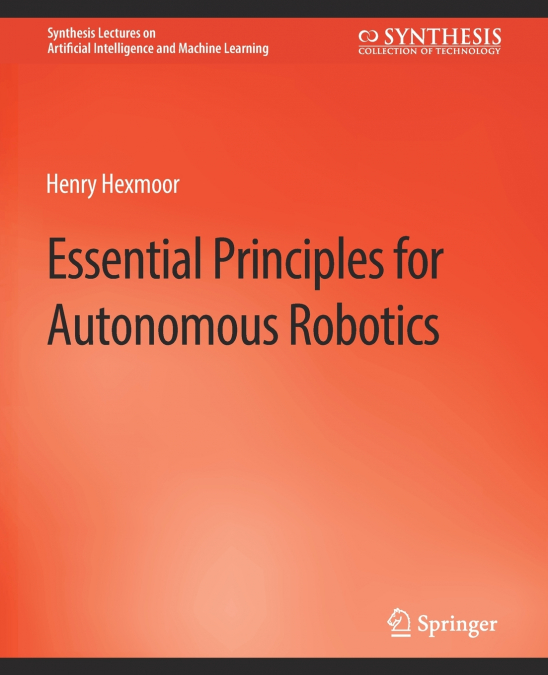
Essential Principles for Autonomous Robotics

Essential Principles for Autonomous Robotics

Henry Hexmoor

48,50 €
IVA incluido
Disponible
Editorial:
Springer Nature B.V.
Año de edición:
2013
Materia
Inteligencia artificial
ISBN:
9783031004353
48,50 €
IVA incluido
Disponible

Selecciona una librería:

  • Librería Samer Atenea
  • Librería Aciertas (Toledo)
  • Kálamo Books
  • Librería Perelló (Valencia)
  • Librería Elías (Asturias)
  • Donde los libros
  • Librería Kolima (Madrid)
  • Librería Proteo (Málaga)

From driving, flying, and swimming, to digging for unknown objects in space exploration, autonomous robots take on varied shapes and sizes. In part, autonomous robots are designed to perform tasks that are too dirty, dull, or dangerous for humans. With nontrivial autonomy and volition, they may soon claim their own place in human society. These robots will be our allies as we strive for understanding our natural and man-made environments and build positive synergies around us. Although we may never perfect replication of biological capabilities in robots, we must harness the inevitable emergence of robots that synchronizes with our own capacities to live, learn, and grow. This book is a snapshot of motivations and methodologies for our collective attempts to transform our lives and enable us to cohabit with robots that work with and for us. It reviews and guides the reader to seminal and continual developments that are the foundations for successful paradigms. It attempts to demystify the abilities and limitations of robots. It is a progress report on the continuing work that will fuel future endeavors. Table of Contents: Part I: Preliminaries/Agency, Motion, and Anatomy/Behaviors / Architectures / Affect/Sensors / Manipulators/Part II: Mobility/Potential Fields/Roadmaps / Reactive Navigation / Multi-Robot Mapping: Brick and Mortar Strategy / Part III: State of the Art / Multi-Robotics Phenomena / Human-Robot Interaction / Fuzzy Control / Decision Theory and Game Theory / Part IV: On the Horizon / Applications: Macro and Micro Robots / References / Author Biography / Discussion
Artículos relacionados

  • Artificial Cognition Systems
    ...
  • Cross-Disciplinary Applications of Artificial Intelligence and Pattern Recognition
    Vijay Kumar Mago
    The need for intelligent machines in areas such as medical diagnostics, biometric security systems, and image processing motivates researchers to develop and explore new techniques, algorithms, and applications in this evolving field. Cross-Disciplinary Applications of Artificial Intelligence and Pattern Recognition: Advancing Technologies provides a common platform for researc...
  • Emerging Applications of Natural Language Processing
    Over the last few years, the area of Natural Language Processing has drastically grown in recognition, not only within the research and development community, but also with industry professionals. As NLP continues to be discussed and researched, certain areas continue to grow and mature. As a result, the need for advanced research and information is in high demand. Emerging App...
  • Androids, Cyborgs, and Robots in Contemporary Culture and Society
    Steven John Thompson
    Mankind’s dependence on artificial intelligence and robotics is increasing rapidly as technology becomes more advanced. Finding a way to seamlessly intertwine these two worlds will help boost productivity in society and aid in a variety of ways in modern civilization. Androids, Cyborgs, and Robots in Contemporary Culture and Society is an essential scholarly resource that delve...
  • Deep Learning Innovations and Their Convergence With Big Data
    The expansion of digital data has transformed various sectors of business such as healthcare, industrial manufacturing, and transportation. A new way of solving business problems has emerged through the use of machine learning techniques in conjunction with big data analytics. Deep Learning Innovations and Their Convergence With Big Data is a pivotal reference for the latest sc...
  • Computational Psychoanalysis and Formal Bi-Logic Frameworks
    Giuseppe Iurato
    Computational psychoanalysis is a new field stemming from Freudian psychoanalysis. The new area aims to understand the primary formal structures and running mechanisms of the unconscious while implementing them into computer sciences. Computational Psychoanalysis and Formal Bi-Logic Frameworks provides emerging information on this new field which uses psychoanalysis and the unc...

Otros libros del autor

  • Essential Principles for Autonomous Robotics
    Henry Hexmoor
    From driving, flying, and swimming, to digging for unknown objects in space exploration, autonomous robots take on varied shapes and sizes. In part, autonomous robots are designed to perform tasks that are too dirty, dull, or dangerous for humans. With nontrivial autonomy and volition, they may soon claim their own place in human society. These robots will be our allies as we s...
    Disponible

    50,95 €