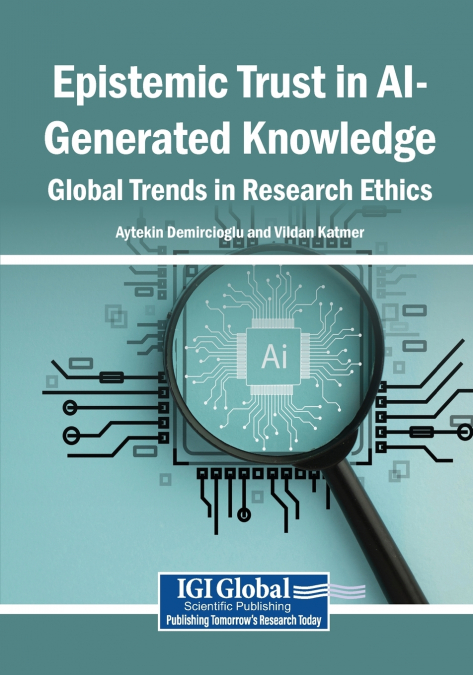

Inicio > > Ciencias de la computación > Inteligencia artificial > Epistemic Trust in AI-Generated Knowledge
Epistemic Trust in AI-Generated Knowledge

Epistemic Trust in AI-Generated Knowledge


340,18 €
IVA incluido
Disponible
Editorial:
IGI Global
Año de edición:
2026
Materia
Inteligencia artificial
ISBN:
9798260012338
340,18 €
IVA incluido
Disponible

Selecciona una librería:

  • Librería Samer Atenea

  • Kálamo Books
  • Librería Elías (Asturias)
  • Librería Kolima (Madrid)
  • Librería Proteo (Málaga)

Artificial intelligence (AI) is increasingly reshaping the ways knowledge is created and trusted. As AI-generated content becomes more common, questions about reliability and credibility are moving to the center of academic and public debate. These concerns extend beyond technical performance and raise fundamental questions about how knowledge is evaluated and accepted. Responses to AI-generated knowledge are shaped by cultural and regional perspectives, making trust a global challenge rather than a purely technological one. The future of AI-generated knowledge depends not only on technological capability, but also on public confidence in its use and evaluation. Epistemic Trust in AI-Generated Knowledge: Global Trends in Research Ethics explores the ethical questions that emerge as AI becomes increasingly involved in the production and dissemination of information. Drawing on perspectives from different regions and scholarly traditions, this book examines how cultural and contextual factors shape perceptions of AI-generated knowledge. Covering topics such as algorithmic governance, LLM hallucination, and teacher identity, this book is an indispensable academic resource for graduate and doctoral students, knowledge management researchers, higher education professionals, data scientists, public sector professionals, policymakers, and more.
Artículos relacionados

  • Artificial Cognition Systems
    ...
  • Cross-Disciplinary Applications of Artificial Intelligence and Pattern Recognition
    Vijay Kumar Mago
    The need for intelligent machines in areas such as medical diagnostics, biometric security systems, and image processing motivates researchers to develop and explore new techniques, algorithms, and applications in this evolving field. Cross-Disciplinary Applications of Artificial Intelligence and Pattern Recognition: Advancing Technologies provides a common platform for researc...
  • Emerging Applications of Natural Language Processing
    Over the last few years, the area of Natural Language Processing has drastically grown in recognition, not only within the research and development community, but also with industry professionals. As NLP continues to be discussed and researched, certain areas continue to grow and mature. As a result, the need for advanced research and information is in high demand. Emerging App...
  • Androids, Cyborgs, and Robots in Contemporary Culture and Society
    Steven John Thompson
    Mankind’s dependence on artificial intelligence and robotics is increasing rapidly as technology becomes more advanced. Finding a way to seamlessly intertwine these two worlds will help boost productivity in society and aid in a variety of ways in modern civilization. Androids, Cyborgs, and Robots in Contemporary Culture and Society is an essential scholarly resource that delve...
  • Deep Learning Innovations and Their Convergence With Big Data
    The expansion of digital data has transformed various sectors of business such as healthcare, industrial manufacturing, and transportation. A new way of solving business problems has emerged through the use of machine learning techniques in conjunction with big data analytics. Deep Learning Innovations and Their Convergence With Big Data is a pivotal reference for the latest sc...
  • Computational Psychoanalysis and Formal Bi-Logic Frameworks
    Giuseppe Iurato
    Computational psychoanalysis is a new field stemming from Freudian psychoanalysis. The new area aims to understand the primary formal structures and running mechanisms of the unconscious while implementing them into computer sciences. Computational Psychoanalysis and Formal Bi-Logic Frameworks provides emerging information on this new field which uses psychoanalysis and the unc...