
Inicio > Sociedad y ciencias sociales > Sociedad y cultura: general > Epidemic Disease and Human Understanding
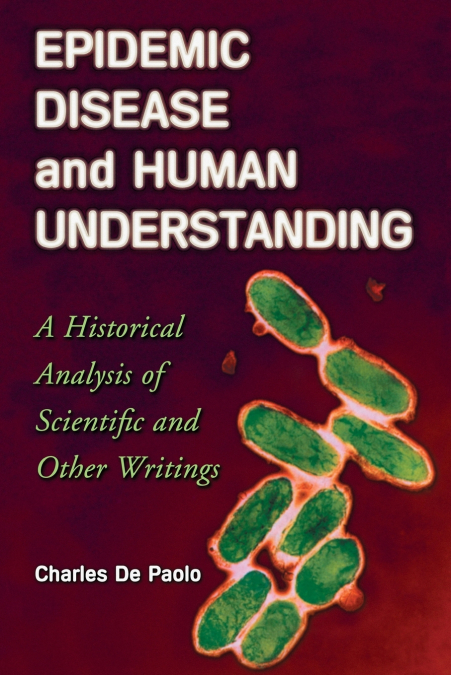
Epidemic Disease and Human Understanding

Epidemic Disease and Human Understanding

Charles De Paolo

57,28 €
IVA incluido
Disponible
Editorial:
McFarland and Company, Inc.
Año de edición:
2006
Materia
Sociedad y cultura: general
ISBN:
9780786425068
57,28 €
IVA incluido
Disponible

Selecciona una librería:

  • Librería Samer Atenea
  • Librería Aciertas (Toledo)
  • Kálamo Books
  • Librería Perelló (Valencia)
  • Librería Elías (Asturias)
  • Donde los libros
  • Librería Kolima (Madrid)
  • Librería Proteo (Málaga)

For more than three thousand years of recorded history, human beings have struggled to understand the epidemic--the rapid spread of a contagious disease throughout a human population. This book draws on an extensive list of primary texts to present a comprehensive history of epidemiological thought. The book is primarily concerned with the human experience of epidemic disease and the various ways this experience has been conceptualized and communicated. Part I examines ancient religious, mythological and philosophical paradigms used to comprehend and interpret epidemic disease. Following the ancient period, perceptions changed; epidemics were understood as natural phenomena rather than as instruments of divine purpose. This transition is covered in Part II and illuminated by historical documents, such as Thucydides’ description of the plague of Athens. Systematic examination of biomedical phenomena, which began in the seventeenth century and developed into modern medicine, is the focus of Part III. Finally, Part IV considers the ways in which epidemic disease has been treated in various works of literature. The discussion includes eyewitness accounts as well as such popular works of fiction as Sinclair Lewis’ Arrowsmith and Albert Camus’ The Plague. In surveying human responses to endemic disease, the book draws connections between three sub-genres of epidemiological writing: the encyclopedia, the intellectual history, and the biographical collection.


Artículos relacionados

  • The Gandhian Iceberg
    Chris D Moore-Backman
    The Gandhian Iceberg presents a bold, new interpretation of Gandhian nonviolence from the rare perspective of an author who is equal parts writer, scholar, and frontlines practitioner. The book faces the current crisis of climate change and the intensification of social unrest around the world, and calls for a new convergence of serious, spiritually-rooted US nonviolence activi...
    Disponible

    11,52 €

  • Contemporary Developments in Child Protection
    Nigel Parton
    Volume 1 "Policy Changes and Challenges" takes as its central theme the ongoing and challenging issues which child protection agencies have to address and the policy and practice initiatives that are developed to try and address these. The volume includes papers on: the relationship between the decline in the rate of ‘unnatural’ deaths and the growth of concern about child abus...
  • Diversity in Information Technology Education
    Goran Trajkovski
    ...
  • Model-Driven Software Development
    Model-driven software development (MDSD) drastically alters the software development process, characterized by a high degree of innovation and productivity. However, quality assurance application in the domain of software models and model-driven software development is still in an emergent phase. Model-Driven Software Development: Integrating Quality Assurance provides in-depth...
  • Evidence-Based Practice in Nursing Informatics
    Andrew Chasin
    Because of the constant advances and dynamics within the nascent field of nursing informatics, many nurses struggle in practice as they continue to try and apply habitual communication practices in the new environment without any critical reflection on, and adaptation of, those practices. Evidence-Based Practice in Nursing Informatics: Concepts and Applications serves as a valu...
  • Actor-Network Theory and Technology Innovation
    Arthur Tatnall
    About 25 years ago, the first developments of ANT (Actor-Network Theory) took place, but it wasn’t until much later that researchers began to take it seriously. In the late 1990s, ANT began to take hold in the scientific community as a new and exciting approach to socio-technical research and social theory. Actor-Network Theory and Technology Innovation: Advancements and New Co...

Otros libros del autor

  • Pandemic Influenza in Fiction
    Charles De Paolo
    The influenza pandemic of 1918-1919--the worst widespread outbreak in recorded history--claimed an estimated 100 million lives globally. Yet only in recent decades has it captured the attention of historians, scientists, and fiction writers. This study surveys influenza research over the last century in original scientific and historical documents and establishes a critical ...
    Disponible

    57,42 €

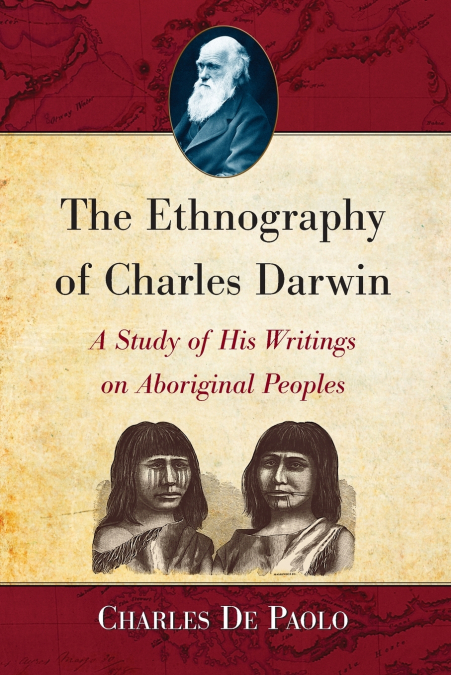
  • The Ethnography of Charles Darwin
    Charles De Paolo
    Because of his stature as one of the great minds of the nineteenth century, Darwin and his work have been examined from almost every conceivable angle. This has led to much critical disagreement on his thoughts regarding the dignity of man, particularly of aboriginal peoples. This book attempts to reconcile the prevailing dual visions of Darwin--as racist and as humanitarian...
    Disponible

    72,10 €

  • Human Prehistory in Fiction
    Charles De Paolo
    What was the world like for people thousands of years ago? How can we know? Through fiction? This is a work of literary criticism, and more. It begins with a discussion of the problem of authenticity and then considers twelve pieces of fiction that depict human prehistory: H.G. Wells’ The Island of Doctor Moreau, Pierre Boulle’s The Planet of the Apes, Jules Verne’s The Vi...
    Disponible

    43,08 €