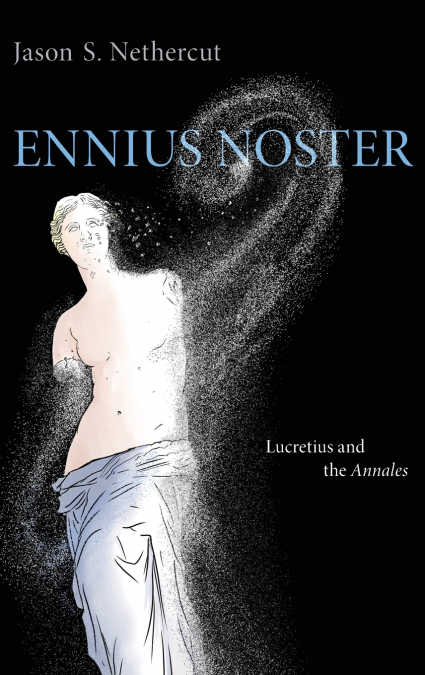

Ennius Noster

Ennius Noster

Jason S. Nethercut

173,77 €
IVA incluido
Consulta disponibilidad
Editorial:
Oxford University Press
Año de edición:
2020
Materia
Filosofía occidental: antigua, hasta c. 500
ISBN:
9780197517697

Selecciona una librería:

  • Librería Samer Atenea
  • Librería Aciertas (Toledo)
  • Kálamo Books
  • Librería Perelló (Valencia)
  • Librería Elías (Asturias)
  • Donde los libros
  • Librería Kolima (Madrid)
  • Librería Proteo (Málaga)

Consensus holds that Lucretius admired the literary prestige of Homeric epos, the form that Ennius famously introduced to Latin literature. However, some hold that Lucretius disagreed with Ennius’ quasi-Pythagorean claim to be Homer reborn, and so uniquely qualified to adapt Homeric poetry to the Latin language. Likewise, received wisdom holds that Lucretius followed in the path of poets writing in the wake of Ennius’ Annales, most of whom employed an Ennian style. However, throughout the De Rerum Natura, Lucretius’ use of Ennius’ Annales as a formal model for a long discursive poem in epic meter was neither inevitable nor predictable, on the one hand, nor meaningful in the simple way that critical consensus has always maintained. Jason Nethercut posits that Lucretius selected Ennius as a model precisely to dismantle the values for which he claimed Ennius stood, including the importance of history as a poetic subject and Rome’s historical achievement in particular. As the first book to offer substantial analysis of the relationship between two of the ancient world’s most impactful poets, Ennius Noster: Lucretius and the Annales fills an important gap not only in Lucretian scholarship, but also in our understanding of Latin literary history.
Artículos relacionados

  • The Nature of Things
    Lucretius Lucretius
    De rerum natura (On the Nature of Things) is a 1st century BC didactic poem by the Roman poet and philosopher Lucretius with the goal of explaining Epicurean philosophy to a Roman audience. Lucretius presents the principles of atomism; the nature of the mind and soul; explanations of sensation and thought; the development of the world and its phenomena; and explains a variety o...
  • Pompeii
    Fergus Mason
    Pompeii was one of most advanced cities of its time; it had a complex water system, gymnasium, and an amphitheater. Despite it's advancements, there was one thing it wasn't ready for: Mount Vesuvius—the volcano that led to its ultimate doom.  The 79 AD eruption of Mount Vesuvius was one of the worst disasters in all of European history. In a near instant, over 15,000 p...
    Disponible

    10,36 €

  • Middle Platonism and Neoplatonism, Volume 1
    Stephen Gersh
    'It is generally agreed that those types of philosophy that are loosely called ’Platonic’ and ’Neoplatonic’ played a crucial role in the history of European culture during the centuries between antiquity and the Renaissance. However, until now no scholar has attempted to describe the evolution of these forms of thought in a single comprehensive academic study.' So writes Stephe...
  • Middle Platonism and Neoplatonism, Volume 2
    Stephen Gersh
    It is generally agreed that those types of philosophy that are loosely called 'Platonic' and 'Neoplatonic' played a crucial role in the history of European culture during the centuries between antiquity and the Middle Ages. However, until now no scholar has attempted to describe the evolution of these forms of thought in a single comprehensive academic study. Middle Platonism a...
  • Porphyry’s Commentary on Ptolemy’s Harmonics
    Andrew Barker
    ...
    Disponible

    77,17 €

  • The Roots of Platonism
    John Dillon
    ...
    Disponible

    25,29 €