Peter C. Hughes / Peter CHughes
 Librería Samer Atenea
 Kálamo Books
 Librería Elías (Asturias)
 Librería Kolima (Madrid)
 Librería Proteo (Málaga)
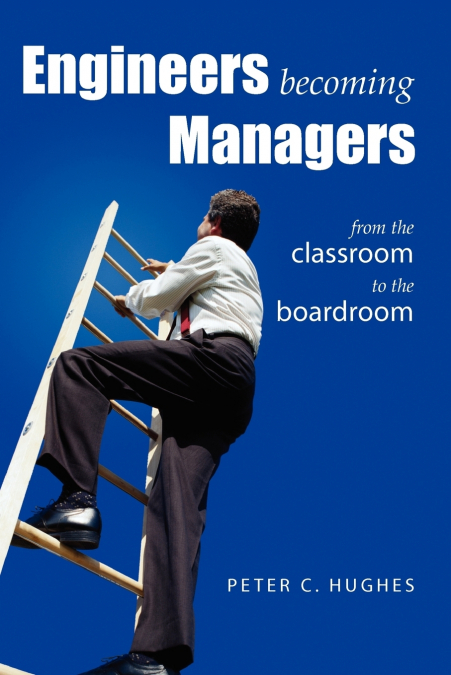
This book rests on three cultures: applied science, engineering, and management. While these plainly overlap to a degree, a person cannot move from success in one to success in another without considerable effort, dedication and talent. Clearly, an understanding of these cultural differences is essential to engineers whose career goal is to evolve into top-level managers. The first step in gaining such understanding is to admit that these three cultures are quite distinct. The applied science culture is typified by the engineering school; the engineering culture is typified by the company engineering design office; and the management culture is typified by the senior management team and the boardroom. The older one gets, the more one realizes the enormous importance of 'culture' to almost every important human issue, and the topic of engineers becoming managers is certainly no exception. The culture of a group is the set of all common traits, responses, values, beliefs, priorities, attitudes and behaviors which characterize that group. A group’s culture is usually not codified but is passed on, from older group members to younger ones by a thousand subtle messages, most being nonverbal. Part I of This BookHaving briefly established in Chapter 1 the inseparability of engineering and management, we then look at the students who enter an engineering school intending to graduate and become employed as young engineers. Although they go to their first classes reasonably expecting that they are now on course to become engineers, as described in Chapter 2 what they usually find on offer, is the culture of applied science. Part I is intended for engineering students and should be read as early as possible in engineering school. Chapter 3 argues that it is the duty of an engineering school to acquaint all of its students not just with careers in civil, chemical and electrical engineering, etc., but about careers in engineering management as well-and to devote an appropriate fraction of its financial and human resources to discharge this duty. Chapter 4 shows, in abridged form, the entire journey from the most abstract of mathematics to the realities of commerce. Also featured in Part I of this book are two subjects (discussed in Chapters 5 and 6) that are crucial for a future in management, yet are rarely considered in a typical undergraduate applied science education: marketing and office politics. Part II of This BookHere, the target readers are functioning engineers in various nonacademic organizations. Part II of this book is intended for young practicing engineers and should be read as early as possible after graduation. One must decide what the future options and opportunities are, what one’s strengths and weaknesses are, and what one most enjoys doing-not just over the next year or two, but over the remainder of one’s career. Chapter 7 considers risk management. No business can be successful without planning, and planning requires making assumptions about the future. To achieve the desired (well-considered, well-calculated) rewards requires a commitment to the associated (well-considered, well-calculated) risks. The second area examined (Chapter 8) is accountancy. Anyone who does not understand the relation between his activities and the financial needs of the business (or considers this relationship to be someone else’s problem) is in a self-limiting career. The third area (Chapter 9) should be a source of excitement for engineers. Their backgrounds and aptitudes prepare them especially well for innovation. The relationship of R&D to innovation and the roles of incubators, technology clusters and university laboratories are also discussed. Finally, in Chapter 10, we examine the important concept of intellectual capital. Knowledge-based companies-the ones that are heavily dependent on what their employees know, how these employees share this knowledge with other employees in the company, and how all this knowledge g