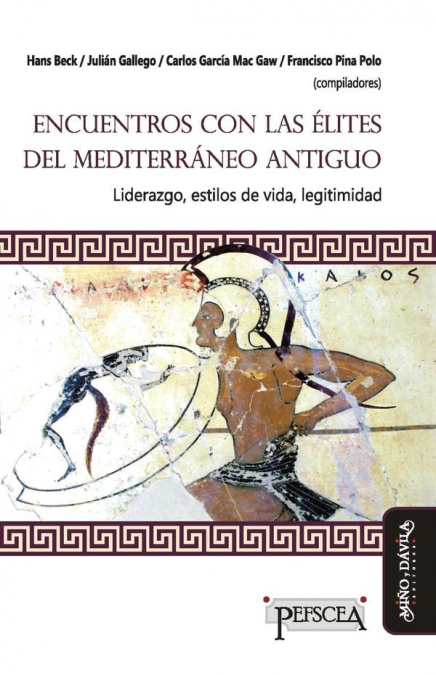
Encuentro con las élites del Mediterráneo antiguo

Encuentro con las élites del Mediterráneo antiguo

Alejandro Díaz Fernández / Alejandro Díaz Fernández / Alex McAuley / Alex McAuley / Brahm Kleinman / Brahm Kleinman / Carlos García Mac Gaw / Catalina Balmaceda / Catalina Balmaceda / Cecilia Ames / Cecilia Ames / Clément Bady / Clément Bady / Cristina Rosillo-López / Cristina Rosillo-López / Elke Stein-Hölkeskamp / Elke S

20,28 €
IVA incluido
Disponible
Editorial:
Miño y Dávila Editores - Esp
Año de edición:
2021
Materia
Historia social y cultural
ISBN:
9788418095900
20,28 €
IVA incluido
Disponible

Selecciona una librería:

  • Librería Samer Atenea
  • Librería Aciertas (Toledo)
  • Kálamo Books
  • Librería Perelló (Valencia)
  • Librería Elías (Asturias)
  • Donde los libros
  • Librería Kolima (Madrid)
  • Librería Proteo (Málaga)

Las élites dirigentes constituyen un objeto de atención creciente. Este interés no es ajeno a la evolución del mundo actual, que evidencia una fase de concentración superlativa de la riqueza desde el vuelco ocurrido en la década de 1980. En este contexto, los estudios sobre las élites han conocido un significativo salto cualitativo tanto en los espacios académicos como en los ámbitos ligados a la experiencia política actual, que pone de relieve cómo las élites utilizan los medios de comunicación para obtener apoyos para sus respectivas agendas.En el Mediterráneo antiguo, el dominio de las élites se forjó sobre las intrincadas relaciones entre el estatus social y una organización política orientada hacia la preeminencia de los sectores superiores de la sociedad. Sin embargo, el simple binomio élites/no-élites se complica a causa de las múltiples conjunciones y relaciones mutuas que trascienden esa clara división. A partir del giro cultural los estudiosos han comenzado a explorar las interconexiones profundas de dicho binomio, sometiendo a escrutinio la actividad pública de las élites, sus estrategias de comunicación, sus usos del capital económico, cultural y simbólico, sus ámbitos de acción, la diferenciación de sus roles públicos y privados, etc. En suma, las antiguas élites mediterráneas tuvieron que demostrar su competencia y respetabilidad en los diversos ámbitos de actuación y, por ende, debieron ser líderes no solo del progreso y la innovación, como Max Weber las describió, sino también de unos complejos sistemas de comunicación.Para materializar estos aspectos, las élites antiguas deben ser ubicadas en su propio contexto cultural. A través de una serie de artículos cuyos autores abordan los temas desde diferentes perspectivas, este volumen explora en particular tres vectores del elitismo: la comunicación del liderazgo y de las funciones propias del liderazgo; la distinción de la élite mediante estilos de vida reconocibles; las estrategias discursivas para asegurar la legitimidad de la élite. 10


Artículos relacionados

  • Arizal
    Raphael Afilalo
    The Ari overflowed with Torah. He was expert in Scripture, Mishnah, Talmud, Midrash, Maaseh Bereishit and Maaseh Merkavah. About all the different levels of prophecy, their details and from which level the prophets had their revelations.  He understood the whistling of the trees, the grass and stones, the language of the birds and other animals, the conversations of angels, the...
    Disponible

    20,44 €

  • Rose-tinted Memory
    Michael S Fryer
    “Those who deny Auschwitz would be ready to remake it”.  ~ Primo Levi, Holocaust survivor and author Seventy years after the mass murder of the Jews of Europe, Holocaust denial and Holocaust revisionism are creeping into our overall perception of what actually happened.Christendom has not ‘denied’ Holocaust, but it has attempted to create a memory of Holocaust which suggests th...
    Disponible

    8,84 €

  • Pan Kapitan of Jordanow
    William Leibner
    Yeshayahu Drucker devoted a good part of his life to rescuing Jewish children from non-Jewish homes. Many parents had given their children to Polish neighbors for safekeeping during the war. Unfortunately most of the parents did not survive the Shoah. At the end of the war, there was no one to claim the children and they remained with the “adopted” Polish families. Following hi...
    Disponible

    48,87 €

  • Holy Dissent
    Glenn Dynner
    BThe religious communities of early modern Eastern Europe—particularly those with a mystical bent—are typically studied in isolation. Yet the heavy Slavic imprint on Jewish popular mysticism and pervasive Judaizing tendencies among Christian dissenters call into question the presumed binary quality of Jewish-Christian interactions. In Holy Dissent: Jewish and Christian Mystics ...
    Disponible

    62,96 €

  • AL-FARD
    Ali Mahdi Muhammad
    The Al-Fard, or the The Dawn, has captured the early rays of Our history. This history is essential if we are to be brought face to face with the One true and living God of the universe. The purpose of this writing is to bring the reader step by step, one degree at a time to the reality of God in person. The teachings of Our Father elevates the believer to the level of Godhood ...
    Disponible

    23,17 €

  • Wild Things. Nature and the Social Imagination
    HISTORIES OF HUMAN CONSTRUCTIONS OF NATUREWild Things: Nature and the Social Imagination assembles eleven substantive and original essays on the cultural and social dimensions of environmental history. They address a global cornucopia of social and ecological systems, from Africa to Europe, North America and the Caribbean, and their temporal range extends from the 1830s into th...
    Disponible

    112,73 €