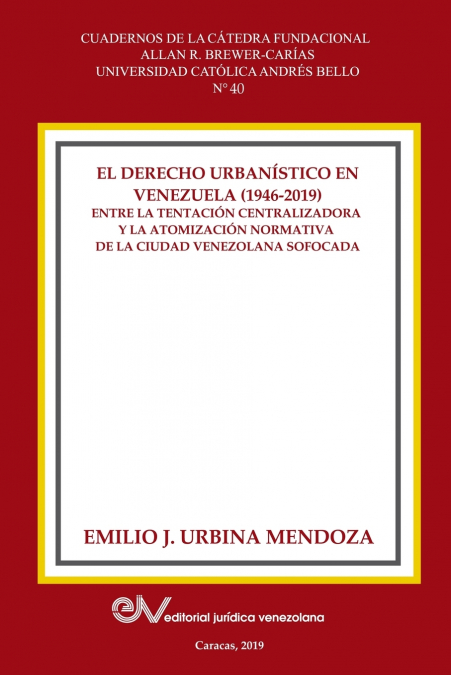
EL DERECHO URBANISTICO EN VENEZUELA (1946-2019).

EL DERECHO URBANISTICO EN VENEZUELA (1946-2019).

EL DERECHO URBANISTICO EN VENEZUELA (1946-2019).

Emilio J. URBINA MENDOZA / Emilio JURBINA MENDOZA

16,87 €
IVA incluido
Disponible
Editorial:
EDITORIAL JURIDICA VENEZOLANA INTER
Año de edición:
2019
Materia
Planificación urbana y municipal
ISBN:
9789803654566
16,87 €
IVA incluido
Disponible

Selecciona una librería:

  • Librería Samer Atenea
  • Librería Aciertas (Toledo)
  • Kálamo Books
  • Librería Perelló (Valencia)
  • Librería Elías (Asturias)
  • Donde los libros
  • Librería Kolima (Madrid)
  • Librería Proteo (Málaga)

La presente obra del profesor Emilio J. Urbina, constituye una auditoría normativa, doctrinal y jurisprudencial del Derecho urbanístico venezolano desde sus inicios hasta nuestros días, en la cual ha hecho una revisión no solo de todos los textos normativos de naturaleza urbanística publicados en Gaceta Oficial desde 1946 hasta 2019, sino de los estudios doctrinales formulados, y los principales hitos jurisprudenciales que marcaron el compás en el contencioso urbanístico, etapa por etapa.En la obra, el autor analiza históricamente la disciplina, en cinco grandes etapas.  La primera, que se inicia en 1946 con la publicación del decreto de creación de la Comisión Nacional de Urbanismo; durante la cual se sancionan la ley de expropiación por causa de utilidad pública y social y las nuevas ordenanzas sobre urbanismo superando la clásica concepción romanista de edificación; estableciéndose la distribución constitucional de competencias entre la República y los Municipios en materia de ordenación urbanística.La segunda etapa, que comienza en 1958 y se mantiene hasta 1982, fue la de la más inusitada expansión urbana en Venezuela, basada sin embargo en una dispersión reglamentaria de normas, y el desarrollo urbano a través de la descentralización funcional. La tercera etapa se inicia en 1983 y dura hasta 2001, y es durante la cual se sancionaron la Ley Orgánica para la Ordenación del Territorio de 1983 y, en 1987, la Ley Orgánica de Ordenación Urbanística. La cuarta etapa que comenzó en 2002 con la aprobación del Decreto presidencial nº 1.666, dio inicio una era de dispersión, caracterizada por la construcción frenética de viviendas y la destrucción progresiva del sistema de planes urbanísticos. Y en 2011, comenzó la quinta etapa, de atomización normativa, con la aprobación de la Ley de emergencia de terrenos y viviendas, acabando con la tradición normativa iniciada en 1946, bajo una concepción particularista del urbanismo y su derecho.La obra finaliza con una revisión exhaustiva sobre los últimos hechos y actos que han modificado la estructura del Derecho urbanístico venezolano.
Artículos relacionados

  • New Approaches, Methods, and Tools in Urban E-Planning
    Carlos Nunes Silva
    Recent advances in information and communication technologies have enhanced the standards of metropolitan planning and development. With the increase in mobile communication, this will help to deliver innovative new services and apps in the field of urban e-planning. New Approaches, Methods, and Tools in Urban E-Planning is a key resource for the latest academic research on rec...
    Disponible

    269,29 €

  • URBAN ECONOMICS, REAL ESTATE, TRANSPORTATION & PUBLIC POLICY
    COHEN JEFFREY P / JEFFREY P COHEN
    The chapters of this book synthesize papers on the inter-related topics of urban economics, real estate, transportation and public policy and include applied and empirical research on a variety of sub-topics. These include innovative econometric techniques that are applied to timely problems, such as impacts of flooding in Vancouver, BC Canada on property values; and the determ...
    Disponible

    101,98 €

  • Moscow under Construction
    Robert Argenbright / Anastasia Rudakova
    Moscow under Construction explores the growth of place-based opposition to redevelopment practices in Moscow and consequent changes in city’s governance regime. Groups of citizens have struggled to defend homes, neighborhoods, heritage buildings, and historic districts. Although their aims typically have been specific and limited, an important consequence of their activism has ...
    Disponible

    34,07 €

  • Advances in Explainable AI Applications for Smart Cities
    As smart cities become more prevalent, the need for explainable AI (XAI) applications has become increasingly important. Advances in Explainable AI Applications for Smart Cities is a co-edited book that showcases the latest research and development in XAI for smart city applications. This book covers a wide range of topics, including medical diagnosis, finance and banking, judi...
    Disponible

    269,06 €

  • Constructing Community
    Jeremy Levine
    A look at the benefits and consequences of the rise of community-based organizations in urban developmentWho makes decisions that shape the housing, policies, and social programs in urban neighborhoods? Who, in other words, governs? Constructing Community offers a rich ethnographic portrait of the individuals who implement community development projects in the Fairmount Corrido...
    Disponible

    40,37 €

  • Constructing Community
    Jeremy Levine
    A look at the benefits and consequences of the rise of community-based organizations in urban developmentWho makes decisions that shape the housing, policies, and social programs in urban neighborhoods? Who, in other words, governs? Constructing Community offers a rich ethnographic portrait of the individuals who implement community development projects in the Fairmount Corrido...
    Disponible

    135,84 €