
Effective Risk Communication

Effective Risk Communication


209,78 €
IVA incluido
Disponible
Editorial:
Springer Nature B.V.
Año de edición:
2004
Materia
Sociedad y cultura: general
ISBN:
9780306484971
209,78 €
IVA incluido
Disponible

Selecciona una librería:

  • Librería Samer Atenea
  • Librería Aciertas (Toledo)
  • Kálamo Books
  • Librería Perelló (Valencia)
  • Librería Elías (Asturias)
  • Donde los libros
  • Librería Kolima (Madrid)
  • Librería Proteo (Málaga)

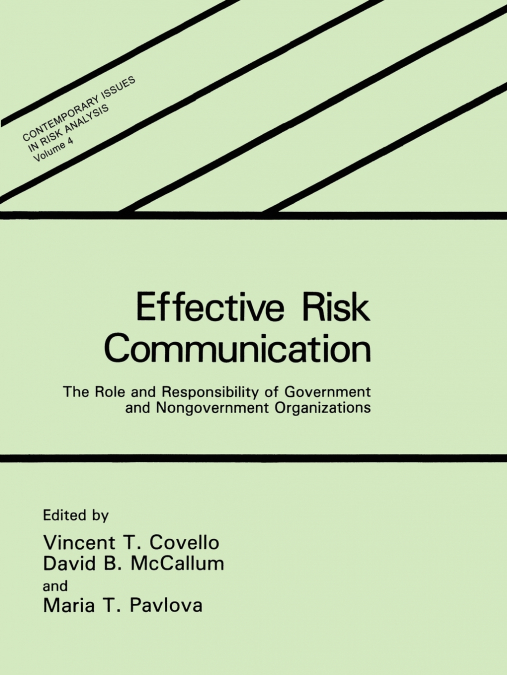
One of the greatest challenges facing those concerned with health and environmental risks is how to carry on a useful public dialogue on these subjects. In a democracy, it is the public that ultimately makes the key decisions on how these risks will be controlled. The stakes are too high for us not to do our very best. The importance of this subject is what led the Task Force on Environmental Cancer and Heart and Lung Disease to establish an Interagency Group on Public Education and Communication. This volume captures the essence of the 'Workshop on the Role of Government in Health Risk Communication and Public Education' held in January 1987. It also includes some valuable appendixes with practical guides to risk communication. As such, it is an important building block in the effort to improve our collective ability to carry on this critical public dialogue. Lee M. Thomas Administrator, U. S. Environmental Protection Agency, and Chairman, The Task Force on Environmental Cancer and Heart and Lung Disease Preface The Task Force on Environmental Cancer and Heart and Lung Disease is an interagency group established by the Clean Air Act Amendments of 1977 (P.L. 95-95). Congress mandated the Task Force to recommend research to determine the relationship between environmental pollutants and human disease and to recommend research aimed at reduc­ ing the incidence of environment-related disease. The Task Force’s Project Group on Public Education and Communication focuses on education as a means of reducing or preventing disease.


Artículos relacionados

  • The Gandhian Iceberg
    Chris D Moore-Backman
    The Gandhian Iceberg presents a bold, new interpretation of Gandhian nonviolence from the rare perspective of an author who is equal parts writer, scholar, and frontlines practitioner. The book faces the current crisis of climate change and the intensification of social unrest around the world, and calls for a new convergence of serious, spiritually-rooted US nonviolence activi...
    Disponible

    11,52 €

  • Contemporary Developments in Child Protection
    Nigel Parton
    Volume 1 "Policy Changes and Challenges" takes as its central theme the ongoing and challenging issues which child protection agencies have to address and the policy and practice initiatives that are developed to try and address these. The volume includes papers on: the relationship between the decline in the rate of ‘unnatural’ deaths and the growth of concern about child abus...
  • Diversity in Information Technology Education
    Goran Trajkovski
    ...
  • Model-Driven Software Development
    Model-driven software development (MDSD) drastically alters the software development process, characterized by a high degree of innovation and productivity. However, quality assurance application in the domain of software models and model-driven software development is still in an emergent phase. Model-Driven Software Development: Integrating Quality Assurance provides in-depth...
  • Evidence-Based Practice in Nursing Informatics
    Andrew Chasin
    Because of the constant advances and dynamics within the nascent field of nursing informatics, many nurses struggle in practice as they continue to try and apply habitual communication practices in the new environment without any critical reflection on, and adaptation of, those practices. Evidence-Based Practice in Nursing Informatics: Concepts and Applications serves as a valu...
  • Actor-Network Theory and Technology Innovation
    Arthur Tatnall
    About 25 years ago, the first developments of ANT (Actor-Network Theory) took place, but it wasn’t until much later that researchers began to take it seriously. In the late 1990s, ANT began to take hold in the scientific community as a new and exciting approach to socio-technical research and social theory. Actor-Network Theory and Technology Innovation: Advancements and New Co...