
East European Transition and EU Enlargement

East European Transition and EU Enlargement


133,38 €
IVA incluido
Disponible
Editorial:
Springer Nature B.V.
Año de edición:
2002
Materia
Economía internacional
ISBN:
9783790815016
133,38 €
IVA incluido
Disponible

Selecciona una librería:

  • Librería Samer Atenea
  • Librería Aciertas (Toledo)
  • Kálamo Books
  • Librería Perelló (Valencia)
  • Librería Elías (Asturias)
  • Donde los libros
  • Librería Kolima (Madrid)
  • Librería Proteo (Málaga)

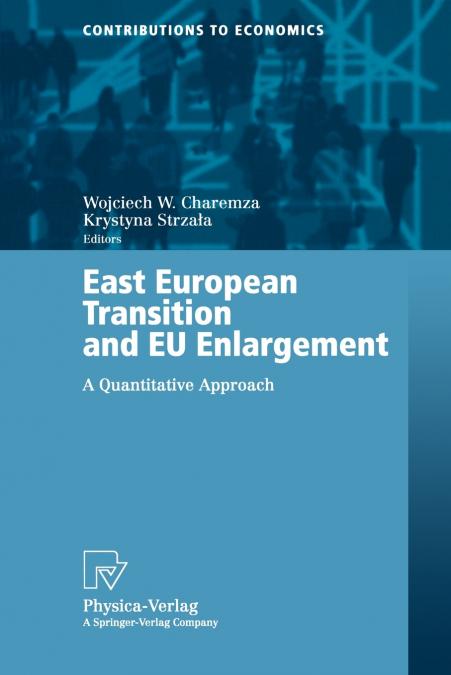
In March 1998 the European Union formally launched the accession process that will lead to a significant enlargement of the Union. So far ten countries from Central Europe: Bulgaria, the Czech Republic, Estonia, Hungary, Latvia, Lithuania, Poland, Romania, the Slovak Republic and Slovenia have submitted their applications for EU membership. This unique process immediately attracted attention of economists and policy makers. Nevertheless, it can be noticed that among numerous results already published, there is a distinctive shortage of books and papers in which quantitative research methods are applied. This is to a large extent justified by the fact that the transition and accession processes are new to the economic sciences, their methodology is not wellresearched, statistical data for the Central and East European countries are scarce and not always reliable and, generally, quantitative approach seems to be a risky and uncertain business. All these all problems can also be seen as a challenge rather than an obstacle. With this on mind, we have decided to clarify the status quo by organising a research seminar which focused on the methodology and quantitative analysis of the Central and East European transition and pre-accession processes. The seminar, East European Transition and EU Enlargement: a Quantitative Approach organised by Macroeconomic and Financial Data Centre (University of Gdansk and University ofLeicester) took place in Gdansk in June 2001. Our edited volume contains papers developed from this seminar.
Artículos relacionados

  • Regional Economic Integration and the Global Financial System
    Engin Sorhun / Hasan Dinçer / Unit Hacioglu
    In theory, regionalism and globalization are intended to be viewed as two separate concepts. However, as long as the approaches complement each other, considering these paradigms in tandem can have significantly positive effects on the overall status of the world economy. Regional Economic Integration and the Global Financial System addresses recent trends in regional integrati...
  • Handbook of Research on Impacts of International Business and Political Affairs on the Global Economy
    The growth of global commerce depends on many different factors and strategies in order for multinational corporations to efficiently compete and thrive in the international marketplace. In addition to business strategies, corporations must also be aware of political affairs that may impact their global economic status. The Handbook of Research on Impacts of International Busin...
  • NEXT CONVERGENCE
    MICHAEL SPENCE
    ...
    Disponible

    17,21 €

  • Interest and Prices
    Michael Woodford
    With the collapse of the Bretton Woods system, any pretense of a connection of the world’s currencies to any real commodity has been abandoned. Yet since the 1980s, most central banks have abandoned money-growth targets as practical guidelines for monetary policy as well. How then can pure 'fiat' currencies be managed so as to create confidence in the stability of national unit...
  • War, Wine, and Taxes
    John V.C. Nye
    In War, Wine, and Taxes, John Nye debunks the myth that Britain was a free-trade nation during and after the industrial revolution, by revealing how the British used tariffs-notably on French wine-as a mercantilist tool to politically weaken France and to respond to pressure from local brewers and others. The book reveals that Britain did not transform smoothly from a mercantil...
  • The Social Construction of Free Trade
    Francesco Duina
    This book offers a compelling new interpretation of the proliferation of regional trade agreements (RTAs) at the end of the twentieth century. Challenging the widespread assumption that RTAs should be seen as fundamentally similar economic initiatives to pursue free trade, Francesco Duina proposes that the world is reorganizing itself into regions that are highly distinctive an...
    Disponible

    54,25 €