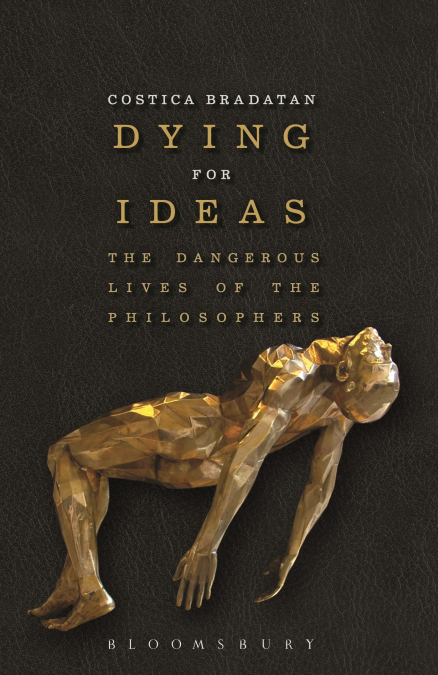

Dying for Ideas

Dying for Ideas

Costica Bradatan

77,18 €
IVA incluido
Consulta disponibilidad
Editorial:
Bloomsbury Publishing plc
Año de edición:
2015
Materia
Filosofía occidental: antigua, hasta c. 500
ISBN:
9781472525512

Selecciona una librería:

  • Librería Samer Atenea
  • Librería Aciertas (Toledo)
  • Kálamo Books
  • Librería Perelló (Valencia)
  • Librería Elías (Asturias)
  • Donde los libros
  • Librería Kolima (Madrid)
  • Librería Proteo (Málaga)

What do Socrates, Hypatia, Giordano Bruno, Thomas More, and Jan Patocka have in common? First, they were all faced one day with the most difficult of choices: stay faithful to your ideas and die or renounce them and stay alive. Second, they all chose to die. Their spectacular deaths have become not only an integral part of their biographies, but are also inseparable from their work. A "death for ideas" is a piece of philosophical work in its own right; Socrates may have never written a line, but his death is one of the greatest philosophical best-sellers of all time.Dying for Ideas explores the limit-situation in which philosophers find themselves when the only means of persuasion they can use is their own dying bodies and the public spectacle of their death. The book tells the story of the philosopher’s encounter with death as seen from several angles: the tradition of philosophy as an art of living; the body as the site of self-transcending; death as a classical philosophical topic; taming death and self-fashioning; finally, the philosophers’ scapegoating and their live performance of a martyr’s death, followed by apotheosis and disappearance into myth.While rooted in the history of philosophy, Dying for Ideas is an exercise in breaking disciplinary boundaries. This is a book about Socrates and Heidegger, but also about Gandhi’s "fasting unto death" and self-immolation; about Girard and Passolini, and self-fashioning and the art of the essay.


Artículos relacionados

  • The Nature of Things
    Lucretius Lucretius
    De rerum natura (On the Nature of Things) is a 1st century BC didactic poem by the Roman poet and philosopher Lucretius with the goal of explaining Epicurean philosophy to a Roman audience. Lucretius presents the principles of atomism; the nature of the mind and soul; explanations of sensation and thought; the development of the world and its phenomena; and explains a variety o...
  • Pompeii
    Fergus Mason
    Pompeii was one of most advanced cities of its time; it had a complex water system, gymnasium, and an amphitheater. Despite it's advancements, there was one thing it wasn't ready for: Mount Vesuvius—the volcano that led to its ultimate doom.  The 79 AD eruption of Mount Vesuvius was one of the worst disasters in all of European history. In a near instant, over 15,000 p...
    Disponible

    10,36 €

  • Middle Platonism and Neoplatonism, Volume 1
    Stephen Gersh
    'It is generally agreed that those types of philosophy that are loosely called ’Platonic’ and ’Neoplatonic’ played a crucial role in the history of European culture during the centuries between antiquity and the Renaissance. However, until now no scholar has attempted to describe the evolution of these forms of thought in a single comprehensive academic study.' So writes Stephe...
  • Middle Platonism and Neoplatonism, Volume 2
    Stephen Gersh
    It is generally agreed that those types of philosophy that are loosely called 'Platonic' and 'Neoplatonic' played a crucial role in the history of European culture during the centuries between antiquity and the Middle Ages. However, until now no scholar has attempted to describe the evolution of these forms of thought in a single comprehensive academic study. Middle Platonism a...
  • Porphyry’s Commentary on Ptolemy’s Harmonics
    Andrew Barker
    ...
    Disponible

    77,17 €

  • The Roots of Platonism
    John Dillon
    ...
    Disponible

    25,29 €

Otros libros del autor

  • In Marx’s Shadow
    Costica Bradatan
    The volume draws attention to the unknown and unexplored areas, trends and ways of thinking under the communist regime. It demonstrates how various bodies of knowledge (philosophical, social, political, aesthetic, even theological) were produced, disseminated and used for a wide variety of purposes: from openly justifying dominant political views to framing oppositional and non...