
Inicio > Artes > Arquitectura > Du potentiel des grandes structures urbaines abandonnées / On the Potential of Abandoned Large Urban Structures
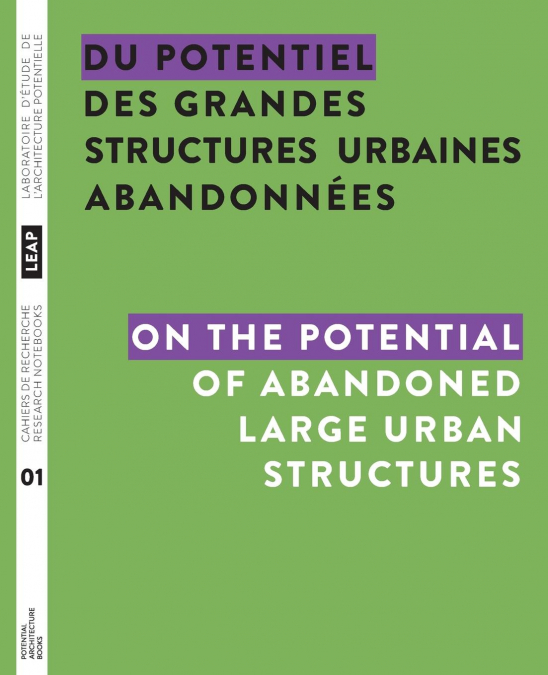
Du potentiel des grandes structures urbaines abandonnées / On the Potential of Abandoned Large Urban Structures

Du potentiel des grandes structures urbaines abandonnées / On the Potential of Abandoned Large Urban Structures

Du potentiel des grandes structures urbaines abandonnées / On the Potential of Abandoned Large Urban Structures


30,97 €
IVA incluido
Disponible
Editorial:
Potential Architecture Books Inc.
Año de edición:
2017
Materia
Arquitectura
ISBN:
9780992131791
Páginas:
160
Encuadernación:
Otros
30,97 €
IVA incluido
Disponible

Selecciona una librería:

  • Librería Samer Atenea
  • Librería Aciertas (Toledo)
  • Kálamo Books
  • Librería Perelló (Valencia)
  • Librería Elías (Asturias)
  • Donde los libros
  • Librería Kolima (Madrid)
  • Librería Proteo (Málaga)

Bâtiment abandonné, ruine moderne, fantôme urbain, squelette immobilier, structure désaffectée… Une variété d’appellations pour tenter de circonscrire, au moins par les mots, le phénomène d’abandon de fragments entiers de villes. Cet abandon, qu’il soit partiel ou total, temporaire ou durable, est examiné ici au prisme du « potentiel » que pourrait représenter la survivance de ces structures. Ciblant 12 études de cas, cette première édition des Cahiers du Laboratoire d’Étude de l’Architecture Potentielle (LEAP) convoque autour de cette thématique la discipline architecturale, l’histoire de l’art et la sémiotique. De Montréal à Berlin, de Détroit à Turin, la variété des contributions est organisée autour de quatre tensions interrogeant le statut de ces structures (monumentalité/monument), leur échelle (architecture/urbanisme), les figures qu’elles cristallisent (utopie/ruine) et les imaginaires qui s’y développent (résistances/potentiels).Les auteurs le montrent : les grandes structures urbaines abandonnées, loin d’être condamnées à l’inertie, sont des vecteurs de mémoire collective, de projets potentiels, d’imaginaires multiples, mais aussi de réévaluation critique de nos sociétés contemporaines. Dès lors, la grande structure urbaine abandonnée ne peut plus seulement être du ressort de l’économie ou de la planification foncière : l’entrelacement complexe des dimensions matérielles, techniques, sociales et culturelles la constituant invite les architectes à investir les réflexions portant sur sa survivance. Abandoned building, modern ruin, urban ghost, skeleton property, deserted structure … these are some of the words used in an attempt to circumscribe the phenomenon of abandoned city fragments. This abandonment, whether partial or total, temporary or long-term, is examined through the “potential” that the survival of these structures would offer. This first edition of the LEAP Research Notebooks gathers 12 case studies, each structured around a common theme in the disciplines of architecture, art history, and semiotics. From Montreal to Berlin, from Detroit to Turin, the various contributions are structured around four tensions calling into question the status of these structures (monumental / monument), their scale (architectural / city planning), the figures they materialize (utopia / ruin) and the poetics they embody (resistance / potential).As revealed by the authors, these large abandoned urban structures are far from being inert. Not only are they vectors of a collective memory, of potential projects, of multiple imaginations, but they also act as a trigger for a critical re-evaluation of our contemporary societies. Therefore, the large abandoned structure cannot be restricted to the fields of economy or land planning: such complex interweaving of material, technical, social and cultural dimensions calls for architects to reflect on its survival.
Artículos relacionados

  • Selected Papers from Building A Better New Zealand (BBNZ 2014) Conference
    This Special Issue includes expanded academic papers selected from the forthcoming BBNZ 2014 Conference.The 2014 Building a Better New Zealand conference was held at The Rendezvous Hotel, Auckland, from 3 September 2014 to 5 September 2014.Themes:•Achieving Better Buildings•Improving the Performance of Materials•Improving the performance of existing buildings•Sustainability•Pro...
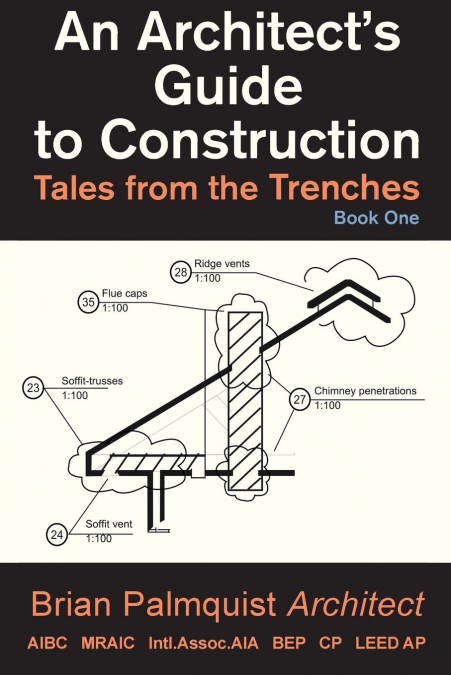
  • An Architect’s Guide to Construction
    Brian Palmquist
    After more than 35 years 'in the trenches' as an architect, specialist consultant and now quality director for a large North American construction company, Brian Palmquist has written An Architect’s Guide to Construction in order to share a balanced wealth of knowledge and experience about the construction phase of building projects.Considering both the consultant and contracto...
    Disponible

    19,68 €

  • ETABS 2016 Black Book
    Gaurav Verma
    The ETABS 2016 Black Book, is written to help beginners learn the basics of ETABS structure modeling and analysis. The book follows a step by step methodology. This book explains the designing of structure, assigning various properties to structure, applying different load conditions, and performing analyses. This book also covers the basics of detailing in ETABS. The book cove...
    Disponible

    66,22 €

  • Conservation of Classical Monuments in the Mediterranean Region
    Kalliopi Vacharopoulou
    This work studies the conservation of classical monuments in the Mediterranean region. It focuses on a specific method, anastylosis, and its application to classical monuments. The terminology, philosophy, theoretical principles and technical issues of anastylosis are explored within the wider context of cultural heritage management, through case studies from Greece and Turkey,...
    Disponible

    128,17 €

  • Handbook of Research on Emerging Technologies for Architectural and Archaeological Heritage
    Alfonso Ippolito
    Cultural heritage is a vital, multifaceted component of modern society. To better protect and promote the integrity of a culture, certain technologies have become essential tools. The Handbook of Research on Emerging Technologies for Architectural and Archaeological Heritage is an authoritative reference source for the latest scholarly research on the use of technological assis...
  • Du potentiel de l’hétéronomie et de l’autonomie en architecture / On the Potential of Heteronomy and Autonomy in Architecture
    Cette deuxième édition des Cahiers du Laboratoire d’Étude de l’Architecture Potentielle propose une réflexion sur l’un des problèmes centraux du Mouvement moderne et de la critique postmoderne : la tension entre l’hétéronomie et l’autonomie en architecture.Abordé à l’aide d’un texte peu connu de Stanford Anderson, le thème invitait chacun, chacune à penser l’architecture entre ...
    Disponible

    32,66 €