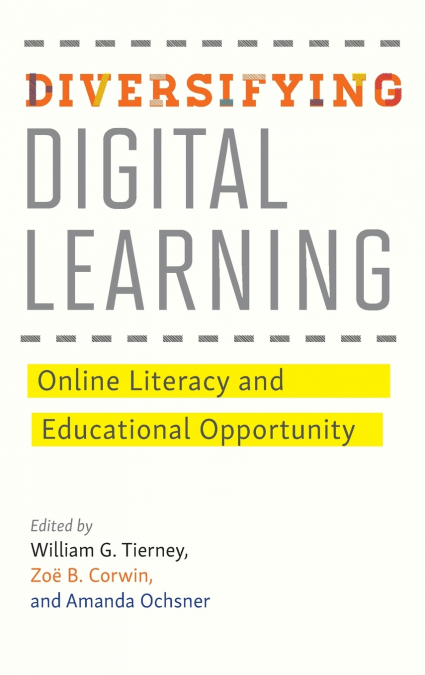

Diversifying Digital Learning

Diversifying Digital Learning


60,29 €
IVA incluido
Consulta disponibilidad
Editorial:
Hopkins Fulfillment Service
Año de edición:
2018
Materia
Organización y gestión educativa
ISBN:
9781421424354

Selecciona una librería:

  • Librería Samer Atenea
  • Librería Aciertas (Toledo)
  • Kálamo Books
  • Librería Perelló (Valencia)
  • Librería Elías (Asturias)
  • Donde los libros
  • Librería Kolima (Madrid)
  • Librería Proteo (Málaga)

How does the digital divide affect the teaching and learning of historically underrepresented students?Many schools and programs in low-income neighborhoods lack access to the technological resources, including equipment and Internet service, that those in middle- and upper-income neighborhoods have at their fingertips. This inequity creates a persistent digital divide--not a simple divide in access to technology per se, but a divide in both formal and informal digital literacy that further marginalizes youths from low-income, minoritized, and first-generation communities.Diversifying Digital Learning outlines the pervasive problems that exist with ensuring digital equity and identifies successful strategies to tackle the issue. Bringing together top scholars to discuss how digital equity in education might become a key goal in American education, this book is structured to provide a framework for understanding how historically underrepresented students most effectively engage with technology--and how institutions may help or hinder students’ ability to develop and capitalize on digital literacies.This book will appeal to readers who are well versed in the diverse uses of social media and technologies, as well as less technologically savvy educators and policy analysts in educational organizations such as schools, afterschool programs, colleges, and universities. Addressing the intersection of digital media, race/ethnicity, and socioeconomic class in a frank manner, the lessons within this compelling work will help educators enable students in grades K-12, as well as in postsecondary institutions, to participate in a rapidly changing world framed by shifting new media technologies.Contributors: Young Whan Choi, Zoë B. Corwin, Christina Evans, Julie Flapan, Joanna Goode, Erica Hodgin, Joseph Kahne, Suneal Kolluri, Lynette Kvasny, David J. Leonard, Jane Margolis, Crystle Martin, Safiya Umoja Noble, Amanda Ochsner, Fay Cobb Payton, Antar A. Tichavakunda, William G. Tierney, S. Craig Watkins


Artículos relacionados

  • Walking the Law and History
    Michelle Janene
    The companion student workbook for the Bible curriculum of Walking the Law and History Genesis. Students will participate in deep Bible study of the creation of the world, the foundations of the Christian faith, and the formation of the Jewish nation.  ...
    Disponible

    9,81 €

  • Reforming Education for the Real World
    George P Waldheim
    Education, as we know it in America, is too often characterized as living in a world by itself; unaccountable and unimproved--so different from the Real World.  Year after year 'Band-Aid' attempts are initiated to improve education and again, year after year, those attempts only produce marginal improvement--if any.  Thus, our international ranking is still depicted as 'mediocr...
    Disponible

    12,21 €

  • Let’s Talk Sex & STDs
    Dr. Katina Davis-Kennedy / DrKatina Davis-Kennedy
    There comes a time when every person has to learn about sex; typically, students learn within their middle school years about sex education. Unfortunately, by then they have been influenced by others with the wrong information, or have heard rumors that are mostly untrue. Let's Talk Sex and STDs: The Student Edition is here to lay all of the misleading information and stori...
    Disponible

    25,31 €

  • Learning with Mobile Technologies, Handheld Devices, and Smart Phones
    Mobile Learning is a new trend in pedagogical communities. It matches the speed of fast moving methodologies in pedagogical world. The theories of activity-based learning, problem-based learning, work-based learning, and opinion-based learning, learner-centered learning, and so forth, can be integrated with these tiny handheld devices. Students and teachers communicate effectiv...
  • Cultural Awareness and Competency Development in Higher Education
    As the world becomes more globalized, student populations in university settings will continue to grow in diversity. To ensure students develop the cultural competence to adapt to new environments, universities and colleges must develop policies and programs to aid in the progression of cultural acceptance and understanding. Cultural Awareness and Competency Development in High...
  • Advancing Next-Generation Teacher Education through Digital Tools and Applications
    The implementation of the Common Core State Standards program has spearheaded many changes within the education field. As this initiative is ultimately designed to optimize student performance and success, it is critical that teacher education programs and technological tools being utilized in classrooms align with Common Core State Standards. Advancing Next-Generation Teacher ...