
Inicio > > Ciencias de la computación > Inteligencia artificial > Discrete Optimization with Interval Data
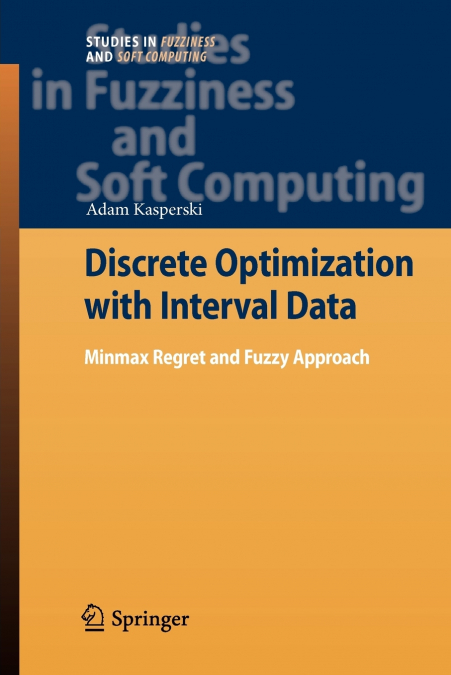
Discrete Optimization with Interval Data

Discrete Optimization with Interval Data

Adam Kasperski

132,81 €
IVA incluido
Consulta disponibilidad
Editorial:
Springer Nature B.V.
Año de edición:
2008
Materia
Inteligencia artificial
ISBN:
9783540784838

Selecciona una librería:

  • Librería Samer Atenea
  • Librería Aciertas (Toledo)
  • Kálamo Books
  • Librería Perelló (Valencia)
  • Librería Elías (Asturias)
  • Donde los libros
  • Librería Kolima (Madrid)
  • Librería Proteo (Málaga)

Operations research often solves deterministic optimization problems based on elegantand conciserepresentationswhereall parametersarepreciselyknown. In the face of uncertainty, probability theory is the traditional tool to be appealed for, and stochastic optimization is actually a signi?cant sub-area in operations research. However, the systematic use of prescribed probability distributions so as to cope with imperfect data is partially unsatisfactory. First, going from a deterministic to a stochastic formulation, a problem may becomeintractable. Agoodexampleiswhengoingfromdeterministictostoch- tic scheduling problems like PERT. From the inception of the PERT method in the 1950’s, it was acknowledged that data concerning activity duration times is generally not perfectly known and the study of stochastic PERT was launched quite early. Even if the power of today’s computers enables the stochastic PERT to be addressed to a large extent, still its solutions often require simplifying assumptions of some kind. Another di?culty is that stochastic optimization problems produce solutions in the average. For instance, the criterion to be maximized is more often than not expected utility. This is not always a meaningful strategy. In the case when the underlying process is not repeated a lot of times, let alone being one-shot, it is not clear if this criterion is realistic, in particular if probability distributions are subjective. Expected utility was proposed as a rational criterion from ?rst principles by Savage. In his view, the subjective probability distribution was - sically an artefact useful to implement a certain ordering of solutions.


Artículos relacionados

  • Artificial Cognition Systems
    ...
  • Cross-Disciplinary Applications of Artificial Intelligence and Pattern Recognition
    Vijay Kumar Mago
    The need for intelligent machines in areas such as medical diagnostics, biometric security systems, and image processing motivates researchers to develop and explore new techniques, algorithms, and applications in this evolving field. Cross-Disciplinary Applications of Artificial Intelligence and Pattern Recognition: Advancing Technologies provides a common platform for researc...
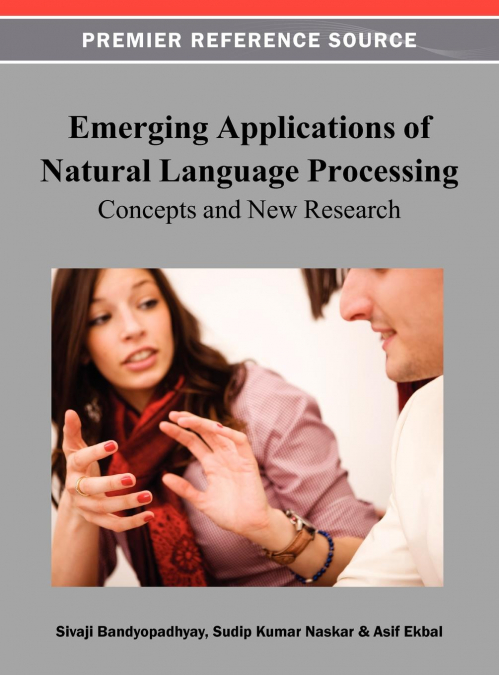
  • Emerging Applications of Natural Language Processing
    Over the last few years, the area of Natural Language Processing has drastically grown in recognition, not only within the research and development community, but also with industry professionals. As NLP continues to be discussed and researched, certain areas continue to grow and mature. As a result, the need for advanced research and information is in high demand. Emerging App...
  • Androids, Cyborgs, and Robots in Contemporary Culture and Society
    Steven John Thompson
    Mankind’s dependence on artificial intelligence and robotics is increasing rapidly as technology becomes more advanced. Finding a way to seamlessly intertwine these two worlds will help boost productivity in society and aid in a variety of ways in modern civilization. Androids, Cyborgs, and Robots in Contemporary Culture and Society is an essential scholarly resource that delve...
  • Deep Learning Innovations and Their Convergence With Big Data
    The expansion of digital data has transformed various sectors of business such as healthcare, industrial manufacturing, and transportation. A new way of solving business problems has emerged through the use of machine learning techniques in conjunction with big data analytics. Deep Learning Innovations and Their Convergence With Big Data is a pivotal reference for the latest sc...
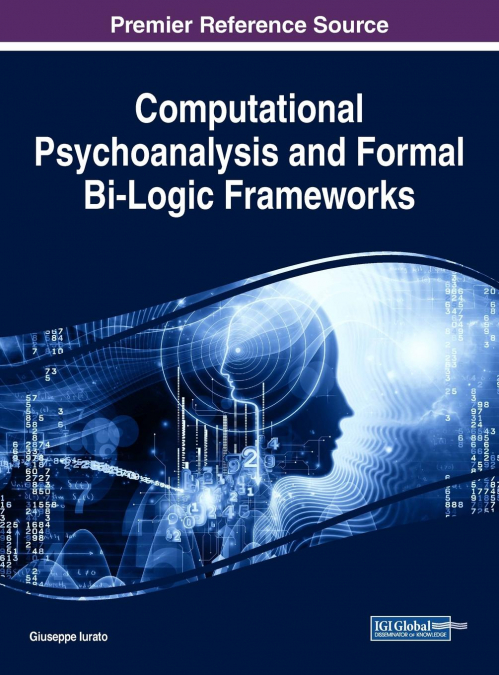
  • Computational Psychoanalysis and Formal Bi-Logic Frameworks
    Giuseppe Iurato
    Computational psychoanalysis is a new field stemming from Freudian psychoanalysis. The new area aims to understand the primary formal structures and running mechanisms of the unconscious while implementing them into computer sciences. Computational Psychoanalysis and Formal Bi-Logic Frameworks provides emerging information on this new field which uses psychoanalysis and the unc...

Otros libros del autor

  • Discrete Optimization with Interval Data
    Adam Kasperski
    Minmax Regret Combinatorial Optimization Problems with Interval Data.- Problem Formulation.- Evaluation of Optimality of Solutions and Elements.- Exact Algorithms.- Approximation Algorithms.- Minmax Regret Minimum Selecting Items.- Minmax Regret Minimum Spanning Tree.- Minmax Regret Shortest Path.- Minmax Regret Minimum Assignment.- Minmax Regret Minimum s???t Cut.- Fuzzy Combi...
    Disponible

    195,66 €