
Inicio > Sociedad y ciencias sociales > Educación pedagogía > Disassembling and Decolonizing School in the Pacific
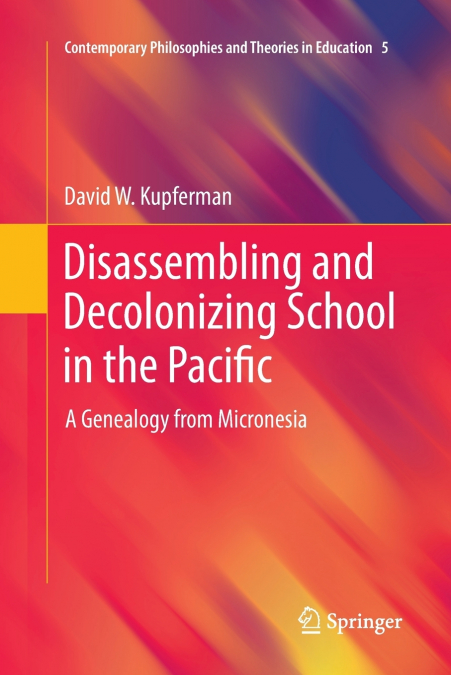
Disassembling and Decolonizing School in the Pacific

Disassembling and Decolonizing School in the Pacific

David W. Kupferman

134,32 €
IVA incluido
Disponible
Editorial:
Springer Nature B.V.
Año de edición:
2014
Materia
Educación pedagogía
ISBN:
9789400795730
134,32 €
IVA incluido
Disponible

Selecciona una librería:

  • Librería Samer Atenea
  • Librería Aciertas (Toledo)
  • Kálamo Books
  • Librería Perelló (Valencia)
  • Librería Elías (Asturias)
  • Donde los libros
  • Librería Kolima (Madrid)
  • Librería Proteo (Málaga)

Schooling in the region known as Micronesia is today a normalized, ubiquitous, and largely unexamined habit. As a result, many of its effects have also gone unnoticed and unchallenged. By interrogating the processes of normalization and governmentality that circulate and operate through schooling in the region through the deployment of Foucaultian conceptions of power, knowledge, and subjectivity, this work destabilizes conventional notions of schooling’s neutrality, self-evident benefit, and its role as the key to contemporary notions of so-called political, economic, and social development. This work aims to disquiet the idea that school today is both rooted in some distant past and a force for decolonization and the postcolonial moment. Instead, through a genealogy of schooling, the author argues that school as it is currently practiced in the region is the product of the present, emerging from the mid-1960s shift in US policy in the islands, the very moment when the US was trying to simultaneously prepare the islands for putative self-determination while producing ever-increasing colonial relations through the practice of schooling. The work goes on to conduct a genealogy of the various subjectivities produced through this present schooling practice, notably the student, the teacher, and the child/parent/family. It concludes by offering a counter-discourse to the normalized narrative of schooling, and suggests that what is displaced and foreclosed on by that narrative in fact holds a possible key to meaningful decolonization and self-determination.

Artículos relacionados

  • Beekeeping At The End Of The Earth
    Mark David Leech
    Beekeeping at the End of the Earth, an essential read for learning about beekeeping in a cool temperate climate with a focus on Tasmania our island home.  One hundred beekeepers one hundred different ways to keep bees.Beekeeping At The End Of The Earth is a practical insight into cool climate beekeeping with a focus on Tasmania, our island home.Richly illustrated with unique di...
    Disponible

    45,16 €

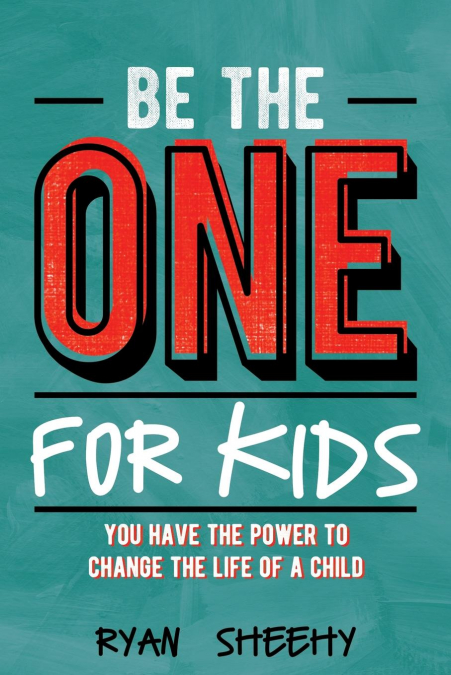
  • Be the One for Kids
    Ryan Sheehy
    One person can make a difference.That person can be you. “I want to show others that one person can make the difference in a child’s life. I want all educators, parents, coaches, and everyone in between to know they have power to Be the One for Kids.” —Ryan Sheehy If you ever feel like you’re all alone or think that no one gets you, just imagine how your students feel. Kids wan...
    Disponible

    27,99 €

  • Handbook of Research on E-Learning Standards and Interoperability
    As the e-learning industry continues to expand and the methods and tools necessary to create and maintain content and infrastructure applications become more complicated, there is an inherent need for these applications to interoperate and exchange data in order to better support the needs of learners and educators. Handbook of Research on E-Learning Standards and Interoperabil...
  • Teaching in the Knowledge Society
    Antonio Cartelli
    ...
  • Enhancing Learning Through Human Computer Interaction
    Elspeth McKay
    ...
  • Learning Objects for Instruction
    Pamela Taylor Northrup
    ...