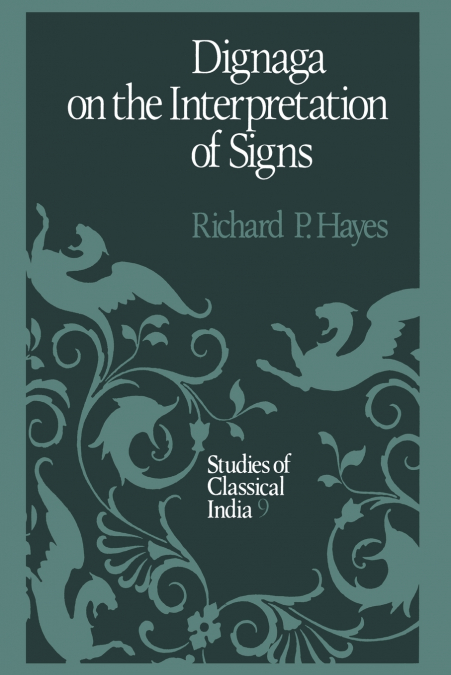

Dignaga on the Interpretation of Signs

Dignaga on the Interpretation of Signs

R.P. Hayes

268,74 €
IVA incluido
Disponible
Editorial:
Springer Nature B.V.
Año de edición:
2012
Materia
Filosofía oriental y de la India
ISBN:
9789401078061
268,74 €
IVA incluido
Disponible

Selecciona una librería:

  • Librería Samer Atenea
  • Librería Aciertas (Toledo)
  • Kálamo Books
  • Librería Perelló (Valencia)
  • Librería Elías (Asturias)
  • Donde los libros
  • Librería Kolima (Madrid)
  • Librería Proteo (Málaga)

Buddhist philosophy in India in the early sixth century C. E. took an important tum away from the traditional methods of explaining and systematizing the teachings in Siitra literature that were attributed to the Buddha. The new direction in which several Indian Buddhist philosophers began to move was that of following reasoning to its natural conclusions, regardless whether the conclusions conflicted with traditional teachings. The central figure in this new movement was DiIinaga, a native of South India who found his way to the centre of Buddhist education at Nalanda, studied the treatises that were learned by the Buddhist intellectuals of his day, and eventually wrote works of his own that formed the core of a distinctly new school of Buddhist thought. Inasmuch as virtually every Indian philosopher after the sixth century had either to reject Dirinaga’s methods or build upon the foundations provided by his investigations into logic, epistemology and language, his influence on the evolution of Indian philosophy was considerable, and indeed some familiarity with Dirinaga’s arguments and conclusions is indispensable for anyone who wishes to understand the historical development of Indian thought. Moreover, since the approach to Buddhism that grew out of Dirinaga’s meditations on language and the limits of knowledge dominated the minds of many of the scholars who took Buddhism to Tibet, some familiarity with Dirinaga is also essential to those who wish to understand the intellectual infrastructure of Tibetan Buddhist philosophy and practice.

Artículos relacionados

  • Bhagavad Gītā
    Swami Lakshmanjoo
    This treasure of knowledge was one of the last works by Swami Lakshmanjoo. He said, "It was a new revelation of the supreme secrets, hidden in the Kashmiri recension of the Bhagavad Gita." Based on Abhinavagupta's commentary of the Gitarthasamgraha, "The Essence of the Gita", Swamiji declared that, "this revelation was initiated by his direct experience of the state of Univ...
  • Fiery World III
    Agni Yoga Society
    Fiery World III is the eleventh book from the Agni Yoga Series which is composed of fourteen books. In them is found a synthesis of ancient Eastern beliefs and modern Western thought and a bridge between the spiritual and the scientific. Unlike previous yogas, Agni Yoga is a path not of physical disciplines, meditation, or asceticism—but of practice in daily life. It is the yog...
    Disponible

    14,47 €

  • Bhagavad Gī̄tā
    Swami Lakshmanjoo
    This treasure of knowledge was one of the last works by Swami Lakshmanjoo. He said, "It was a new revelation of the supreme secrets, hidden in the Kashmiri recension of the Bhagavad Gita." Based on Abhinavagupta's commentary of the Gitarthasamgraha, "The Essence of the Gita", Swamiji declared that, "this revelation was initiated by his direct experience of the state of Univ...
    Disponible

    26,24 €

  • The Quantum Screen
    Samuel Avery
    What is the connection between physics and consciousness? In this groundbreaking new book, Samuel Avery presents the quantum screen, a paradigm-shifting model of perceptual consciousness and of the world. This model looks to the enigmas of modern physics to demonstrate the primacy of consciousness—the essential oneness of spirit and matter.Our intellectual culture is divided be...
    Disponible

    13,80 €

  • Confucian Analects
    Confucius
    The superior man bends his attention to what is radical. That being established, all practical courses naturally grow up. Filial piety and fraternal submission,-are they not the root of all benevolent actions?To rule a country of a thousand chariots, there must be reverent attention to business, and sincerity; economy in expenditure, and love for men; and the employment of the ...
  • Leaves of Morya’s Garden II
    Agni Yoga Society
    Leaves of Morya's Garden II (Illumination) is the second book from the Agni Yoga Series which is composed of fourteen books. In them is found a synthesis of ancient Eastern beliefs and modern Western thought and a bridge between the spiritual and the scientific. Unlike previous yogas, Agni Yoga is a path not of physical disciplines, meditation, or asceticism—but of practice...
    Disponible

    12,10 €

Otros libros del autor

  • Dignaga on the Interpretation of Signs
    R.P. Hayes
    1: Preliminaries.- 1.1 The central issues.- 1.2 The contributions of previous scholars.- 1.2.1 Satis Chandra Vidy?bh??a?a.- 1.2.2 Th. Stcherbatsky.- 1.2.3 Satkari Mookerjee.- 1.2.4 Erich Frauwallner.- 1.2.5 Kitagawa Hidenori, Hattori Masaaki and Katsura Shoryu.- 1.2.6 Radhika Herzberger.- 1.3 The argument of this book.- Notes.- 2: Rational Skepticism in Pre-Di?n?gan Buddhism.- ...