
Die hohe Selektivität des deutschen Bildungssystems

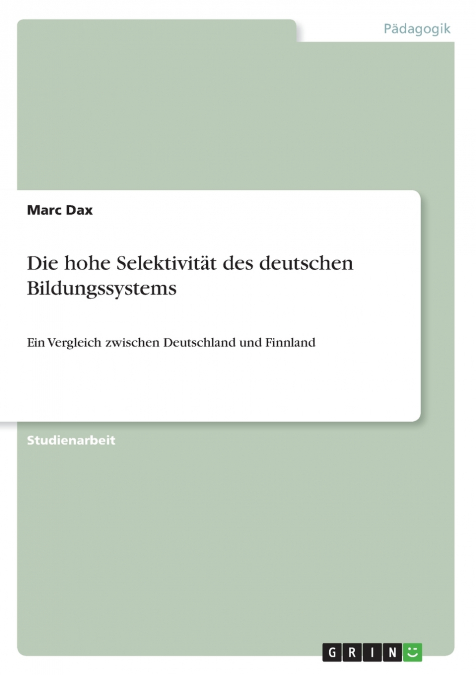
Die hohe Selektivität des deutschen Bildungssystems

Marc Dax

22,44 €
IVA incluido
Disponible
Editorial:
GRIN Verlag
Año de edición:
2010
Materia
Organización y gestión educativa
ISBN:
9783640772780
22,44 €
IVA incluido
Disponible

Selecciona una librería:

  • Librería Samer Atenea
  • Librería Aciertas (Toledo)
  • Kálamo Books
  • Librería Perelló (Valencia)
  • Librería Elías (Asturias)
  • Donde los libros
  • Librería Kolima (Madrid)
  • Librería Proteo (Málaga)

Studienarbeit aus dem Jahr 2010 im Fachbereich Pädagogik - Schulwesen, Bildungs- u. Schulpolitik, Note: 1,3, Ruhr-Universität Bochum (Institut für Erziehungswissenschaft), Veranstaltung: Bildungspolitik in der europäischen Union, Sprache: Deutsch, Abstract: Die vorliegende Hausarbeit beschäftigt sich mit dem finnischen und deutschen Bildungssystem. Es sollen zunächst die grundlegenden Eigenschaften der beiden Bildungssysteme vom Vorschulbereich bis in den Tertiärbereich kurz und knapp skizziert werden, um die grundlegenden Unterschiede deutlich zu machen.Erst seit der PISA Studie im Jahre 2000 ist das finnische und das deutsche Bil-dungssystem in den Blickpunkt der Öffentlichkeit geraten. Finnland, weil es eines der besten Bildungssysteme weltweit besitzt und Deutschland, weil es eines der schlechtesten Bildungssysteme der Industrieländern laut OECD besitzt.Dadurch, dass Finnland und Deutschland schon von der Einwohnerzahl und der Gesamtwohnfläche sehr unterschiedlich sind, sollen absolute Zahlen bezüglich Einwohnerzahl sowie Schülerinnen und Schüler einen Vergleich transparenter machen. Fundamental für die Unterschiede der zwei Bildungssysteme, ist hier zunächst die Bildungspolitik beider Länder zu nennen. Daher soll in einem weiteren Teil der Ar-beit auf die Schul- bzw. Bildungspolitik beider Länder eingegangen werden.Der erste Unterschied besteht zunächst darin, dass beide Länder unterschiedlich viel Geld in ihr Bildungssystem investieren. Der zweite Unterschied besteht darin, dass die Anzahl der Schülerinnen und Schüler mit Migrationshintergrund in Deutschland und Finnland sehr variieren.Ein weiterer Teil dieser Arbeit handelt mit den unterschiedlichen Lernsituationen der beiden Länder. Es soll die Frage geklärt werden wie finnische und deutsche Schülerinnen und Schüler lernen. Wo besteht der Unterschied? Bzw. Gibt es einen Unterschied? In diesem Kontext sollen dann aktuelle Studien der Schulpädagogik zum Tragen kommen. Es soll diskutiert und begründet werden, i


Artículos relacionados

  • Walking the Law and History
    Michelle Janene
    The companion student workbook for the Bible curriculum of Walking the Law and History Genesis. Students will participate in deep Bible study of the creation of the world, the foundations of the Christian faith, and the formation of the Jewish nation.  ...
    Disponible

    9,81 €

  • Reforming Education for the Real World
    George P Waldheim
    Education, as we know it in America, is too often characterized as living in a world by itself; unaccountable and unimproved--so different from the Real World.  Year after year 'Band-Aid' attempts are initiated to improve education and again, year after year, those attempts only produce marginal improvement--if any.  Thus, our international ranking is still depicted as 'mediocr...
    Disponible

    12,21 €

  • Let’s Talk Sex & STDs
    Dr. Katina Davis-Kennedy / DrKatina Davis-Kennedy
    There comes a time when every person has to learn about sex; typically, students learn within their middle school years about sex education. Unfortunately, by then they have been influenced by others with the wrong information, or have heard rumors that are mostly untrue. Let's Talk Sex and STDs: The Student Edition is here to lay all of the misleading information and stori...
    Disponible

    25,31 €

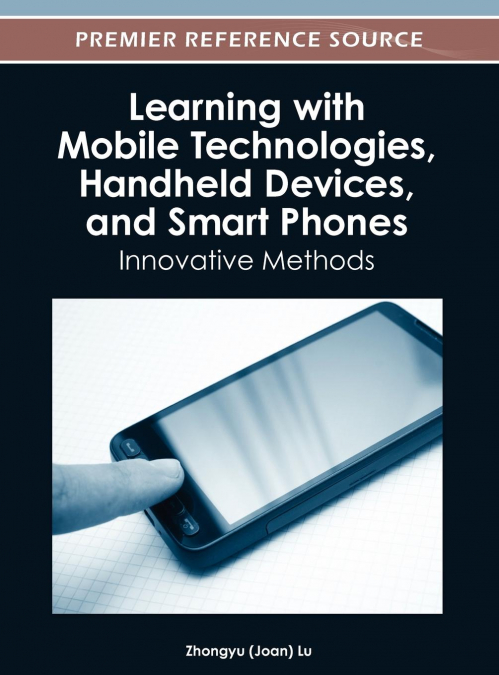
  • Learning with Mobile Technologies, Handheld Devices, and Smart Phones
    Mobile Learning is a new trend in pedagogical communities. It matches the speed of fast moving methodologies in pedagogical world. The theories of activity-based learning, problem-based learning, work-based learning, and opinion-based learning, learner-centered learning, and so forth, can be integrated with these tiny handheld devices. Students and teachers communicate effectiv...
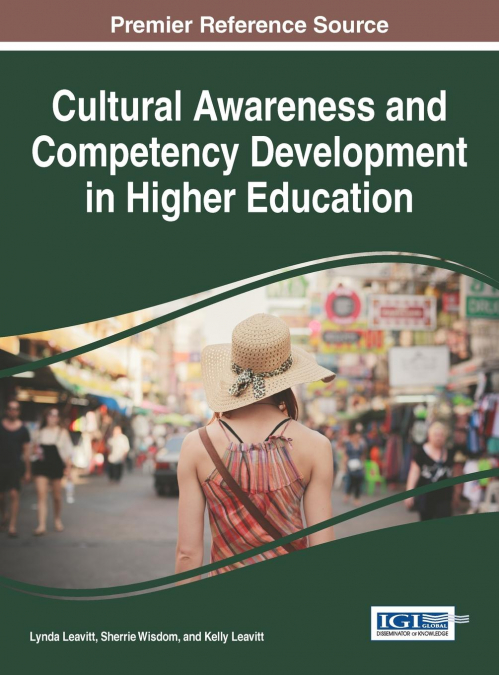
  • Cultural Awareness and Competency Development in Higher Education
    As the world becomes more globalized, student populations in university settings will continue to grow in diversity. To ensure students develop the cultural competence to adapt to new environments, universities and colleges must develop policies and programs to aid in the progression of cultural acceptance and understanding. Cultural Awareness and Competency Development in High...
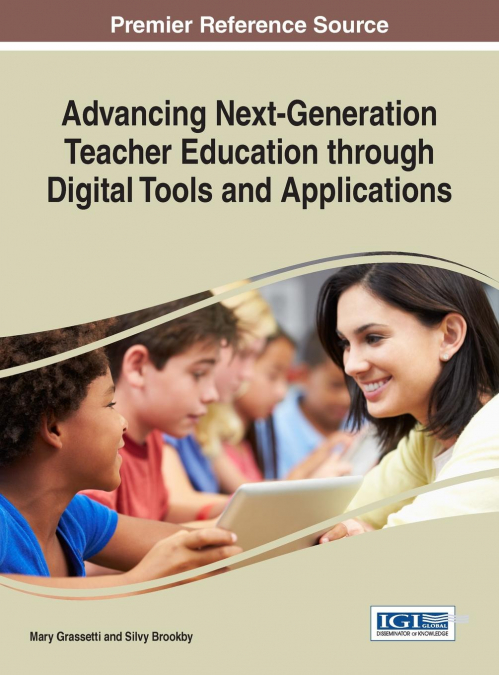
  • Advancing Next-Generation Teacher Education through Digital Tools and Applications
    The implementation of the Common Core State Standards program has spearheaded many changes within the education field. As this initiative is ultimately designed to optimize student performance and success, it is critical that teacher education programs and technological tools being utilized in classrooms align with Common Core State Standards. Advancing Next-Generation Teacher ...