 Librería Samer Atenea
 Kálamo Books
 Librería Elías (Asturias)
 Librería Kolima (Madrid)
 Librería Proteo (Málaga)
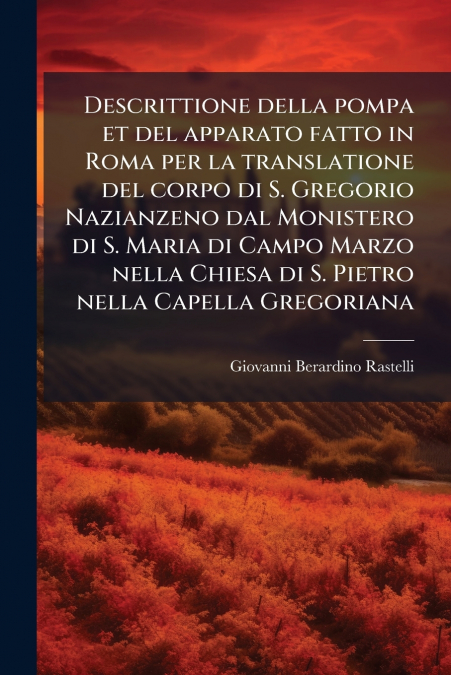
Descrittione della pompa et del apparato fatto in Roma per la translatione del corpo di S. Gregorio Nazianzeno dal Monistero di S. Maria di Campo Marzo nella Chiesa di S. Pietro nella Capella Gregoriana meticulously recounts the grand ceremony and elaborate preparations undertaken in Rome for the translation of the body of Saint Gregory Nazianzenus. Authored by Giovanni Berardino Rastelli and published around 1580, this work provides a detailed account of the procession and display organized to move the saint’s relics from the Monastery of Santa Maria di Campo Marzo to the Gregorian Chapel in Saint Peter’s Basilica.Rastelli’s description offers invaluable insights into the religious practices, artistic expressions, and architectural achievements of the period. It serves as a historical record of a significant event in the religious life of Rome, highlighting the reverence accorded to saints and the opulent displays of faith characteristic of the era. This book is essential for historians and scholars interested in the intersection of religion, art, and culture during the late 16th century in Italy.This work has been selected by scholars as being culturally important, and is part of the knowledge base of civilization as we know it. This work was reproduced from the original artifact, and remains as true to the original work as possible. Therefore, you will see the original copyright references, library stamps (as most of these works have been housed in our most important libraries around the world), and other notations in the work.This work is in the public domain in the United States of America, and possibly other nations. Within the United States, you may freely copy and distribute this work, as no entity (individual or corporate) has a copyright on the body of the work.As a reproduction of a historical artifact, this work may contain missing or blurred pages, poor pictures, errant marks, etc. Scholars believe, and we concur, that this work is important enough to be preserved, reproduced, and made generally available to the public. We appreciate your support of the preservation process, and thank you for being an important part of keeping this knowledge alive and relevant.