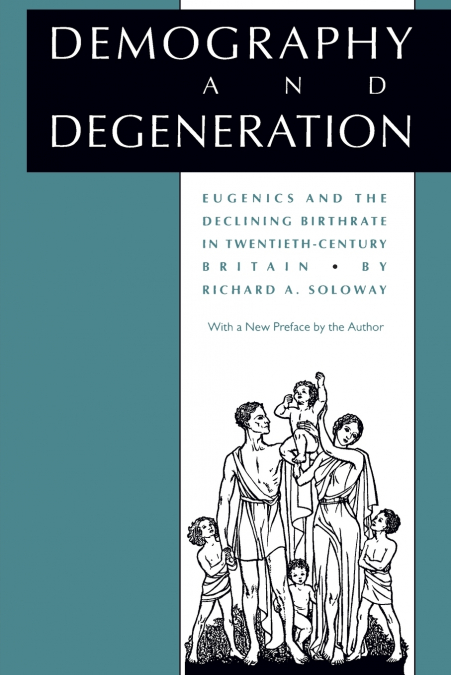
Demography and Degeneration

Demography and Degeneration

Demography and Degeneration

Richard A. Soloway / Richard ASoloway

69,98 €
IVA incluido
Disponible
Editorial:
Longleaf on behalf of Univ of N. Carolina Press
Año de edición:
1995
Materia
Población y demografía
ISBN:
9780807845547
69,98 €
IVA incluido
Disponible

Selecciona una librería:

  • Librería Samer Atenea
  • Librería Aciertas (Toledo)
  • Kálamo Books
  • Librería Perelló (Valencia)
  • Librería Elías (Asturias)
  • Donde los libros
  • Librería Kolima (Madrid)
  • Librería Proteo (Málaga)

Richard Soloway offers a compelling and authoritative study of the relationship of the eugenics movement to the dramatic decline in the birthrate and family size in twentieth-century Britain. Working in a tradition of hereditarian determinism which held fast to the premise that “like tends to beget like,” eugenicists developed and promoted a theory of biosocial engineering through selective reproduction. Soloway shows that the appeal of eugenics to the middle and upper classes of British society was closely linked to recurring concerns about the relentless drop in fertility and the rapid spread of birth control practices from the 1870s to World War II.Demography and Degeneration considers how differing scientific and pseudoscientific theories of biological inheritance became popularized and enmeshed in the prolonged, often contentious national debate about “race suicide” and “the dwindling family.” Demographic statistics demonstrated that birthrates were declining among the better-educated, most successful classes while they remained high for the poorest, least-educated portion of the population. For many people steeped in the ideas of social Darwinism, eugenicist theories made this decline all the more alarming: they feared that falling birthrates among the “better” classes signfied a racial decline and degeneration that might prevent Britain from successfully negotiating the myriad competive challenges facing the nation in the twentieth century.Although the organized eugenics movement remained small and elitist throughout most of its history, this study demonstrates how pervasive eugenic assumptions were in the middle and upper reaches of British society, at least until World War II. It also traces the important role of eugenics in the emergence of the modern family planning movement and the formulation of population policies in the interwar years.

Artículos relacionados

  • The Nature of Demography
    Hervé Le Bras
    Rapid changes over the last twenty years have impacted every branch of demographic analysis, from birth rates and immigration, to marriage rates and aging. The Nature of Demography is a response to these enormous changes. Written by one of the world’s leading demographers, this authoritative text offers a systematic and coherent overview of the fundamental ideas governing the s...
    Disponible

    110,57 €

  • Interaction Ritual Chains
    Randall Collins
    Sex, smoking, and social stratification are three very different social phenomena. And yet, argues sociologist Randall Collins, they and much else in our social lives are driven by a common force: interaction rituals. Interaction Ritual Chains is a major work of sociological theory that attempts to develop a 'radical microsociology.' It proposes that successful rituals create s...
    Disponible

    56,26 €

  • Migration, Mobility and Multiple Affiliations
    ...
  • Finding Strength in Numbers
    Alan Blackshaw
    A topical exploration of how communities can help heal trauma in individuals and groupsThere are many books dedicated to trauma. What sets ’Finding Strength in Numbers’ apart from these books is that it is one of the very few, or even the first, focussing on trauma and its relationship to community as the place where we heal. Trauma is a common human experience. Almost all of u...
    Disponible

    18,45 €

  • India Population Report
    ...
  • Death and the Metropolis
    John Landers
    ...
    Disponible

    49,91 €

Otros libros del autor

  • Birth Control and the Population Question in England, 1877-1930
    Richard A. Soloway / Richard ASoloway
    Soloway examines the origins of the modern birth control movement in England in the wider context of the dramatic decline in fertility that first became apparent in the 1880s. He concludes that the response of individuals and organizations drawn into the debate over birth control and the consequences of diminished fertility mirrored their attitudes toward the profound social, e...
    Disponible

    76,64 €