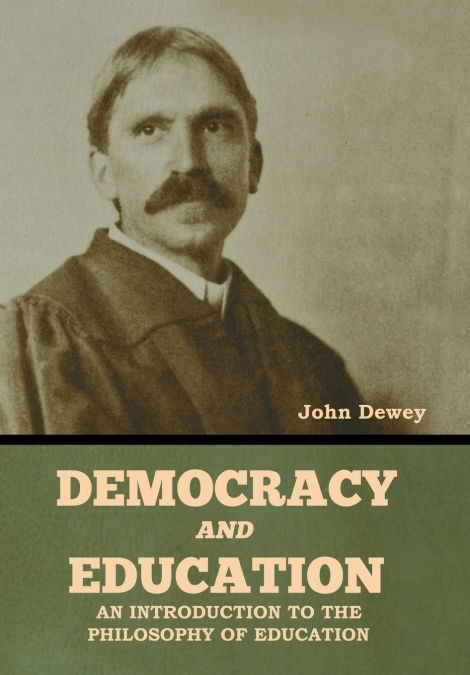

Democracy and Education

Democracy and Education

John Dewey

31,60 €
IVA incluido
Consulta disponibilidad
Editorial:
IndoEuropeanPublishing
Año de edición:
2023
Materia
Filosofía y teoría de la educación
ISBN:
9798889420057

Selecciona una librería:

  • Librería Samer Atenea
  • Librería Aciertas (Toledo)
  • Kálamo Books
  • Librería Perelló (Valencia)
  • Librería Elías (Asturias)
  • Donde los libros
  • Librería Kolima (Madrid)
  • Librería Proteo (Málaga)

In Democracy and Education, Dewey argues that the primary ineluctable facts of the birth and death of each one of the constituent members in a social group determine the necessity of education. On one hand, there is the contrast between the immaturity of the new-born members of the group (its future sole representatives) and the maturity of the adult members who possess the knowledge and customs of the group. On the other hand, there is the necessity that these immature members be not merely physically preserved in adequate numbers, but that they be initiated into the interests, purposes, information, skill, and practices of the mature members: otherwise the group will cease its characteristic life.  Dewey observes that even in a 'savage' tribe, the achievements of adults are far beyond what the immature members would be capable of if left to themselves. With the growth of civilization, the gap between the original capacities of the immature and the standards and customs of the elders increases. Mere physical growing up and mastery of the bare necessities of subsistence will not suffice to reproduce the life of the group. Deliberate effort and the taking of thoughtful pains are required. Beings who are born not only unaware of, but quite indifferent to, the aims and habits of the social group have to be rendered cognizant of them and actively interested. According to Dewey, education, and education alone, spans the gap. Dewey’s ideas were never broadly and deeply integrated into the practices of American public schools, though some of his values and terms were widespread. Progressive education (both as espoused by Dewey, and in the more popular and inept forms of which Dewey was critical) was essentially scrapped during the Cold War, when the dominant concern in education was creating and sustaining a scientific and technological elite for military purposes. In the post-Cold War period, however, progressive education had reemerged in many school reform and education theory circles as a thriving field of inquiry learning and inquiry-based science. Some find it cumbersome that Dewey’s philosophical anthropology, unlike Egan, Vico, Ernst Cassirer, Claude Lévi-Strauss, and Nietzsche, does not account for the origin of thought of the modern mind in the aesthetic, more precisely the myth, but instead in the original occupations and industries of ancient people, and eventually in the history of science. A criticism of this approach is that it does not account for the origin of cultural institutions, which can be accounted for by the aesthetic. Language and its development, in Dewey’s philosophical anthropology, have not a central role but are instead a consequence of the cognitive capacity. While Dewey’s educational theories have enjoyed a broad popularity during his lifetime and after, they have a troubled history of implementation. Dewey’s writings can also be difficult to read, and his tendency to reuse commonplace words and phrases to express extremely complex reinterpretations of them makes him susceptible to misunderstanding. So while he held the role of a leading public intellectual, he was often misinterpreted, even by fellow academics. Many enthusiastically embraced what they mistook for Dewey’s philosophy, but which in fact bore little or a distorted resemblance to it. ... (Wikipedia.org)

Artículos relacionados

  • First, Do No Harm
    Steve Nelson
    First Do No Harm: Progressive Education in a Time of Existential Risk develops a comprehensive argument for the importance of progressive education in light of the world’s increasingly severe challenges.  Current educational practices, particularly in the United States, instill conformity and compliance at a time when authority must be challenged, skepticism must thrive and our...
    Disponible

    23,82 €

  • Human Nature
    Arthur Schopenhauer
    Collected here are five short essays, Human Nature, Government, Free-will and Fatalism, Character, Moral Instinct, and, Ethical Reflections, by the world renowned philosopher Arthur Schopenhauer. ...
  • The Fire Within
    Joe David
    Violence-ridden Church Junior High School is the setting for Joe David’s hard look into the world of “education,” a world filled with hatred and deception, boredom and indoctrination – financially supported by government decree!The central character is Anne Harte, an idealist who tries to teach by igniting the fire within of knowledge. Unlike teachers who indoctrinate, Anne att...
    Disponible

    13,30 €

  • VIGLETS
    Viggo Hansen
    Viglet III, Time, Infinity & Eternity - explores these concepts from many perspectives. It dares address the question - is there such a thing as 'time' or is 'time' simply a jumble of numbers needed to pass Physics 101? If 'time' is not puzzling enough then consider infinity and eternity.How pervasive is 'time' - if it exists? Do other living things like ameba, puddy cats and p...
    Disponible

    12,68 €

  • The Symphony of High Dimensional Wisdoms (SPECIAL EDITION)
    FENG LIU / BO AI
    This book 'The Symphony of High Dimensional Wisdoms' uses the scientific context and builds an intertwined network of wisdom systems. It is a hub connecting all wisdom languages; an internal bridge that seeks commonalities and existing for the harmonious symphony of multiculturalism in the world. The fundamental meaning of life is to improve the dimension of consciousness energ...
    Disponible

    31,46 €

  • How to Think like Shakespeare
    Scott Newstok
    A lively and engaging guide to vital habits of mind that can help you think more deeply, write more effectively, and learn more joyfullyHow to Think like Shakespeare is a brilliantly fun exploration of the craft of thought—one that demonstrates what we’ve lost in education today, and how we might begin to recover it. In fourteen brief chapters that draw from Shakespeare’s world...
    Disponible

    19,91 €

Otros libros del autor

  • Democracy and Education (Esprios Classics)
    John Dewey
    John Dewey (October 20, 1859 - June 1, 1952) was an American philosopher, psychologist, and educational reformer whose ideas have been influential in education and social reform. He was one of the most prominent American scholars in the first half of the twentieth century. The overriding theme of Dewey’s works was his profound belief in democracy, be it in politics, education, ...
  • The Public and Its Problems
    John Dewey
    The Public and Its Problems (1927) by John Dewey is a philosophical and political work examining the nature of democracy in modern society.Dewey argues that a 'public' forms whenever the actions of individuals have indirect consequences for others, creating shared problems that require collective regulation. In modern, complex societies, these consequences are often obscured by...
    Disponible

    14,18 €

  • The Public and Its Problems
    John Dewey
    The Public and Its Problems (1927) by John Dewey is a philosophical and political work examining the nature of democracy in modern society.Dewey argues that a 'public' forms whenever the actions of individuals have indirect consequences for others, creating shared problems that require collective regulation. In modern, complex societies, these consequences are often obscured by...
  • Democracy and Education
    John Dewey
    Democracy and Education (1916) by John Dewey argues that education is the foundation of a healthy democracy. Dewey sees education not as rote learning, but as a social process through which individuals grow by participating in shared experiences. Schools, he claims, should mirror democratic life by encouraging cooperation, critical thinking, and problem-solving rather than pass...
    Disponible

    30,72 €

  • Democracy and Education
    John Dewey
    Democracy and Education (1916) by John Dewey argues that education is the foundation of a healthy democracy. Dewey sees education not as rote learning, but as a social process through which individuals grow by participating in shared experiences. Schools, he claims, should mirror democratic life by encouraging cooperation, critical thinking, and problem-solving rather than pass...
  • Human Nature and Conduct - An introduction to social psychology
    John Dewey
    In the spring of 1918 I was invited by Leland Stanford Junior University to give a series of three lectures upon the West Memorial Foundation. One of the topics included within the scope of the Foundation is Human Conduct and Destiny. This volume is the result, as, according to the terms of the Foundation, the lectures are to be published. The lectures as given have, however, b...
    Disponible

    16,71 €