 Librería Samer Atenea
 Kálamo Books
 Librería Elías (Asturias)
 Librería Kolima (Madrid)
 Librería Proteo (Málaga)
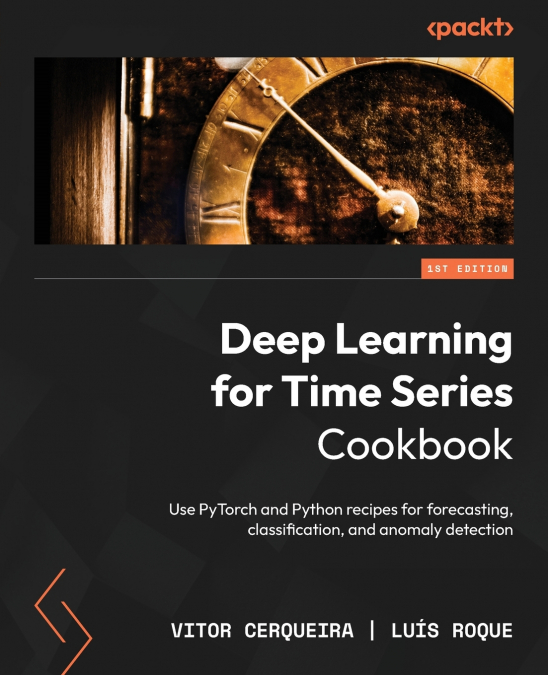
Learn how to deal with time series data and how to model it using deep learning and take your skills to the next level by mastering PyTorch using different Python recipesKey FeaturesLearn the fundamentals of time series analysis and how to model time series data using deep learningExplore the world of deep learning with PyTorch and build advanced deep neural networksGain expertise in tackling time series problems, from forecasting future trends to classifying patterns and anomaly detectionPurchase of the print or Kindle book includes a free PDF eBookBook DescriptionMost organizations exhibit a time-dependent structure in their processes, including fields such as finance. By leveraging time series analysis and forecasting, these organizations can make informed decisions and optimize their performance. Accurate forecasts help reduce uncertainty and enable better planning of operations. Unlike traditional approaches to forecasting, deep learning can process large amounts of data and help derive complex patterns. Despite its increasing relevance, getting the most out of deep learning requires significant technical expertise.This book guides you through applying deep learning to time series data with the help of easy-to-follow code recipes. You’ll cover time series problems, such as forecasting, anomaly detection, and classification. This deep learning book will also show you how to solve these problems using different deep neural network architectures, including convolutional neural networks (CNNs) or transformers. As you progress, you’ll use PyTorch, a popular deep learning framework based on Python to build production-ready prediction solutions.By the end of this book, you’ll have learned how to solve different time series tasks with deep learning using the PyTorch ecosystem.What you will learnGrasp the core of time series analysis and unleash its power using PythonUnderstand PyTorch and how to use it to build deep learning modelsDiscover how to transform a time series for training transformersUnderstand how to deal with various time series characteristicsTackle forecasting problems, involving univariate or multivariate dataMaster time series classification with residual and convolutional neural networksGet up to speed with solving time series anomaly detection problems using autoencoders and generative adversarial networks (GANs)Who this book is forIf you’re a machine learning enthusiast or someone who wants to learn more about building forecasting applications using deep learning, this book is for you. Basic knowledge of Python programming and machine learning is required to get the most out of this book.Table of ContentsGetting Started with Time SeriesGetting Started with PyTorchUnivariate Time Series ForecastingForecasting with PyTorch LightningGlobal Forecasting ModelsAdvanced Deep Learning Architectures for Time Series ForecastingProbabilistic Time Series ForecastingDeep Learning for Time Series ClassificationDeep Learning for Time Series Anomaly Detection