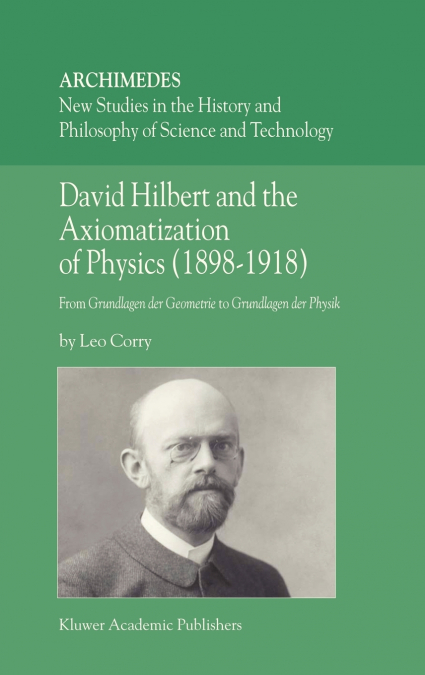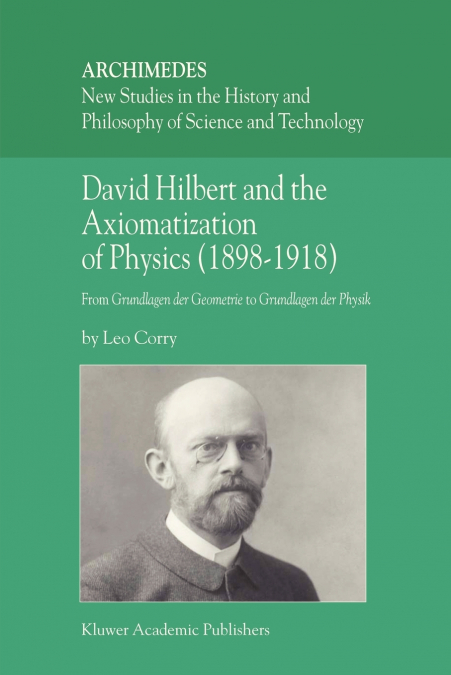

David Hilbert and the Axiomatization of Physics (1898-1918)

David Hilbert and the Axiomatization of Physics (1898-1918)

L. Corry

366,39 €
IVA incluido
Disponible
Editorial:
Springer Nature B.V.
Año de edición:
2010
Materia
Influencia de la ciencia y la tecnología sobre la sociedad
ISBN:
9789048167197
366,39 €
IVA incluido
Disponible

Selecciona una librería:

  • Librería Samer Atenea
  • Librería Aciertas (Toledo)
  • Kálamo Books
  • Librería Perelló (Valencia)
  • Librería Elías (Asturias)
  • Donde los libros
  • Librería Kolima (Madrid)
  • Librería Proteo (Málaga)

David Hilbert (1862-1943) was the most influential mathematician of the early twentieth century and, together with Henri Poincaré, the last mathematical universalist. His main known areas of research and influence were in pure mathematics (algebra, number theory, geometry, integral equations and analysis, logic and foundations), but he was also known to have some interest in physical topics. The latter, however, was traditionally conceived as comprising only sporadic incursions into a scientific domain which was essentially foreign to his mainstream of activity and in which he only made scattered, if important, contributions. Based on an extensive use of mainly unpublished archival sources, the present book presents a totally fresh and comprehensive picture of Hilbert’s intense, original, well-informed, and highly influential involvement with physics, that spanned his entire career and that constituted a truly main focus of interest in his scientific horizon. His program for axiomatizing physical theories provides the connecting link with his research in more purely mathematical fields, especially geometry, and a unifying point of view from which to understand his physical activities in general. In particular, the now famous dialogue and interaction between Hilbert and Einstein, leading to the formulation in 1915 of the generally covariant field-equations of gravitation, is adequately explored here within the natural context of Hilbert’s overall scientific world-view. This book will be of interest to historians of physics and of mathematics, to historically-minded physicists and mathematicians, and to philosophers of science.

Artículos relacionados

  • Interactive Media Use and Youth
    Modern advancements in technology have changed the way that young people use interactive media. Learning from such methods was not even considered until recently. It is now slowly defining the landscape of contemporary pedagogical practices. Interactive Media Use and Youth: Learning, Knowledge Exchange and Behavior provides a comprehensive collection of knowledge based on diffe...
  • Social and Economic Effects of Community Wireless Networks and Infrastructures
    Abdelaal
    It is surprising to think that in today’s rapidly evolving world of technology, over half of the globe still does not have access to high speed internet. Creating community wireless networks has in the past been a way to provide remote communities with internet and network access. Social and Economic Effects of Community Wireless Networks and Infrastructures highlights the succ...
  • The New Atlantis
    Francis Bacon
    In this work, Bacon portrayed a vision of the future of human discovery and knowledge, expressing his aspirations and ideals for humankind. The novel depicts the creation of a utopian land where 'generosity and enlightenment, dignity and splendour, piety and public spirit' are the commonly held qualities of the inhabitants of 'Bensalem'. ...
  • Sport 2.0
    Andy Miah
    ...
    Disponible

    28,86 €

  • Productivity Machines
    Corinna Schlombs
    ...
    Disponible

    48,52 €

  • Open Space
    Mariel Borowitz
    ...
    Disponible

    38,25 €

Otros libros del autor

  • David Hilbert and the Axiomatization of Physics (1898-1918)
    L. Corry
    David Hilbert (1862-1943) was the most influential mathematician of the early twentieth century and, together with Henri Poincaré, the last mathematical universalist. His main known areas of research and influence were in pure mathematics (algebra, number theory, geometry, integral equations and analysis, logic and foundations), but he was also known ...