
Inicio > Humanidades > Filosofía > Historia de la filosofía occidental > Filosofía occidental: antigua, hasta c. 500 > Das Verhältnis zwischen Abbild und Wirklichkeit in Platons Höhlengleichnis
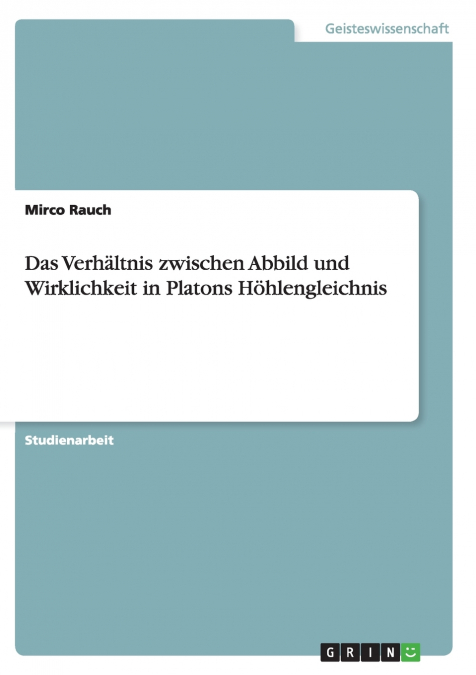
Das Verhältnis zwischen Abbild und Wirklichkeit in Platons Höhlengleichnis

Das Verhältnis zwischen Abbild und Wirklichkeit in Platons Höhlengleichnis

Mirco Rauch

25,82 €
IVA incluido
Disponible
Editorial:
GRIN Verlag
Año de edición:
2008
Materia
Filosofía occidental: antigua, hasta c. 500
ISBN:
9783638894838
25,82 €
IVA incluido
Disponible

Selecciona una librería:

  • Librería Samer Atenea
  • Librería Aciertas (Toledo)
  • Kálamo Books
  • Librería Perelló (Valencia)
  • Librería Elías (Asturias)
  • Donde los libros
  • Librería Kolima (Madrid)
  • Librería Proteo (Málaga)

Studienarbeit aus dem Jahr 2007 im Fachbereich Philosophie - Philosophie der Antike, Note: 2,0, Christian-Albrechts-Universität Kiel (Philosophisches Seminar), Veranstaltung: Bildbegriffe und Bilderwissen seit der Antike, Sprache: Deutsch, Abstract: Aus der Einleitung:(...)Platon stellt in seinem sogenannten Höhlengleichnis, dem wohl bekanntestenAbschnitt aus seinem Hauptwerk „Politeia', dieses Problem ausführlich dar. Mithilfe einer genaueren Analyse jenes Textabschnittes soll in dervorliegenden Arbeit der Fragstellung nachgegangen werden, wie sich darindas Verhältnis zwischen Abbild und Wirklichkeit darstellt.Zuerst wird dabei das Interesse auf das Höhlengleichnis im Kontext der„Politeia' gestützt. Der Akzent soll hier vor allem auf dem Sonnen- und Liniengleichnisliegen, weil sie für das Vorverständnis des Höhlengleichnisseseine nicht ganz unerhebliche Rolle spielen. Darauf aufbauend besitzt die Inhaltsangabedes Höhlengleichnisses die wesentliche Aufgabe, die für die o.g.Fragestellung relevanten Punkte noch einmal herauszukristallisieren. Aberauch ein Blick auf die griechischen Termini für den deutschen Ausdruck ‚Bild’bzw. ‚Abbild’ wird daneben nicht unwichtig erscheinen; so sollen auch gleichzeitigdie für die Analyse wesentlichen Begriffe, welche Platon selbst in seinemWerk verwendet, herausgearbeitet und deren Bedeutungsunterschiedeaufgezeigt werden, um eine eindeutigere Interpretation zu gewährleisten. Imnächsten Abschnitt orientiert sich die Einteilung der Kapitel an der Dreiteilungdes Gleichnisses Leben in der Höhle - Aufstieg aus der Höhle - erneuterAbstieg in die Höhle. Aus diesem Grund soll zunächst das Augenmerk aufdie Situation der Menschen in der von Platon beschriebenen Höhle gerichtetwerden. Dabei wird es vor allem auf die Frage ankommen, wie die dortigenBewohner die wahrgenommenen Abbilder bewerten, damit anschließend einVergleich mit der ‚neuen’ Realität (im Gleichnis gekennzeichnet durch denAufstieg aus der Höhle ins Licht)

Artículos relacionados

  • The Nature of Things
    Lucretius Lucretius
    De rerum natura (On the Nature of Things) is a 1st century BC didactic poem by the Roman poet and philosopher Lucretius with the goal of explaining Epicurean philosophy to a Roman audience. Lucretius presents the principles of atomism; the nature of the mind and soul; explanations of sensation and thought; the development of the world and its phenomena; and explains a variety o...
  • Pompeii
    Fergus Mason
    Pompeii was one of most advanced cities of its time; it had a complex water system, gymnasium, and an amphitheater. Despite it's advancements, there was one thing it wasn't ready for: Mount Vesuvius—the volcano that led to its ultimate doom.  The 79 AD eruption of Mount Vesuvius was one of the worst disasters in all of European history. In a near instant, over 15,000 p...
    Disponible

    10,36 €

  • Middle Platonism and Neoplatonism, Volume 1
    Stephen Gersh
    'It is generally agreed that those types of philosophy that are loosely called ’Platonic’ and ’Neoplatonic’ played a crucial role in the history of European culture during the centuries between antiquity and the Renaissance. However, until now no scholar has attempted to describe the evolution of these forms of thought in a single comprehensive academic study.' So writes Stephe...
  • Middle Platonism and Neoplatonism, Volume 2
    Stephen Gersh
    It is generally agreed that those types of philosophy that are loosely called 'Platonic' and 'Neoplatonic' played a crucial role in the history of European culture during the centuries between antiquity and the Middle Ages. However, until now no scholar has attempted to describe the evolution of these forms of thought in a single comprehensive academic study. Middle Platonism a...
  • Porphyry’s Commentary on Ptolemy’s Harmonics
    Andrew Barker
    ...
    Disponible

    77,17 €

  • The Roots of Platonism
    John Dillon
    ...
    Disponible

    25,29 €