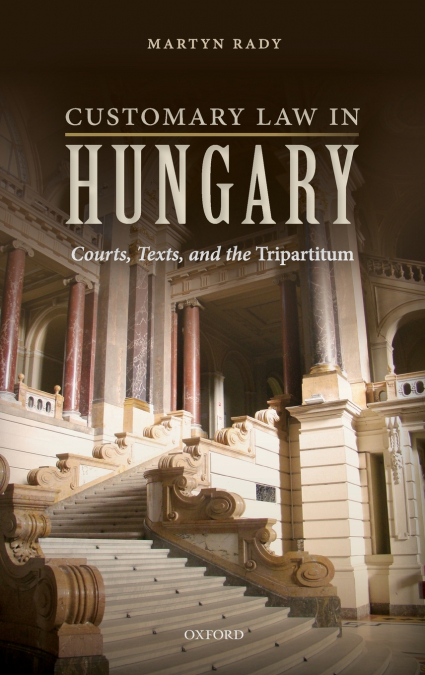

Customary Law in Hungary

Customary Law in Hungary

Martyn Rady

186,82 €
IVA incluido
Consulta disponibilidad
Editorial:
Oxford University Press
Año de edición:
2015
Materia
Derecho constitucional y administrativo
ISBN:
9780198743910

Selecciona una librería:

  • Librería Samer Atenea
  • Librería Aciertas (Toledo)
  • Kálamo Books
  • Librería Perelló (Valencia)
  • Librería Elías (Asturias)
  • Donde los libros
  • Librería Kolima (Madrid)
  • Librería Proteo (Málaga)

This is the first comprehensive treatment in any language of the history of customary law in Hungary, from the thirteenth to the twentieth centuries. Hungary’s customary law was described by Stephen Werboczy in 1517 in the extensive law code known as the Tripartitum. As Werboczy explained, Hungarian law derived from the interplay of Romano-canonical law, statute, written instruments, and court judgments. It was also responsive, however, to popular conceptions of the law’s content and application, as communicated through the lay membership of the kingdom’s courts. Publication of the Tripartitum was intended to make the law more certain by fixing it in writing. Nevertheless, its text was customized by actual use, in the same way as the statute laws of the kingdom were adjusted as a consequence of court practice and of errors in their transmission. The reputation attaching to the Tripartitum and Hungary’s insulation from the Roman Law Reception meant that the Tripartitum continued to retain authority until well into the nineteenth century. Attempts to replace it foundered and it was the principal text on which the courts and the schools relied, not only in Habsburg Hungary but also in Transylvania. Courts, nevertheless, continued to modify its provisions in the interests of rendering judgments that they deemed either to be right or in conformity with developing practices. Even after the establishment of a parliamentary form of government in the nineteenth century, a strong customary element attached to Hungarian law, which was amplified by the association of customary law with national traditions. The consequence was that Hungary maintained aspects of a customary law regime until the Communist period.
Artículos relacionados

  • REVISTA DE DERECHO PÚBLICO (Venezuela), No. 149-150, enero-junio 2017
    REVISTA DE DERECHO PÚBLICO, ISSN: 1317-2719. Director-Fundador: Allan R. Brewer-Carías, editada por la Fundación de Derecho Público y la Editorial Jurídica Venezolana. Nº 149-150, enero-junio 2017, Caracas Venezuela: Este número. 147-148 de la Revista tiene el siguiente contenido: Artículos: Asdrúbal AGUIAR ARANGUREN, Los orígenes del pensamiento constitucional venezolano, en l...
    Disponible

    33,13 €

  • Transforming Administrative Procedure
    JAVIER BARNES
    Collective work with the participation of eleven authors from different countries. New coordinates of such an important and ubiquitous institution as the administrative procedure institution is, are analyzed in this book. The ten chapters deal with the evolution of the process in today's world: new generations of procedures as a result of new forms of government and adminis...
    Disponible

    41,62 €

  • The Hong Kong Legal System
    Kevin Kwok-yin Cheng / Stefan H. C. Lo / Wing Hong Chui
    ...
    Disponible

    82,78 €

  • The 'Fall' of the Arab Spring
    Tofigh Maboudi
    ...
    Disponible

    35,58 €

  • EL DERECHO PUBLICO Y SUS RETOS ACTUALES. Libro Homenaje al profesor Libardo Rodriguez R.
    Esta obra, coordinada por los profesores Allan R. Brewer-Carías, Luciano Parejo Alfonso y Víctor Hernández Medible, ha sido editada en Homenaje al profesor Libardo Rodríguez R, por Editorial Temis de Colombia, en coedición con Editorial Reus y Editorial Jurídica Venezolana International. Reúne 44 estudios sobre El derecho público y sus retos actuales, redactados con tal motivo ...
    Disponible

    43,19 €

  • Restoring the Lost Constitution
    Randy E. Barnett
    The U.S. Constitution found in school textbooks and under glass in Washington is not the one enforced today by the Supreme Court. In Restoring the Lost Constitution, Randy Barnett argues that since the nation’s founding, but especially since the 1930s, the courts have been cutting holes in the original Constitution and its amendments to eliminate the parts that protect liberty ...
    Disponible

    35,51 €

Otros libros del autor