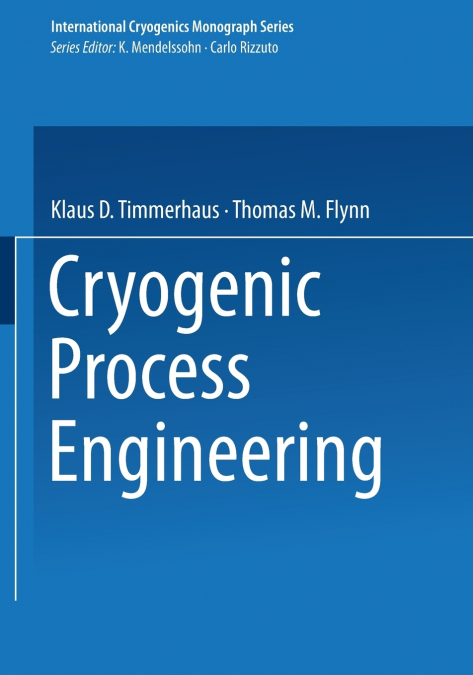
Cryogenic Process Engineering

Cryogenic Process Engineering

Klaus D. Timmerhaus / Thomas M. Flynn

222,87 €
IVA incluido
Disponible
Editorial:
Springer Nature B.V.
Año de edición:
2013
Materia
Química industrial
ISBN:
9781468487589
222,87 €
IVA incluido
Disponible

Selecciona una librería:

  • Librería Samer Atenea
  • Librería Aciertas (Toledo)
  • Kálamo Books
  • Librería Perelló (Valencia)
  • Librería Elías (Asturias)
  • Donde los libros
  • Librería Kolima (Madrid)
  • Librería Proteo (Málaga)

Cryogenics, a term commonly used to refer to very low temperatures, had its beginning in the latter half of the last century when man learned, for the first time, how to cool objects to a temperature lower than had ever existed na tu rally on the face of the earth. The air we breathe was first liquefied in 1883 by a Polish scientist named Olszewski. Ten years later he and a British scientist, Sir James Dewar, liquefied hydrogen. Helium, the last of the so-caBed permanent gases, was finally liquefied by the Dutch physicist Kamerlingh Onnes in 1908. Thus, by the beginning of the twentieth century the door had been opened to astrange new world of experimentation in which aB substances, except liquid helium, are solids and where the absolute temperature is only a few microdegrees away. However, the point on the temperature scale at which refrigeration in the ordinary sense of the term ends and cryogenics begins has ne ver been weB defined. Most workers in the field have chosen to restrict cryogenics to a tem­ perature range below -150°C (123 K). This is a reasonable dividing line since the normal boiling points of the more permanent gases, such as helium, hydrogen, neon, nitrogen, oxygen, and air, lie below this temperature, while the more common refrigerants have boiling points that are above this temperature. Cryogenic engineering is concerned with the design and development of low-temperature systems and components.

Artículos relacionados

  • Quantitative Structure-Activity Relationships in Drug Design, Predictive Toxicology, and Risk Assessment
    Kunal Roy
    Quantitative structure-activity relationships (QSARs) represent predictive models derived from the application of statistical tools correlating biological activity or other properties of chemicals with descriptors representative of molecular structure and/or property. Quantitative Structure-Activity Relationships in Drug Design, Predictive Toxicology, and Risk Assessment discus...
    Disponible

    387,85 €

  • Chemical Compound Structures and the Higher Dimension of Molecules
    Gennadiy Vladimirovich Zhizhin
    Originally, scientists believed that molecules were three-dimensional; however, studies have proven that geometric dimensions are continuous. Therefore, molecules are able to have higher dimensions which influences how they interact with other molecules leading to advances in various fields including nanomedicine, nanotoxicology and quantum biology. Chemical Compound Structures...
    Disponible

    237,72 €

  • CHEMICAL THERMODYNAMICS, 2ND EDITION
    Byung Chan Eu / BYUNG CHAN EU & MAZEN AL-GHOUL / EU BYUNG CHAN / Mazen Al-Ghoul
    This book enables the reader to learn, in a single volume, equilibrium and nonequilibrium thermodynamics as well as generalized forms of hydrodynamics for linear and nonlinear processes applied to various hydrodynamic flow processes — including chemical oscillation phenomena and pattern formations, shock wave phenomena, sound wave propagations, and Liesegang pattern formation, ...
    Disponible

    152,39 €

  • CARBOHYDRATE CHEMISTRY
    ALEN RAIMO / Raimo Alen
     This book presents a comprehensive approach to the versatile and fascinating field of carbohydrate chemistry. It covers, besides the colorful historical perspective within the utilization of carbohydrates and their derivatives, all modern aspects on their properties, nomenclature, uses, and natural occurrence as such or as residues in a variety of biologically active molecules...
    Disponible

    152,65 €

  • Recent Developments in Geopolymers and Alkali-Activated Materials
    Sujeong Lee
    We are compiling and publishing a collection of the latest research papers in the fields of Geopolymer and Alkali-Activated Materials (AAM). This compilation includes eight original research and two review papers covering a diverse range of topics, including various raw materials, manufacturing processes, and applications in the realms of Geopolymer and AAM. The publication aim...
    Disponible

    70,00 €

  • Introduction to Chemical Engineering Fluid Mechanics
    William M. Deen
    ...
    Disponible

    104,92 €