 Librería Samer Atenea
 Kálamo Books
 Librería Elías (Asturias)
 Librería Kolima (Madrid)
 Librería Proteo (Málaga)
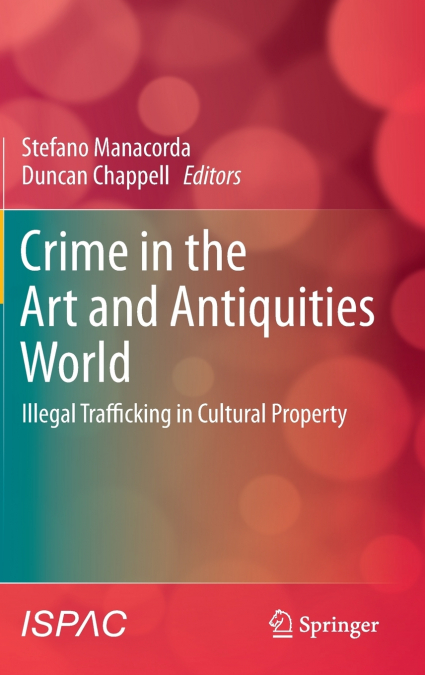
The theft, trafficking, and falsification of cultural property and cultural heritage objects are crimes of a particularly complex nature, which often have international ramifications and significant economic consequences. Organized criminal groups of various types and origins are involved in these illegal acts.The book Crime in the Art and Antiquities World has contributions both from researchers specializing in the illegal trafficking of art, and representatives of international institutions involved with prevention and detection of cultural property-related crimes, such as Interpol and UNESCO.This work is a unique and useful reference for scholars and private and public bodies alike.This innovative volume also includes an Appendix of the existing legal texts, i.e. international treaties, conventions, and resolutions, which have not previously been available in a single volume.As anyone who has undertaken research or study relating to the protection of cultural heritage discovers one of the frustrations encountered is the absence of ready access to the multi- various international instruments which exist in the field. Since the end of the Second World War these instruments have proliferated, first in response to increasing recognition of the need for concerted multinational action to give better protection to cultural property during armed conflict as well as ensuring the repatriation of cultural property looted during such conflict. Thus the international community agreed in 1954 upon a Convention for the Protection of Cultural Property in the Event of Armed Conflict.That Convention, typically referred to as the Hague Convention of 1954, is now to be found reproduced in the Appendix to this book (Appendix I) together with 25 other important and diverse documents that we believe represent a core of the essential international sources of reference in this subject area. In presenting these documents in one place we hope that readers will now experience less frustration while having the benefit of supplementing their understanding and interpretation of the various instruments by referring to individual chapters in the book dealing with a particular issue or topic. For example, Chapter 9 by Mathew Bogdanos provides some specific and at times rather depressing descriptions of the application in the field of the Hague Convention 1954, and its Protocols (Appendices II and III), to the armed conflict in Iraq. Reference may also be had to the resolution of the UN Security Council in May 2003 (Appendix VI) urging Member States to take appropriate steps to facilitate the safe return of looted Iraqi cultural property taken from the Iraq National Museum, the National Library and other locations in Iraq. Despite such pleas the international antiquities market seems to have continued to trade such looted property in a largely unfettered manner, as demonstrated by Neil Brodie in Chapter 7.Fittingly, as referred to in the Preface to this book, the last document contained in the Appendix (Appendix 26) is the 'Charter of Courmayeur', formulated at a ground breaking international workshop on the protection of cultural property conducted by the International Scientific and Professional Advisory Council (ISPAC) to the United Nations Crime Prevention and Criminal Justice Program in Courmayeur, Italy, in June 1992. The Charter makes mention of many of the instruments contained in the Appendix while also foreshadowing many of the developments which have taken place in the ensuing two decades designed to combat illicit trafficking in cultural property through international collaboration and action in the arena of crime prevention and criminal justice.