
Creative Economies in Post-Industrial Cities

Creative Economies in Post-Industrial Cities

Myrna Margulies Breitbart

103,90 €
IVA incluido
Disponible
Editorial:
Taylor & Francis Ltd
Año de edición:
2016
Materia
Geografía
ISBN:
9781138277083
103,90 €
IVA incluido
Disponible

Selecciona una librería:

  • Librería Samer Atenea
  • Librería Aciertas (Toledo)
  • Kálamo Books
  • Librería Perelló (Valencia)
  • Librería Elías (Asturias)
  • Donde los libros
  • Librería Kolima (Madrid)
  • Librería Proteo (Málaga)

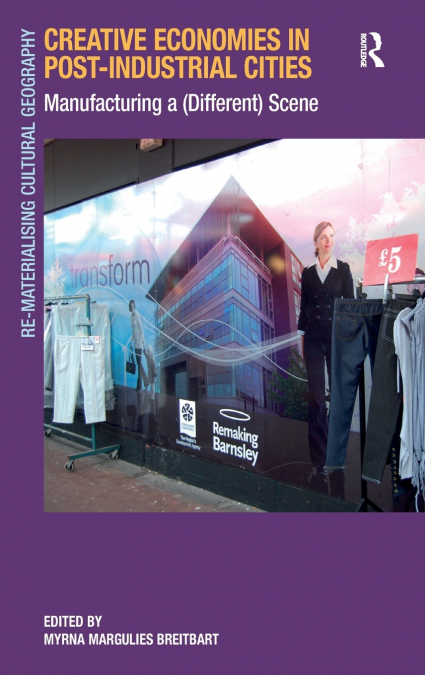
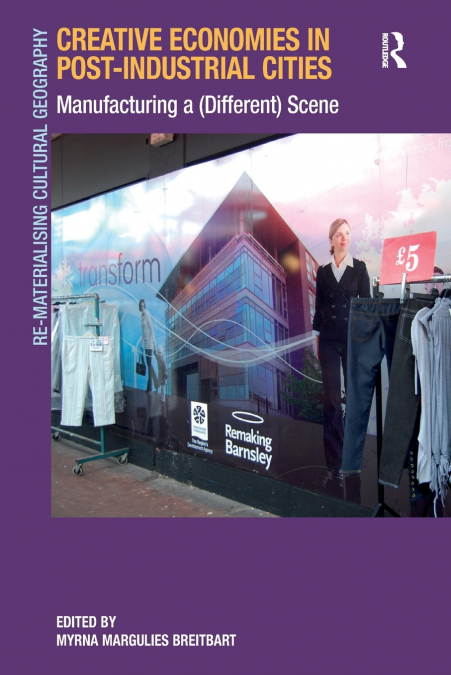
There has been much written on the new creative economy, but most work focuses on the so-called ’creative class,’ with lifestyle preferences that favor trendy new restaurants, mountain biking, and late night clubbing. This ’creative class,’ flagship cultural destinations, and other forms of commodity-driven cultural production, now occupy a relatively uncritical place in the revitalization schemes of most cities up and down the urban hierarchy. In contrast, this book focuses on small- to medium-size post-industrial cities in the US, Canada, and Europe that are trying to redress the effects of deindustrialization and economic decline through cultural economic regeneration. It examines how culture-infused economic opportunities are being incorporated into planning in distinct ways, largely under the radar, in many working class communities and considers to what extent places rooted in an industrial past are able to envisage a different economic future for themselves. It questions whether these visions replicate strategies employed in larger cities or put forth plans that better suit the unique histories and challenges of places that remain outside the global limelight. Exploring the intersection between a cultural and sustainable economy raises issues that are central to how urban regeneration is approached and neighborhood needs and assets are understood. Case studies in this book examine spaces and planning processes that hold the possibility of addressing inequality by forging new economic and social relationships and by embarking on more inclusive and collaborative experiments in culture-based economic development. These examples often focus on building upon the assets of existing residents and broadly define creativity and talent. They also acknowledge both the economic and non-monetary value of cultural practices. This book maintains a critical edge, incorporating left critiques of mainstream creative economy theories and practices into empirical case studies that depart from standard cultural economy discourse. Structural barriers and unequal distributions of power make the search for viable urban development alternatives especially difficult for smaller post-industrial cities and risk derailing even creative grassroots initiatives. While acknowledging these obstacles, this book moves beyond critique and focuses on how the growing economy surrounding culture, the arts, and ecological design can be harnessed and transformed to best benefit such cities and improve the quality of life for its residents.
Artículos relacionados

  • Tourism and Indigeneity in the Arctic
    This is the first book to exclusively address tourism and indigenous peoples in the circumpolar North. It examines how tourism in indigenous communities is influenced by academic and political discourses, and how these communities are influenced by tourism. The volume focuses on the ambivalence relating to tourism as a modern force within ethnic groups who are concerned with ma...
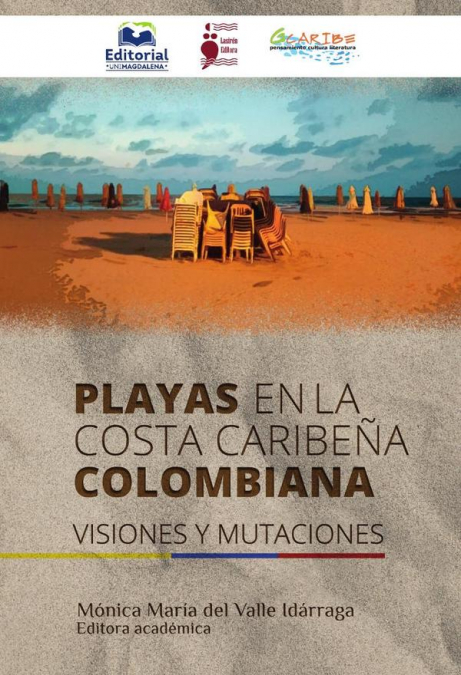
  • Playas en la costa caribeña colombiana
    Diva Marcela Piamba Tulcán / Eduardo Silva Peña / Eliana Díaz Muñoz / Juliana Javierre / Mónica María Del Valle Idárraga / Yessica Chiquillo
    En este libro, reconstruimos el surgimiento y transformación de varias playas del hoy llamado Caribe colombiano, como playas turísticas, entre 1950 y 1990. Mediante un análisis de archivos periodísticos y audiovisuales y de narraciones de Amira de la Rosa, Jaime Manrique, Fanny Buitrago, Tomás González, entre otros, desanudamos el cronotopo playas, tomando como foco Prado Mar y...
    Disponible

    20,75 €

  • Sustainable Water Management
    Miklas Scholz
    The collection is comprised of 40 reprinted articles grouped into six sections. Section 1 is concerned with the interface between climate change, water resources and public health. The water-related impacts of climate change on agriculture and, subsequently, on public health are also assessed. Agricultural water management is covered in Section 2. Novel water retention and nutr...
  • Sustainable Water Management
    Miklas Scholz
    The collection is comprised of 40 reprinted articles grouped into six sections. Section 1 is concerned with the interface between climate change, water resources and public health. The water-related impacts of climate change on agriculture and, subsequently, on public health are also assessed. Agricultural water management is covered in Section 2. Novel water retention and nutr...
  • Agricultural farming practices in the face of climate change
    Nougbodjingni Damien Makponse
    In recent years, the land pact region has experienced the vulnerability and adverse effects of climate change. This research analyses the adaptation strategies used by farmers to improve their living conditions. The methodology used consists of collecting, processing and analysing results based on 120 farmers in two districts of each commune. The field results reveal that the i...
    Disponible

    48,30 €

  • FACTEURS ENVIRONNEMENTAUX ET DÉVELOPPEMENT ÉCONOMIQUE
    Huda Abdul Rahim Abdul Kadir
    Les facteurs environnementaux qui nous entourent sont nombreux, les hommes, les animaux et les plantes en sont affectés, et affectent l’activité et la capacité de production, ainsi que l’économie de la vie qui en est affectée sous différents aspects. L’effet de ces facteurs se reflète clairement sur l’agriculture générale et comprend de nombreux types de produits, y compris les...
    Disponible

    54,38 €

Otros libros del autor

  • Creative Economies in Post-Industrial Cities
    Myrna Margulies Breitbart
    There has been much written on the new creative economy, but most work focuses on the so-called ’creative class,’ with lifestyle preferences that favor trendy new restaurants, mountain biking, and late night clubbing. This ’creative class,’ flagship cultural destinations, and other forms of commodity-driven cultural production, now occupy a relatively uncritical place in the re...