
Courage in the Democratic Polis

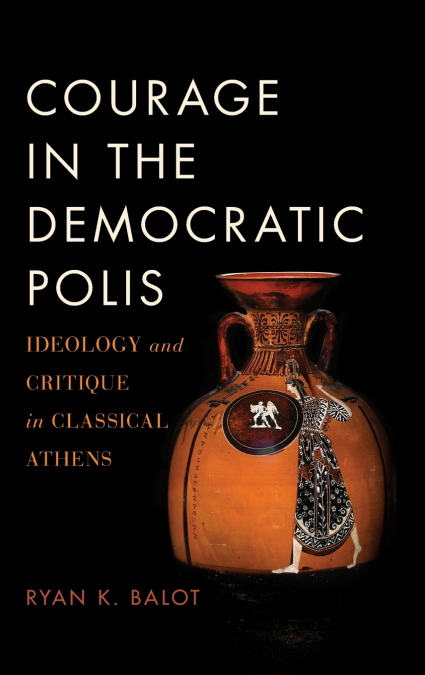
Courage in the Democratic Polis

Ryan K Balot

173,33 €
IVA incluido
Consulta disponibilidad
Editorial:
Oxford University Press
Año de edición:
2014
Materia
Filosofía occidental: antigua, hasta c. 500
ISBN:
9780199982158

Selecciona una librería:

  • Librería Samer Atenea
  • Librería Aciertas (Toledo)
  • Kálamo Books
  • Librería Perelló (Valencia)
  • Librería Elías (Asturias)
  • Donde los libros
  • Librería Kolima (Madrid)
  • Librería Proteo (Málaga)

In this careful and compelling study, Ryan K. Balot brings together political theory, classical history, and ancient philosophy in order to reinterpret courage as a specifically democratic virtue. Ranging from Thucydides and Aristophanes to the Greek tragedians and Plato, Balot shows that the ancient Athenians constructed a novel vision of courage that linked this virtue to fundamental democratic ideals such as freedom, equality, and practical rationality. The Athenian ideology of courage had practical implications for the conduct of war, for gender relations, and for the citizens' self-image as democrats. In revising traditional ideals, Balot argues, the Athenians reimagined the emotional and cognitive motivations for courage in ways that will unsettle and transform our contemporary discourses. Without losing sight of political tensions and practical conflicts, Balot illustrates the merits of the Athenian ideal, provocatively explaining its potential to enlarge our contemporary understandings of politics and ethics. The result is a remarkable interdisciplinary work that has significant implications for the theory and practice of democracy, both ancient and modern.


Artículos relacionados

  • The Nature of Things
    Lucretius Lucretius
    De rerum natura (On the Nature of Things) is a 1st century BC didactic poem by the Roman poet and philosopher Lucretius with the goal of explaining Epicurean philosophy to a Roman audience. Lucretius presents the principles of atomism; the nature of the mind and soul; explanations of sensation and thought; the development of the world and its phenomena; and explains a variety o...
  • Pompeii
    Fergus Mason
    Pompeii was one of most advanced cities of its time; it had a complex water system, gymnasium, and an amphitheater. Despite it's advancements, there was one thing it wasn't ready for: Mount Vesuvius—the volcano that led to its ultimate doom.  The 79 AD eruption of Mount Vesuvius was one of the worst disasters in all of European history. In a near instant, over 15,000 p...
    Disponible

    10,36 €

  • Middle Platonism and Neoplatonism, Volume 1
    Stephen Gersh
    'It is generally agreed that those types of philosophy that are loosely called ’Platonic’ and ’Neoplatonic’ played a crucial role in the history of European culture during the centuries between antiquity and the Renaissance. However, until now no scholar has attempted to describe the evolution of these forms of thought in a single comprehensive academic study.' So writes Stephe...
  • Middle Platonism and Neoplatonism, Volume 2
    Stephen Gersh
    It is generally agreed that those types of philosophy that are loosely called 'Platonic' and 'Neoplatonic' played a crucial role in the history of European culture during the centuries between antiquity and the Middle Ages. However, until now no scholar has attempted to describe the evolution of these forms of thought in a single comprehensive academic study. Middle Platonism a...
  • Porphyry’s Commentary on Ptolemy’s Harmonics
    Andrew Barker
    ...
    Disponible

    77,17 €

  • The Roots of Platonism
    John Dillon
    ...
    Disponible

    25,29 €