
Country Risk

Country Risk

Norbert Gaillard

132,63 €
IVA incluido
Consulta disponibilidad
Editorial:
Springer Nature B.V.
Año de edición:
2020
Materia
Economía internacional
ISBN:
9783030457877

Selecciona una librería:

  • Librería Samer Atenea
  • Librería Aciertas (Toledo)
  • Kálamo Books
  • Librería Perelló (Valencia)
  • Librería Elías (Asturias)
  • Donde los libros
  • Librería Kolima (Madrid)
  • Librería Proteo (Málaga)

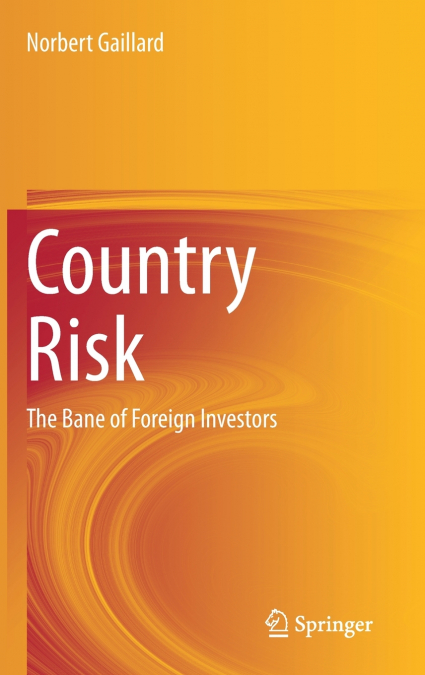
Country risk has been a key notion for economists, financiers, and investors. Norbert Gaillard defines this notion as 'any macroeconomic, microeconomic, financial, social, political, institutional, judiciary, climatic, technological, or sanitary risk that affects (or could affect) an investor in a foreign country. Damages may materialize in several ways: financial losses; threat to the safety of the investing company’s employees, clients, or consumers; reputational damage; or loss of a market or supply source.'Chapter 1 introduces the key concepts. Chapter 2 investigates how country risk has evolved and manifested since the advent of the Pax Britannica in 1816. It describes the international political and economic environment and identifies the main obstacles to foreign investment. Chapter 3 documents the numerous forms that country risk may take and provides illustrations of them. Seven broad components of country risk are scrutinized in turn: international political risks; domestic political and institutional risks; jurisdiction risks; macroeconomic risks; microeconomic risks; sanitary, health, industrial, and environmental risks; and natural and climate risks. Chapter 4 focuses on sovereign risk. It presents the rating methodologies used by four raters; next, it measures and compares their performance (i.e., their ability to forecast sovereign defaults). Chapter 5 studies the risks likely to affect exporters, importers, foreign creditors of corporate entities, foreign shareholders, and foreign direct investors. It presents the rating methodologies used by seven raters and measures their track records in terms of anticipating eight types of shocks that reflect the main components of country risk analyzed in Chapter 3.This book will be most relevant to graduate students in economics as well as professional economists and international investors.
Artículos relacionados

  • Regional Economic Integration and the Global Financial System
    Engin Sorhun / Hasan Dinçer / Unit Hacioglu
    In theory, regionalism and globalization are intended to be viewed as two separate concepts. However, as long as the approaches complement each other, considering these paradigms in tandem can have significantly positive effects on the overall status of the world economy. Regional Economic Integration and the Global Financial System addresses recent trends in regional integrati...
  • Handbook of Research on Impacts of International Business and Political Affairs on the Global Economy
    The growth of global commerce depends on many different factors and strategies in order for multinational corporations to efficiently compete and thrive in the international marketplace. In addition to business strategies, corporations must also be aware of political affairs that may impact their global economic status. The Handbook of Research on Impacts of International Busin...
  • NEXT CONVERGENCE
    MICHAEL SPENCE
    ...
    Disponible

    17,21 €

  • Interest and Prices
    Michael Woodford
    With the collapse of the Bretton Woods system, any pretense of a connection of the world’s currencies to any real commodity has been abandoned. Yet since the 1980s, most central banks have abandoned money-growth targets as practical guidelines for monetary policy as well. How then can pure 'fiat' currencies be managed so as to create confidence in the stability of national unit...
  • War, Wine, and Taxes
    John V.C. Nye
    In War, Wine, and Taxes, John Nye debunks the myth that Britain was a free-trade nation during and after the industrial revolution, by revealing how the British used tariffs-notably on French wine-as a mercantilist tool to politically weaken France and to respond to pressure from local brewers and others. The book reveals that Britain did not transform smoothly from a mercantil...
  • The Social Construction of Free Trade
    Francesco Duina
    This book offers a compelling new interpretation of the proliferation of regional trade agreements (RTAs) at the end of the twentieth century. Challenging the widespread assumption that RTAs should be seen as fundamentally similar economic initiatives to pursue free trade, Francesco Duina proposes that the world is reorganizing itself into regions that are highly distinctive an...
    Disponible

    54,25 €

Otros libros del autor

  • Country Risk
    Norbert Gaillard
    Country risk has been a key notion for economists, financiers, and investors. Norbert Gaillard defines this notion as 'any macroeconomic, microeconomic, financial, social, political, institutional, judiciary, climatic, technological, or sanitary risk that affects (or could affect) an investor in a foreign country. Damages may materialize in several ways: financial losses; threa...
    Disponible

    133,98 €

  • A Century of Sovereign Ratings
    Norbert Gaillard
    The financial difficulties experienced by Greece since 2009 serve as a reminder that countries (i.e., sovereigns) may default on their debt. Many observers considered the financial turmoil was behind us because major advanced countries had adopted stimulus packages to prevent banks from going bankrupt. However, there are rising doubts about the creditworthiness of several advan...
    Disponible

    123,69 €

  • When Sovereigns Go Bankrupt
    Norbert Gaillard
    The public debt crisis that Eurozone countries have experienced since 2010 has been accompanied by a resurgence of sovereign risk. Greece was obliged to restructure its debt in 2012. The credit position of even the wealthy countries is shakier than at any time since the Great Depression. Now more than ever it is essential to understand sovereign risk because the default of a co...
    Disponible

    66,80 €

  • A Century of Sovereign Ratings
    Norbert Gaillard
    The financial difficulties experienced by Greece since 2009 serve as a reminder that countries (i.e., sovereigns) may default on their debt. Many observers considered the financial turmoil was behind us because major advanced countries had adopted stimulus packages to prevent banks from going bankrupt. However, there are rising doubts about the credit...