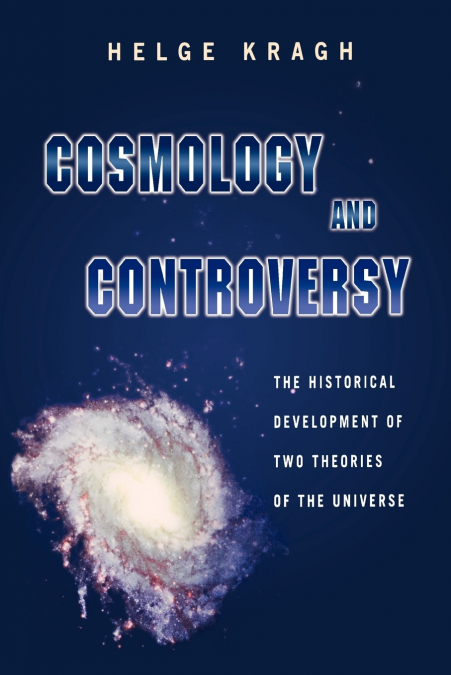

Cosmology and Controversy

Cosmology and Controversy

Cosmology and Controversy

Helge Kragh

84,75 €
IVA incluido
Disponible
Editorial:
Princeton University Press
Año de edición:
1999
Materia
Historia de la ciencia
ISBN:
9780691005461
84,75 €
IVA incluido
Disponible

Selecciona una librería:

  • Librería Samer Atenea
  • Librería Aciertas (Toledo)
  • Kálamo Books
  • Librería Perelló (Valencia)
  • Librería Elías (Asturias)
  • Donde los libros
  • Librería Kolima (Madrid)
  • Librería Proteo (Málaga)

For over three millennia, most people could understand the universe only in terms of myth, religion, and philosophy. Between 1920 and 1970, cosmology transformed into a branch of physics. With this remarkably rapid change came a theory that would finally lend empirical support to many long-held beliefs about the origins and development of the entire universe: the theory of the big bang. In this book, Helge Kragh presents the development of scientific cosmology for the first time as a historical event, one that embroiled many famous scientists in a controversy over the very notion of an evolving universe with a beginning in time. In rich detail he examines how the big-bang theory drew inspiration from and eventually triumphed over rival views, mainly the steady-state theory and its concept of a stationary universe of infinite age. In the 1920s, Alexander Friedmann and Georges Lemaître showed that Einstein’s general relativity equations possessed solutions for a universe expanding in time. Kragh follows the story from here, showing how the big-bang theory evolved, from Edwin Hubble’s observation that most galaxies are receding from us, to the discovery of the cosmic microwave background radiation. Sir Fred Hoyle proposed instead the steady-state theory, a model of dynamic equilibrium involving the continuous creation of matter throughout the universe. Although today it is generally accepted that the universe started some ten billion years ago in a big bang, many readers may not fully realize that this standard view owed much of its formation to the steady-state theory. By exploring the similarities and tensions between the theories, Kragh provides the reader with indispensable background for understanding much of today’s commentary about our universe.
Artículos relacionados

  • GRAVITY
    BRIAN CLEGG
    ...
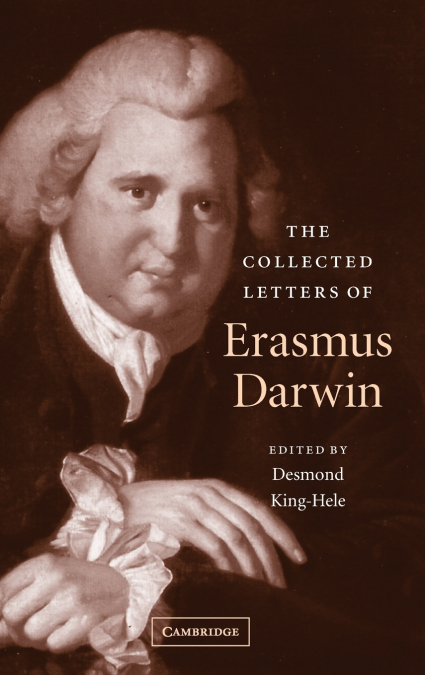
  • Collected Letters of Erasmus Darwin
    Erasmus Darwin
    ...
  • System
    Clifford Siskin
    ...
    Disponible

    23,67 €

  • The Science of Roman History
    Walter Scheidel
    How the latest cutting-edge science offers a fuller picture of life in Rome and antiquityThis groundbreaking book provides the first comprehensive look at how the latest advances in the sciences are transforming our understanding of ancient Roman history. Walter Scheidel brings together leading historians, anthropologists, and geneticists at the cutting edge of their fields, wh...
    Disponible

    36,21 €

  • Scouting and Scoring
    Christopher J. Phillips
    An in-depth look at the intersection of judgment and statistics in baseballScouting and scoring are considered fundamentally different ways of ascertaining value in baseball. Scouting seems to rely on experience and intuition, scoring on performance metrics and statistics. In Scouting and Scoring, Christopher Phillips rejects these simplistic divisions. He shows how both scouts...
    Disponible

    26,38 €

  • Osservazioni intorno alle vipere
    Francesco Redi
    Redi, con l’aiuto di una penna affilata, rompe gli schemi del suo tempo, sfidando le tradizione aristotelica e ponendo delle solide basi per la nascita della biologia sperimentale. In un connubio di rigore scientifico e eloquenza poetica, l’autore ci conduce attraverso un intricato labirinto di miti e leggende, illuminando la verità con la luce della ragione.  ...
    Disponible

    20,42 €

Otros libros del autor

  • Niels Bohr
    Helge Kragh
    Niels Bohr’s atomic theory of 1913 is one of the absolute highlights in the history of modern science. It was only with this work that physicists realized that quantum theory is an essential ingredient in atomic physics, and it was also only with this work that Rutherford’s nuclear model dating from 1911 was transformed into a proper theory of atomic structure. In a longer pers...
    Disponible

    148,27 €

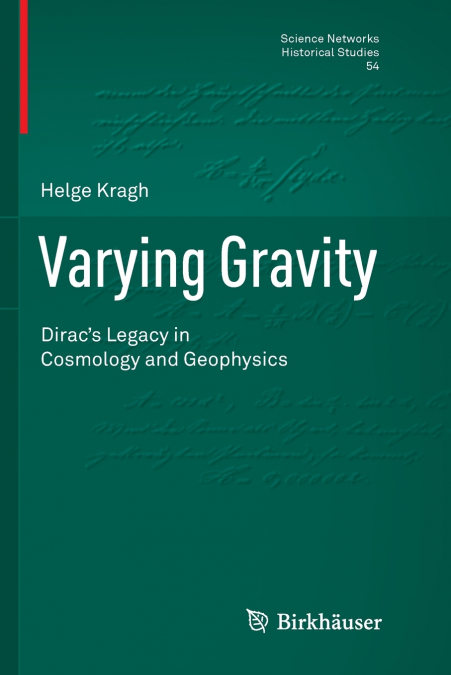
  • Varying Gravity
    Helge Kragh
    The main focus of this book is on the interconnection of two unorthodox scientific ideas, the varying-gravity hypothesis and the expanding-earth hypothesis. As such, it provides a fascinating insight into a nearly forgotten chapter in both the history of cosmology and the history of the earth sciences.The hypothesis that the force of gravity decreases over cosmic time was first...
    Disponible

    68,34 €

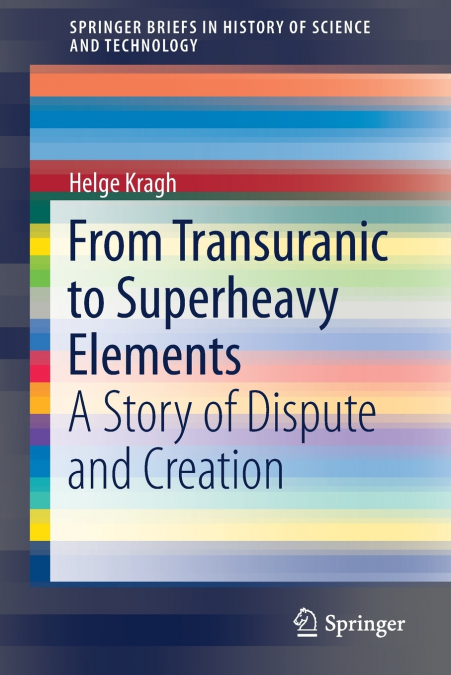
  • From Transuranic to Superheavy Elements
    Helge Kragh
    The story of superheavy elements  - those at the very end of the periodic table  - is not well known outside the community of heavy-ion physicists and nuclear chemists. But it is a most interesting story which deserves to be known also to historians, philosophers, and sociologists of science and indeed to the general public. This is what the present work aims at. It tells the s...
    Disponible

    85,56 €

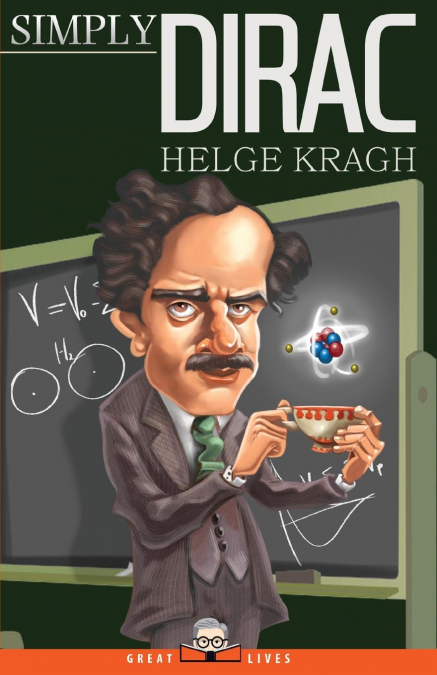
  • Simply Dirac
    Helge Kragh
    “What a fantastic entrée into the life of Paul Dirac and the exotic world of Quantum Mechanics, of which he was one of the great pioneers. With its cast of some of the most important scientists of the modern age, this is both an entertaining and an enlightening read.” —Michael White, Bestselling author of 39 books including Isaac Newton: The Last Sorcerer Paul Dirac (1902–1984)...
    Disponible

    7,95 €

  • Varying Gravity
    Helge Kragh
    The main focus of this book is on the interconnection of two unorthodox scientific ideas, the varying-gravity hypothesis and the expanding-earth hypothesis. As such, it provides a fascinating insight into a nearly forgotten chapter in both the history of cosmology and the history of the earth sciences.The hypothesis that the force of gravity decreases over cosmic time was first...
  • Quantum Generations
    Helge Kragh
    At the end of the nineteenth century, some physicists believed that the basic principles underlying their subject were already known, and that physics in the future would only consist of filling in the details. They could hardly have been more wrong. The past century has seen the rise of quantum mechanics, relativity, cosmology, particle physics, and solid-state physics, among ...
    Disponible

    92,04 €