 Librería Samer Atenea
 Kálamo Books
 Librería Elías (Asturias)
 Librería Kolima (Madrid)
 Librería Proteo (Málaga)
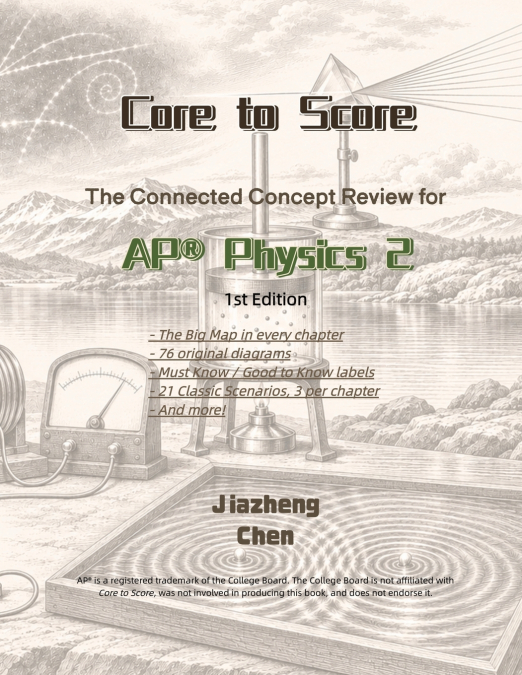
AP Physics 2 can feel like seven separate courses: gases and engines, electric fields, circuits, magnetism, mirrors and lenses, waves, and the physics of atoms and nuclei. The exam doesn’t treat them that way. A charged particle in a magnetic field is a circular-motion problem. A soap film’s colors follow the same path-difference rule as two loudspeakers. An atom’s energy levels are energies of an electron-nucleus system, built on the potential-energy idea you first met with a ball on a hill. Students who see these links can reason through unfamiliar questions. Students who memorized each unit on its own often can’t.Core to Score: The Connected Concept Review for AP® Physics 2 is built around those links. It covers every topic in the AP Physics 2 Course and Exam Description, in the course’s own order. Its seven chapters are numbered 9 through 15 to match the official units, from Thermodynamics to Modern Physics. Each chapter opens with the Big Map, a single concept map of the whole course. The map shows where you are, which ideas connect to other chapters, and what you’re bringing in from AP Physics 1.Inside every chapter:30-Second Versions that sum up each section in one paragraph, for previews and last-minute reviewMust Know and Good to Know labels, so you can tell the tested core from helpful extra detailCommon Misconception, Watch the Wording, and Word Roots boxes that target the errors that cost students pointsHow Do We Know? boxes on the experiments behind key ideas, from Joule’s work on heat to Millikan’s oil drops and the photoelectric effect, with ways to try a version in a school labOn the Exam boxes that show how each topic appears in multiple-choice questions and in the four free-response types: Mathematical Routines, Translation Between Representations, Experimental Design and Analysis, and Qualitative/Quantitative TranslationClear original figures: field-line maps, circuit diagrams, pressure-volume graphs, ray diagrams, interference patterns, and energy-level diagramsQuick Recall questions after every section, a Cumulative Check after every chapter, and three multi-part Classic Scenarios per chapter, each moving from qualitative reasoning to calculationThe back of the book helps you pull everything together. Putting It All Together follows four threads through all seven chapters: systems, interactions, conservation, and representations. It also includes Graphs You Must Recognize, a visual guide to the graph shapes the exam uses most. Appendix A explains the official equation sheet line by line. Appendix B is a quick guide to the science practices, with a Lab Graphs at a Glance table that shows how to linearize data from the course’s classic experiments. Appendix C is a Word Roots Index. A full Answers section and an Index complete the book.Calculations use g = 10 m/s² (every practice question that involves gravity states the value it uses), and the other constants come from the AP Physics 2 table of information. The chapter on the exam describes the format beginning in May 2027: 42 multiple-choice questions and 4 free-response questions.Use it as a companion while you take the course, as a review plan in the eight to ten weeks before the exam, or as a last-month sprint through the 30-Second Versions and One-Page Summaries. Whichever way you use it, you’ll finish with one connected picture of AP Physics 2, and that picture is what the exam rewards.AP® and Advanced Placement® are registered trademarks of the College Board, which was not involved in the production of, and does not endorse, this product.