Benedictus Müllner / Franciscus Sebald / Fridericus Fridl
 Librería Samer Atenea
 Kálamo Books
 Librería Elías (Asturias)
 Librería Kolima (Madrid)
 Librería Proteo (Málaga)
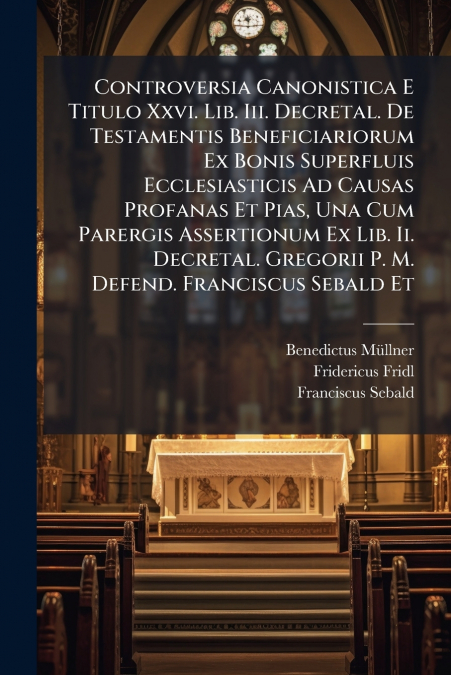
Controversia Canonistica E Titulo Xxvi. Lib. Iii. Decretal. De Testamentis Beneficiariorum Ex Bonis Superfluis Ecclesiasticis Ad Causas Profanas Et Pias, Una Cum Parergis Assertionum Ex Lib. Ii. Decretal. Gregorii P. M. Defend. Franciscus Sebald Et delves into specific controversies within Canon Law. Focusing on testaments of beneficiaries and the disposition of superfluous ecclesiastical goods for both secular and pious causes, this work examines assertions related to the Decretals of Gregory P.M. This historical text provides valuable insight into the intricacies of Canon Law and Church history, particularly concerning the management and distribution of church assets. Scholars and researchers interested in religious law, ecclesiastical history, and the legal frameworks of the Catholic Church will find this a compelling and informative resource.This work has been selected by scholars as being culturally important, and is part of the knowledge base of civilization as we know it. This work was reproduced from the original artifact, and remains as true to the original work as possible. Therefore, you will see the original copyright references, library stamps (as most of these works have been housed in our most important libraries around the world), and other notations in the work.This work is in the public domain in the United States of America, and possibly other nations. Within the United States, you may freely copy and distribute this work, as no entity (individual or corporate) has a copyright on the body of the work.As a reproduction of a historical artifact, this work may contain missing or blurred pages, poor pictures, errant marks, etc. Scholars believe, and we concur, that this work is important enough to be preserved, reproduced, and made generally available to the public. We appreciate your support of the preservation process, and thank you for being an important part of keeping this knowledge alive and relevant.