 Librería Samer Atenea
 Librería Aciertas (Toledo)
 Kálamo Books
 Librería Perelló (Valencia)
 Librería Elías (Asturias)
 Donde los libros
 Librería Kolima (Madrid)
 Librería Proteo (Málaga)
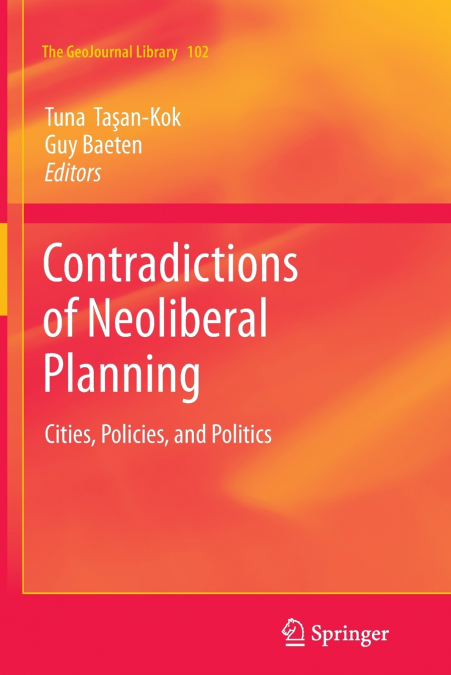
This book argues that the concepts of ’neoliberalism’ and ’neoliberalisation,’ while in common use across the whole range of social sciences, have thus far been generally overlooked in planning theory and the analysis of planning practice. Offering insights from papers presented during a conference session at a meeting of the Association of American Geographers in Boston in 2008 and a number of commissioned chapters, this book fills this significant hiatus in the study of planning. What the case studies from Africa, Asia, North-America and Europe included in this volume have in common is that they all reveal the uneasy cohabitation of ’planning’ - some kind of state intervention for the betterment of our built and natural environment - and ’neoliberalism’ - a belief in the superiority of market mechanisms to organize land use and the inferiority of its opposite, state intervention. Planning, if anything, may be seen as being in direct contrast to neoliberalism, as something that should be rolled back or even annihilated through neoliberal practice. To combine ’neoliberal’ and ’planning’ in one phrase then seems awkward at best, and an outright oxymoron at worst. To admit to the very existence or epistemological possibility of ’neoliberal planning’ may appear to be a total surrender of state planning to market superiority, or in other words, the simple acceptance that the management of buildings, transport infrastructure, parks, conservation areas etc. beyond the profit principle has reached its limits in the 21st century. Planning in this case would be reduced to a mere facilitator of ’market forces’ in the city, be it gentle or authoritarian. Yet in spite of these contradictions and outright impossibilities, planners operate within, contribute to, resist or temper an increasingly neoliberal mode of producing spaces and places, or the revival of profit-driven changes in land use. It is this contradiction between the serving of private profit-seeking interests while actually seeking the public betterment of cities that this volume has sought to describe, explore, analyze and make sense of through a set of case studies covering a wide range of planning issues in various countries. This book lays bare just how spatial planning functions in an age of market triumphalism, how planners respond to the overruling profit principle in land allocation and what is left of non-profit driven developments.