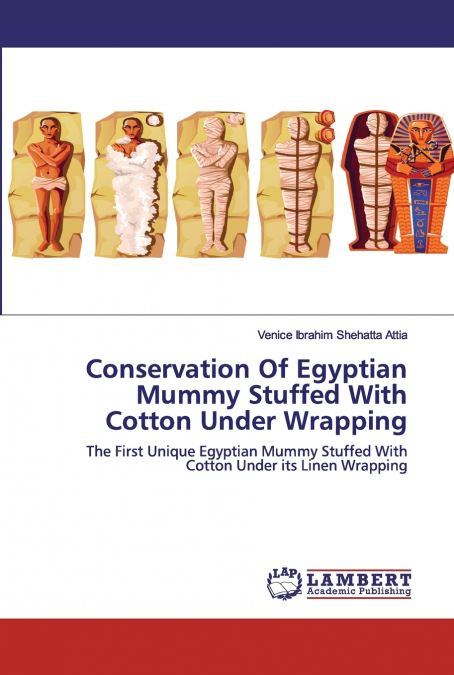

Conservation Of Egyptian Mummy Stuffed With Cotton Under Wrapping

Conservation Of Egyptian Mummy Stuffed With Cotton Under Wrapping

Venice Ibrahim Shehatta Attia

51,12 €
IVA incluido
Disponible
Editorial:
KS OmniScriptum Publishing
Año de edición:
2020
Materia
Filosofía occidental: antigua, hasta c. 500
ISBN:
9786202552097
51,12 €
IVA incluido
Disponible

Selecciona una librería:

  • Librería Samer Atenea
  • Librería Aciertas (Toledo)
  • Kálamo Books
  • Librería Perelló (Valencia)
  • Librería Elías (Asturias)
  • Donde los libros
  • Librería Kolima (Madrid)
  • Librería Proteo (Málaga)

An Egyptian mummy stuffed with crude cotton plant under its linen wrapping dating back to the late era, its detailed study yielded significant information and we can say as a great finding it may be considered as a discovery. Its study corrected historical facts concerning cotton plant in ancient Egypt, also the treatment and conservation processes revealed its aesthetic value , its investigation and conservation led to the correction of the information concerning cotton in ancient Egypt proving that cotton was well known,cultivated and used as a sort of plant fiber in textile but was less used than flax plant that produced linen fibers and also it se came in later times of ancient Egypt, thus its revolutionary modern industrial introduction in modern Egypt as well as importing new spices from India and other parts of the world was led by Mohamed Ali pasha the great in the beginning of the 19th century.
Artículos relacionados

  • The Nature of Things
    Lucretius Lucretius
    De rerum natura (On the Nature of Things) is a 1st century BC didactic poem by the Roman poet and philosopher Lucretius with the goal of explaining Epicurean philosophy to a Roman audience. Lucretius presents the principles of atomism; the nature of the mind and soul; explanations of sensation and thought; the development of the world and its phenomena; and explains a variety o...
  • Pompeii
    Fergus Mason
    Pompeii was one of most advanced cities of its time; it had a complex water system, gymnasium, and an amphitheater. Despite it's advancements, there was one thing it wasn't ready for: Mount Vesuvius—the volcano that led to its ultimate doom.  The 79 AD eruption of Mount Vesuvius was one of the worst disasters in all of European history. In a near instant, over 15,000 p...
    Disponible

    10,36 €

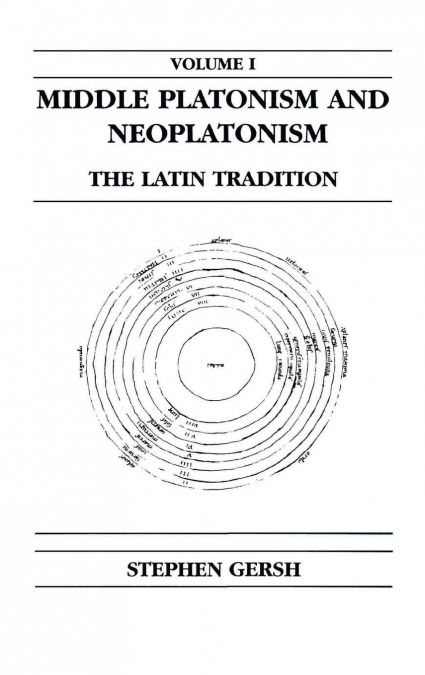
  • Middle Platonism and Neoplatonism, Volume 1
    Stephen Gersh
    'It is generally agreed that those types of philosophy that are loosely called ’Platonic’ and ’Neoplatonic’ played a crucial role in the history of European culture during the centuries between antiquity and the Renaissance. However, until now no scholar has attempted to describe the evolution of these forms of thought in a single comprehensive academic study.' So writes Stephe...
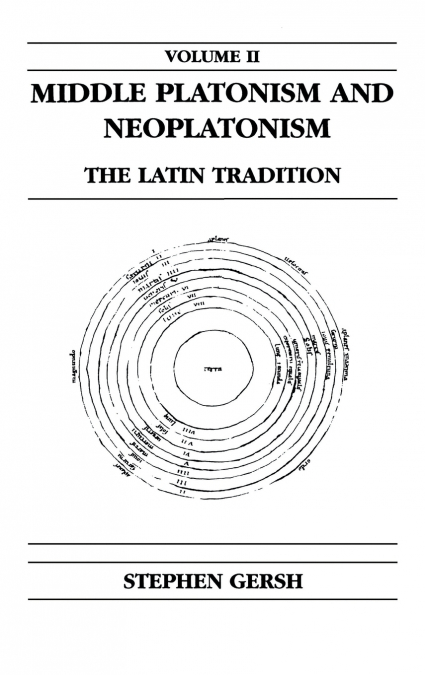
  • Middle Platonism and Neoplatonism, Volume 2
    Stephen Gersh
    It is generally agreed that those types of philosophy that are loosely called 'Platonic' and 'Neoplatonic' played a crucial role in the history of European culture during the centuries between antiquity and the Middle Ages. However, until now no scholar has attempted to describe the evolution of these forms of thought in a single comprehensive academic study. Middle Platonism a...
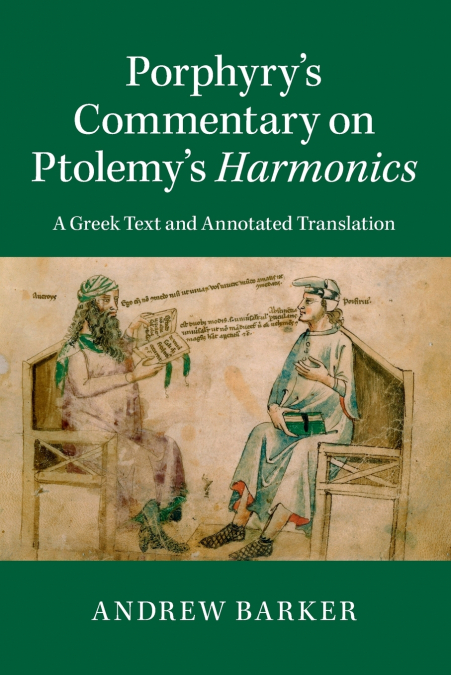
  • Porphyry’s Commentary on Ptolemy’s Harmonics
    Andrew Barker
    ...
    Disponible

    77,17 €

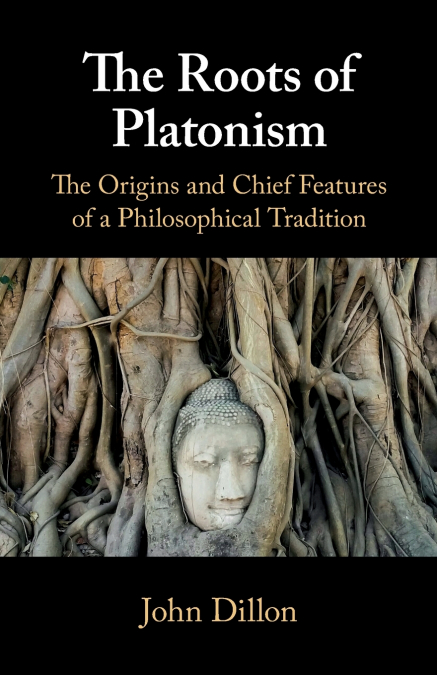
  • The Roots of Platonism
    John Dillon
    ...
    Disponible

    25,29 €

Otros libros del autor

  • Sedative Plants In Ancient Egypt
    Venice Ibrahim Shehatta Attia
    There is a lot and versatile evidences showing several kinds of sedative (narcotic) plants that was used in ancient Egypt. Egyptologists confirm making it clear that uses of narcotics varied from practical daily life uses (mood boost) to religious use (incense offered to the Gods), besides being mainly and widely used medically as a treatment of various ailments. Some reference...
    Disponible

    125,82 €