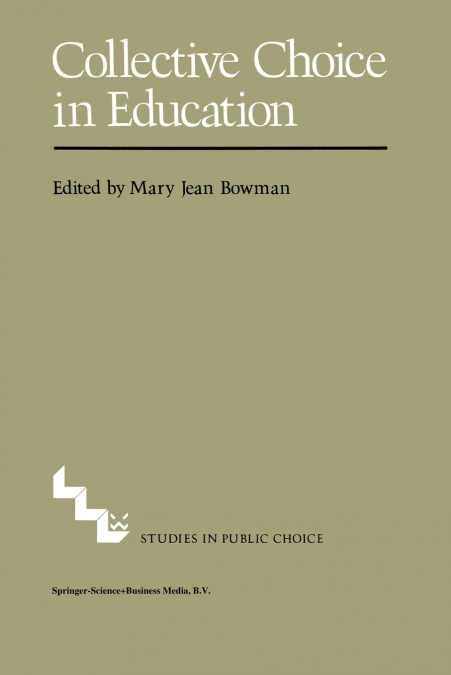
Collective Choice in Education

Collective Choice in Education

M.J. Bowman

48,06 €
IVA incluido
Disponible
Editorial:
Springer Nature B.V.
Año de edición:
2014
Materia
Educación pedagogía
ISBN:
9789400973992
48,06 €
IVA incluido
Disponible

Selecciona una librería:

  • Librería Samer Atenea
  • Librería Aciertas (Toledo)
  • Kálamo Books
  • Librería Perelló (Valencia)
  • Librería Elías (Asturias)
  • Donde los libros
  • Librería Kolima (Madrid)
  • Librería Proteo (Málaga)

The persistently increasing scale and complexity of government, of quasi­ public organizations, and of private organizations pose many problems in the economics of collective choice. Moreover, education as a quasi-public good has drawn ever more heavily on public budgets. Yet economic research into collective behavior with respect to education has been sparse (with the partial exception of recent work on teacher unions). In view of these trends, it was decided that the third conference under the Ford-sponsored UK. jUS. Pro­ gramme in the Economics of Education should make the high-risk effort of encouraging and bringing together studies relating to collective choice in education, with some emphasis on studies in educational finance. The con­ ference exploited opportunities for an exchange of ideas between economists in the United Kingdom and in the United States; there were special gains that could come from such an interchange. British and American economists do share a common inheritance that goes back to Benthamite utilitarianism and a common training in neo-classical economic theory even when one or both of these is challenged (which happens, of course, on both sides of the Atlantic). They share also a culture of political democracy despite important dissimilar­ ities in governmental structures and institutions. These commonalities and contrasts facilitate comparative testing of analyses developed in either setting.
Artículos relacionados

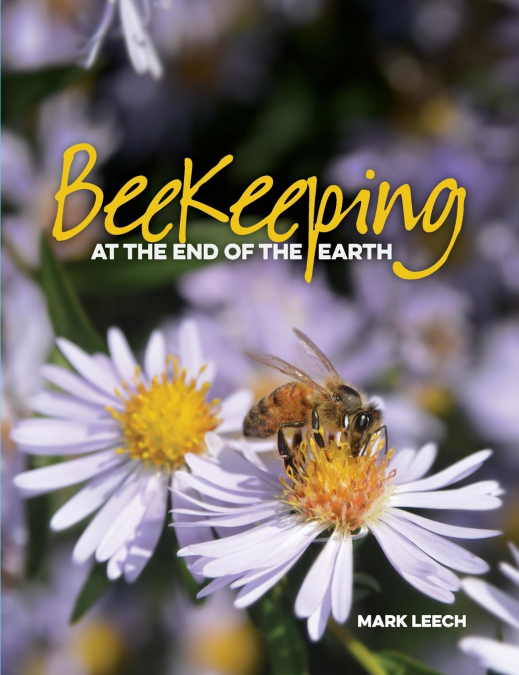
  • Beekeeping At The End Of The Earth
    Mark David Leech
    Beekeeping at the End of the Earth, an essential read for learning about beekeeping in a cool temperate climate with a focus on Tasmania our island home.  One hundred beekeepers one hundred different ways to keep bees.Beekeeping At The End Of The Earth is a practical insight into cool climate beekeeping with a focus on Tasmania, our island home.Richly illustrated with unique di...
    Disponible

    45,16 €

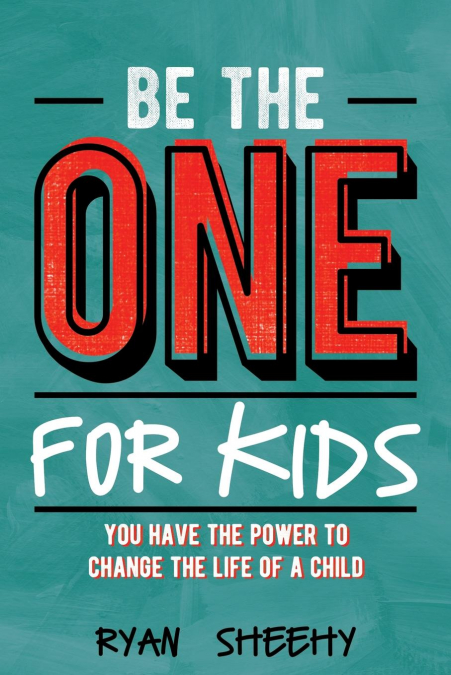
  • Be the One for Kids
    Ryan Sheehy
    One person can make a difference.That person can be you. “I want to show others that one person can make the difference in a child’s life. I want all educators, parents, coaches, and everyone in between to know they have power to Be the One for Kids.” —Ryan Sheehy If you ever feel like you’re all alone or think that no one gets you, just imagine how your students feel. Kids wan...
    Disponible

    27,99 €

  • Handbook of Research on E-Learning Standards and Interoperability
    As the e-learning industry continues to expand and the methods and tools necessary to create and maintain content and infrastructure applications become more complicated, there is an inherent need for these applications to interoperate and exchange data in order to better support the needs of learners and educators. Handbook of Research on E-Learning Standards and Interoperabil...
  • Teaching in the Knowledge Society
    Antonio Cartelli
    ...
  • Enhancing Learning Through Human Computer Interaction
    Elspeth McKay
    ...
  • Learning Objects for Instruction
    Pamela Taylor Northrup
    ...

Otros libros del autor

  • Collective Choice in Education
    M.J. Bowman
    The persistently increasing scale and complexity of government, of quasi­ public organizations, and of private organizations pose many problems in the economics of collective choice. Moreover, education as a quasi-public good has drawn ever more heavily on public budgets. Yet economic research into collective behavior with respect to education has bee...
    Disponible

    133,95 €

  • Collective Choice in Education
    M.J. Bowman
    The persistently increasing scale and complexity of government, of quasi­ public organizations, and of private organizations pose many problems in the economics of collective choice. Moreover, education as a quasi-public good has drawn ever more heavily on public budgets. Yet economic research into collective behavior with respect to education has bee...