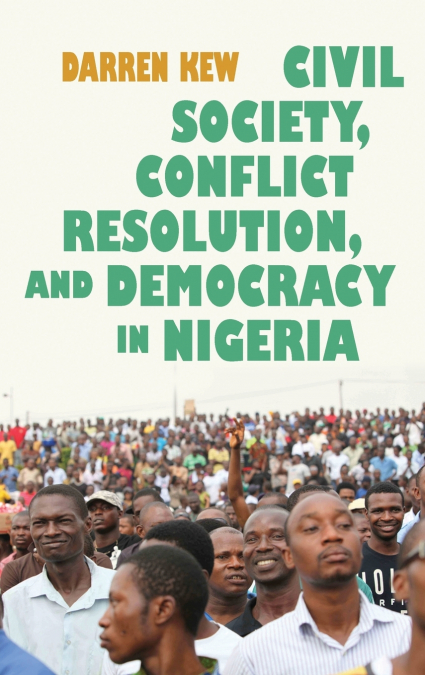
Civil Society, Conflict Resolution, and Democracy in Nigeria

Civil Society, Conflict Resolution, and Democracy in Nigeria

Darren Kew

106,39 €
IVA incluido
Consulta disponibilidad
Editorial:
Longleaf on behalf of Syracuse Univ Press
Año de edición:
2016
Materia
Estructuras políticas: democracia
ISBN:
9780815634584

Selecciona una librería:

  • Librería Desdémona
  • Librería Samer Atenea
  • Librería Aciertas (Toledo)
  • Kálamo Books
  • Librería Perelló (Valencia)
  • Librería Elías (Asturias)
  • Donde los libros
  • Librería Kolima (Madrid)
  • Librería Proteo (Málaga)

African nations have watched the recent civic dramas of the Arab Spring and Occupy Wall Street asking if they too will see similar civil society actions in their own countries. Nigeria-Africa’s most populous nation-has long enjoyed one of the continent’s most vibrant civil society spheres, which has been instrumental in political change. Initially viewed as contributing to democracy’s development, however, civil society groups have come under increased scrutiny by scholars and policymakers. Do some civil society groups promote democracy more effectively than others? And if so, which ones, and why? By examining the structure, organizational cultures, and methods of more than one hundred Nigerian civil society groups, Kew finds that the groups that best promote democratic development externally are themselves internally democratic. Specifically, the internally democratic civil society groups build more sustainable coalitions to resist authoritarian rule; support and influence political parties more effectively; articulate and promote public interests in a more negotiable fashion; and, most importantly, inculcate democratic norms in their members, which in turn has important democratizing impacts on national political cultures and institutions. Further, internally democratic groups are better able to resolve ethnic differences and ethnic-based tensions than their undemocratically structured peers. This book is a deeply comprehensive account of Nigerian civil society groups in the late twentieth and early twenty-first centuries. Kew blends democratic theory with conflict resolution methodologies to argue that the manner in which groups-and states-manage internal conflicts provides an important gauge as to how democratic their political cultures are. The conclusions will allow donors and policymakers to make strategic decisions in their efforts to build a democratic society in Nigeria and other regions.


Artículos relacionados

  • The Common Lot
    David Grant
    The first randomly-selected representatives of the Citizen House convenes. But just because it is proportionally representative of all willing and able citizens does not mean that these new representatives are well-suited.The only reason that Cathy Gresham has accepted her selection is because her politically engaged aunt pushed her into it. If it were up to Cathy she’d be spen...
  • Dare to Say It
    Sr Michael Der Manouel
    This book is an examination of where I and many people think we are going directionally as a country and feel that we finally have a leader in President Trump, who will not be intimidated or forced to abandon his beliefs by being bullied and intimidated by the liberal left, who have forced many of us to alter our beliefs. It is time for someone to speak out and be politically i...
  • Argumentos de filosofía política de la tercera y cuarta transformaciones de México. Una aproximación interdisciplinar
    Ana Paola Tiro Chagoyán / Virginia Aspe Armella
    Presentamos al lector el tercero de los tres libros que fueron resultado del proyecto de investigación semilla Fondo Fomento a la Investigación de la Universidad Panamericana que en nuestro caso fue titulado Argumentos de filosofía política de las cuatro transformaciones de México, etapa primera, la Ilustración mexicana de los siglos XVIII y primeros años del XIX, la Independen...
    Disponible

    30,68 €

  • Making Democracy Fun
    Josh A. Lerner
    ...
    Disponible

    33,87 €

  • Resist Turbulent Times
    Verda Harris-Olayinka
    Resist Turbulent Times is for Everyday People and College students (who are also Everyday Ppl) - and their professors who assign textbooks for their students.Verda H. Olayinka followed the advice of noted Kemetic (African) American visionary, Harold Cruse who advised theCultural Intellectual to 'Synthesize a Black Social Science methodology in the process of developing a functi...
    Disponible

    16,64 €

  • By Executive Order
    Andrew Rudalevige
    How the executive branch-not the president alone-formulates executive orders, and how this process constrains the chief executive’s ability to act unilaterallyThe president of the United States is commonly thought to wield extraordinary personal power through the issuance of executive orders. In fact, the vast majority of such orders are proposed by federal agencies and shaped ...
    Disponible

    43,00 €