Chris Webster / Dr Gianfranco Conti
 Librería Samer Atenea
 Kálamo Books
 Librería Elías (Asturias)
 Librería Kolima (Madrid)
 Librería Proteo (Málaga)
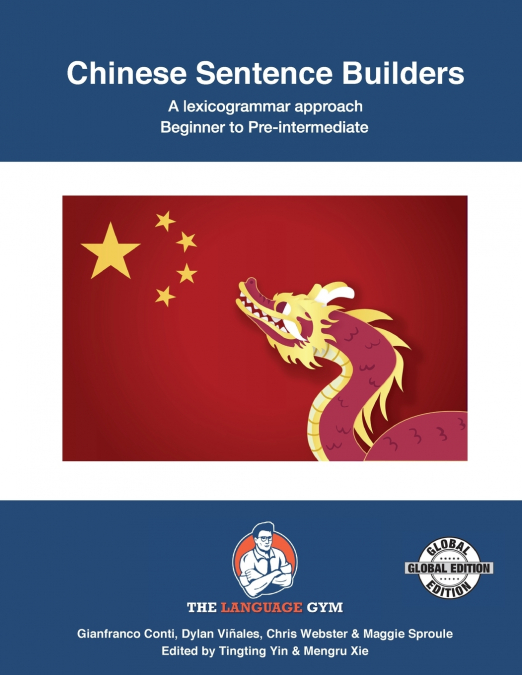
Chinese Sentence Builders is a workbook aimed at beginner to pre-intermediate students co-authored by 3 modern languages educators with over 50 years of extensive classroom experience in China, the UK and internationallyThis ’no-frills’ book contains 19 units of work on very popular themes, jam-packed with graded vocabulary-building, reading, translation, retrieval practice and writing activities. Key vocabulary, lexical patterns and structures are recycled and interleaved throughout.Each unit includes:a sentence builder modelling the target constructions;a set of vocabulary building activities which reinforce the material;a set of narrow reading texts exploited through a range of tasks focusing on both the meaning and structural levels of the text;a set of translation tasks aimed at consolidation through retrieval practice;a set of writing tasks targeting essential writing micro-skills such as spelling, functional and positional processing, editing and communication of meaning.Alongside the macro-units you will find:grammar units: one or two pages of activities occurring at regular intervals. They explicitly focus on key grammar structures which enhance the generative power of the constructions in the sentence builders. At this level they mainly concern themselves with full conjugations of key verbs, with agreement and preposition usage. Note that these units recycle the same verbs many times over by revisiting at regular intervals but in different linguistic contexts;question-skills units: one or two pages on understanding and creating questions. These micro-units too occur at regular intervals in the book, so as to recycle the same question patterns in different linguistic contexts;revision quickies: these are retrieval practice tasks aimed at keeping the previously learnt vocabulary alive. These too occur at regular intervals;self-tests: these occur at the end of the book. They are divided into two sections, one for less confident and one for more confident learnersBased on the Extensive Processing Instruction (E.P.I.) principle that learners learn best from comprehensible and highly patterned input flooded with the target linguistic features, the authors have carefully designed each and every text and activity to enable the student to process and produce each item many times over.