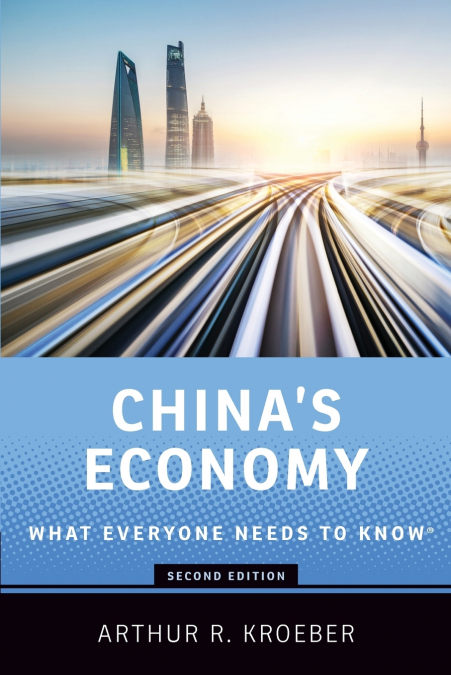

China’s Economy

China’s Economy

Arthur R. Kroeber

20,05 €
IVA incluido
Disponible
Editorial:
Oxford University Press
Año de edición:
2020
Materia
Economía internacional
ISBN:
9780190946463
20,05 €
IVA incluido
Disponible

Selecciona una librería:

  • Librería Samer Atenea
  • Librería Aciertas (Toledo)
  • Kálamo Books
  • Librería Perelló (Valencia)
  • Librería Elías (Asturias)
  • Donde los libros
  • Librería Kolima (Madrid)
  • Librería Proteo (Málaga)

China’s economic growth has been revolutionary, and is the foundation of its increasingly prominent role in world affairs. It is the world’s second biggest economy, the largest manufacturing and trading nation, the consumer of half the world’s steel and coal, the biggest source of international tourists, and one of the most influential investors in developing countries from southeast Asia to Africa to Latin America. Multinational companies make billions of dollars in profits in China each year, while traders around the world shudder at every gyration of the country’s unruly stock markets. Perhaps paradoxically, its capitalist economy is governed by an authoritarian Communist Party that shows no sign of loosening its grip. China is frequently in the news, whether because of trade disputes, the challenges of its Belt and Road initiative for global infrastructure, or its increasing military strength. China’s political and technological challenges, created by a country whose political system and values differ dramatically from most of the other major world economies, creates uncertainty and even fear. China’s Economy: What Everyone Needs to Know� is a concise introduction to the most astonishing economic and political story of the last three decades. Arthur Kroeber enhances our understanding of China’s changes and their implications. Among the essential questions he answers are: How did China grow so fast for so long? Can it keep growing and still solve its problems of environmental damage, fast-rising debt and rampant corruption? How long can its vibrant economy co-exist with the repressive one-party state? How do China’s changes affect the rest of the world? This thoroughly revised and updated second edition includes a comprehensive discussion of the origins and development of the US-China strategic rivalry, including Trump’s trade war and the race for technological supremacy. It also explores the recent changes in China’s political system, reflecting Xi Jinping’s emergence as the most powerful leader since Mao Zedong. It includes insights on changes in China’s financial sector, covering the rise and fall of the shadow banking sector, and China’s increasing integration with global financial markets. And it covers China’s rapid technological development and the rise of its global Internet champions such as Alibaba and Tencent.
Artículos relacionados

  • Regional Economic Integration and the Global Financial System
    Engin Sorhun / Hasan Dinçer / Unit Hacioglu
    In theory, regionalism and globalization are intended to be viewed as two separate concepts. However, as long as the approaches complement each other, considering these paradigms in tandem can have significantly positive effects on the overall status of the world economy. Regional Economic Integration and the Global Financial System addresses recent trends in regional integrati...
  • Handbook of Research on Impacts of International Business and Political Affairs on the Global Economy
    The growth of global commerce depends on many different factors and strategies in order for multinational corporations to efficiently compete and thrive in the international marketplace. In addition to business strategies, corporations must also be aware of political affairs that may impact their global economic status. The Handbook of Research on Impacts of International Busin...
  • NEXT CONVERGENCE
    MICHAEL SPENCE
    ...
    Disponible

    17,21 €

  • Interest and Prices
    Michael Woodford
    With the collapse of the Bretton Woods system, any pretense of a connection of the world’s currencies to any real commodity has been abandoned. Yet since the 1980s, most central banks have abandoned money-growth targets as practical guidelines for monetary policy as well. How then can pure 'fiat' currencies be managed so as to create confidence in the stability of national unit...
  • War, Wine, and Taxes
    John V.C. Nye
    In War, Wine, and Taxes, John Nye debunks the myth that Britain was a free-trade nation during and after the industrial revolution, by revealing how the British used tariffs-notably on French wine-as a mercantilist tool to politically weaken France and to respond to pressure from local brewers and others. The book reveals that Britain did not transform smoothly from a mercantil...
  • The Social Construction of Free Trade
    Francesco Duina
    This book offers a compelling new interpretation of the proliferation of regional trade agreements (RTAs) at the end of the twentieth century. Challenging the widespread assumption that RTAs should be seen as fundamentally similar economic initiatives to pursue free trade, Francesco Duina proposes that the world is reorganizing itself into regions that are highly distinctive an...
    Disponible

    54,25 €