
China Triangle

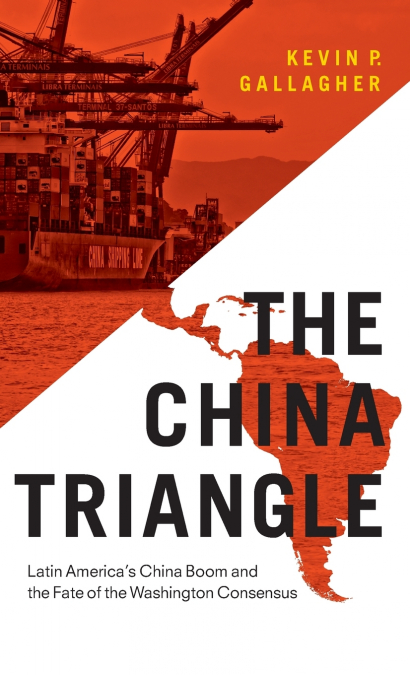
China Triangle

Kevin P. Gallagher

27,01 €
IVA incluido
Consulta disponibilidad
Editorial:
Oxford University Press
Año de edición:
2016
Materia
Economía internacional
ISBN:
9780190246730

Selecciona una librería:

  • Librería Samer Atenea
  • Librería Aciertas (Toledo)
  • Kálamo Books
  • Librería Perelló (Valencia)
  • Librería Elías (Asturias)
  • Donde los libros
  • Librería Kolima (Madrid)
  • Librería Proteo (Málaga)

Since 1980, China has evolved from a poor and mostly rural society into one of the largest economies in the world. As it grew into a major industrial power, it demanded enormous amounts of steel for new factories and cities, copper for electronic wires, petroleum for cars and manufacturing plants, and soybeans and cattle to feed its workers. By the 1990s, many Latin American countries were riding China’s coattails and beginning to prosper from the new demand. Ever since China entered the World Trade Organization at the turn of the century, Latin America supplied China with more and more of the primary commodities it needs and more. That in turn has produced one the most impressive periods of economic growth on the continent in fifty years. And it was more evenly spread too - a region infamous for its extreme inequality saw it decline by a couple of percentage points over the course of the era. In The China Triangle, Kevin P. Gallagher traces the development of the China-Latin America trade over time and covers how it has affected the centuries-old (and highly unequal) US-Latin American relationship. He argues that despite these opportunities Latin American nations have little to show for riding the coattails of the ’China Boom’ and now face significant challenges in the next decades as China’s economy slows down and shifts more toward consumption and services. While the Latin American region saw significant economic growth due to China’s rise over the past decades, Latin Americans saved very little of the windfall profits it earned even as the region saw a significant hollowing of its industrial base. What is more, commodity-led growth during the China boom reignited social and environmental conflicts across the region. Scholars and reporters have covered the Chinese expansion into East Asia, Southeast Asia, Australasia, Africa, the US, and Europe. Yet China’s penetration Latin America is as little understood as it is significant-especially for America given its longstanding ties to the region. Gallagher provides a clear overview of China’s growing economic ties with Latin America and points to ways that Latin American nations, China, and even the United States can act in order to make the next decades of China-Latin America economic activity more prosperous for all involved.
Artículos relacionados

  • Regional Economic Integration and the Global Financial System
    Engin Sorhun / Hasan Dinçer / Unit Hacioglu
    In theory, regionalism and globalization are intended to be viewed as two separate concepts. However, as long as the approaches complement each other, considering these paradigms in tandem can have significantly positive effects on the overall status of the world economy. Regional Economic Integration and the Global Financial System addresses recent trends in regional integrati...
  • Handbook of Research on Impacts of International Business and Political Affairs on the Global Economy
    The growth of global commerce depends on many different factors and strategies in order for multinational corporations to efficiently compete and thrive in the international marketplace. In addition to business strategies, corporations must also be aware of political affairs that may impact their global economic status. The Handbook of Research on Impacts of International Busin...
  • NEXT CONVERGENCE
    MICHAEL SPENCE
    ...
    Disponible

    17,21 €

  • Interest and Prices
    Michael Woodford
    With the collapse of the Bretton Woods system, any pretense of a connection of the world’s currencies to any real commodity has been abandoned. Yet since the 1980s, most central banks have abandoned money-growth targets as practical guidelines for monetary policy as well. How then can pure 'fiat' currencies be managed so as to create confidence in the stability of national unit...
  • War, Wine, and Taxes
    John V.C. Nye
    In War, Wine, and Taxes, John Nye debunks the myth that Britain was a free-trade nation during and after the industrial revolution, by revealing how the British used tariffs-notably on French wine-as a mercantilist tool to politically weaken France and to respond to pressure from local brewers and others. The book reveals that Britain did not transform smoothly from a mercantil...
  • The Social Construction of Free Trade
    Francesco Duina
    This book offers a compelling new interpretation of the proliferation of regional trade agreements (RTAs) at the end of the twentieth century. Challenging the widespread assumption that RTAs should be seen as fundamentally similar economic initiatives to pursue free trade, Francesco Duina proposes that the world is reorganizing itself into regions that are highly distinctive an...
    Disponible

    54,25 €

Otros libros del autor

  • Putting Development First
    Kevin P. Gallagher
    This book examines how far the economic forces and rules that govern the global economy are shrinking the 'policy space' available to developing countries in constructing policies to raise living standards. The contributors analyze what room for movement developing countries still have, despite global macro-economic realities, IMF/World Bank policies, and the trade rules regime...
    Disponible

    61,42 €