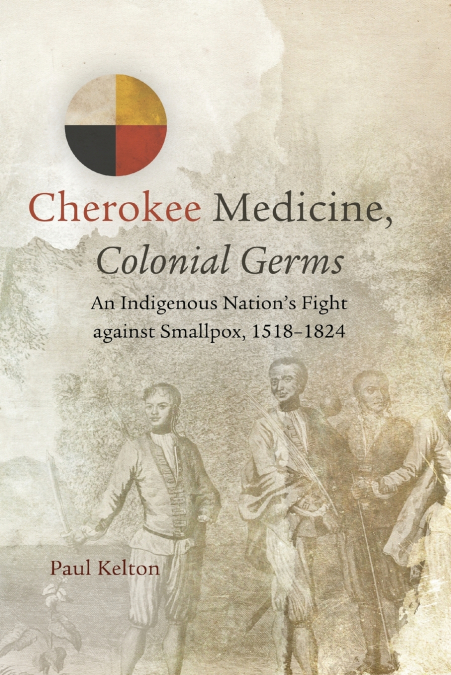

Cherokee Medicine, Colonial Germs

Cherokee Medicine, Colonial Germs

Cherokee Medicine, Colonial Germs

Paul Kelton

35,28 €
IVA incluido
Disponible
Editorial:
University of Oklahoma Press
Año de edición:
2018
Materia
Historia de América
ISBN:
9780806160986
35,28 €
IVA incluido
Disponible

Selecciona una librería:

  • Librería Samer Atenea
  • Librería Aciertas (Toledo)
  • Kálamo Books
  • Librería Perelló (Valencia)
  • Librería Elías (Asturias)
  • Donde los libros
  • Librería Kolima (Madrid)
  • Librería Proteo (Málaga)

How smallpox, or Variola, caused widespread devastation during the European colonization of the Americas is a well-known story. But as historian Paul Kelton informs us, that’s precisely what it is: a convenient story. In Cherokee Medicine, Colonial Germs Kelton challenges the “virgin soil thesis,” or the widely held belief that Natives’ lack of immunities and their inept healers were responsible for their downfall. Eschewing the metaphors and hyperbole routinely associated with the impact of smallpox, he firmly shifts the focus to the root cause of indigenous suffering and depopulation—colonialism writ large; not disease.Kelton’s account begins with the long, false dawn between 1518 and the mid-seventeenth century, when sporadic encounters with Europeans did little to bring Cherokees into the wider circulation of guns, goods, and germs that had begun to transform Native worlds. By the 1690s English-inspired slave raids had triggered a massive smallpox epidemic that struck the Cherokees for the first time. Through the eighteenth century, Cherokees repeatedly responded to real and threatened epidemics—and they did so effectively by drawing on their own medicine. Yet they also faced terribly destructive physical violence from the British during the Anglo-Cherokee War (1759–1761) and from American militias during the Revolutionary War. Having suffered much more from the scourge of war than from smallpox, the Cherokee population rebounded during the nineteenth century and, without abandoning Native medical practices and beliefs, Cherokees took part in the nascent global effort to eradicate Variola by embracing vaccination.A far more complex and nuanced history of Variola among American Indians emerges from these pages, one that privileges the lived experiences of the Cherokees over the story of their supposedly ill-equipped immune systems and counterproductive responses. Cherokee Medicine, Colonial Germs shows us how Europeans and their American descendants have obscured the past with the stories they left behind, and how these stories have perpetuated a simplistic understanding of colonialism. 3
Artículos relacionados

  • Pan-Africanism and Education
    Kenneth J. King / Kenneth JKing
    This is an analysis of the complex links between Black America and Africa in the period of 1880 to 1945. It examines an extended white attempt to pattern politics and education in colonial Africa upon the example of the U.S. South. This export of United States race relations to Africa was resisted by Black intellectuals in the United States and many of the early nationalists in...
    Disponible

    24,60 €

  • The Native American Cookbook Recipes From Native American Tribes
    G.W. Mullins
    Light Of The Moon Publishing along with Author G.W. Mullins and Illustrator / Artist C.L. Hause have joined together to explore Native American Indian Cooking.  More than just a cookbook, this Native American recipe collection offers a look into a forgotten past.  'The Native American Cookbook Recipes From Native American Tribes,' offers a large collection of recipes from and i...
    Disponible

    24,56 €

  • A Public Spirit
    George H. Atkinson
    George Henry Atkinson (1819-89) was a son of New England who arrived in the Oregon Territory in 1848, sent by the American Home Missionary Society. Although his commission from the Society specified that his work was to be ecclesiastical and educational, he took an approach to that assignment which went well beyond his mandate. Well-informed and energetic, he made an impact on ...
    Disponible

    10,45 €

  • North Carolina Women of the Confederacy
    Lucy London Anderson
    Long out of print, this volume of recollections, stories, and verse provides a glimpse of women's lives on the home front-and sometimes in the thick of battle-during the War between the States. Nearly fifty years after the American Civil War, Lucy Worth London Anderson (Mrs. John Huske Anderson) of Fayetteville, N.C., compiled one of the first memorial collections honoring the...
    Disponible

    17,20 €

  • Freedom by a Thread
    Freedom by a Thread: The History of Quilombos in Brazil brings together some of the best scholars in the world working on the history of quilombos (maroon societies) in Brazil from a variety of perspectives and approaches. Over 40 percent of the total volume of captive Africans arrived in Brazil during a 400-year period of legal and contraband transatlantic slaving. If slavery ...
    Disponible

    36,71 €

  • Nashville Baseball History
    Bill Traughber
    Nashville is a Big League city despite never having been home to a major league team. From the Civil War era, to star-studded exhibitions, to outstanding Negro Leagues teams, to some of the great minor league franchises of all time, few cities have as rich a baseball tradition as Nashville, Tennessee.Nashville sports historian Bill Traughber, who has been writing about baseball...
    Disponible

    13,15 €