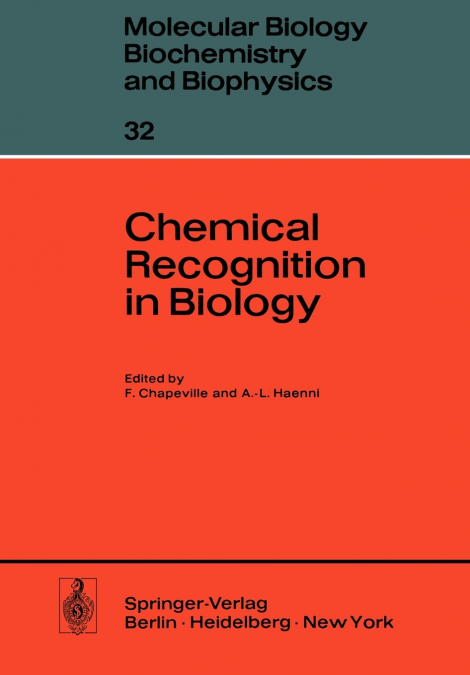

Chemical Recognition in Biology

Chemical Recognition in Biology


133,19 €
IVA incluido
Disponible
Editorial:
Springer Nature B.V.
Año de edición:
2011
Materia
Zoología y ciencias animales
ISBN:
9783642815058
133,19 €
IVA incluido
Disponible

Selecciona una librería:

  • Librería Samer Atenea
  • Librería Aciertas (Toledo)
  • Kálamo Books
  • Librería Perelló (Valencia)
  • Librería Elías (Asturias)
  • Donde los libros
  • Librería Kolima (Madrid)
  • Librería Proteo (Málaga)

Studies of chemical recognition in biology were initiated about half a century ago with the flrst kinetic data obtained on enzyme catalysis and inhibition. They led to a rather static representation of the recognition process illustrated by the lock and key model that still continues to influence our overall image of recognition and its specificity. In several cases, crystallographic studies of enzyme-substrate complexes have supported this model. Indeed, in a crystallized ligand-enzyme complex, a close fltting is observed between the active center of the enzyme and the functional groups of the ligand. How­ ever, this does not necessarily result from a direct recognition process between rigid structures, but may result from a progressive adaptation during which the initial struc­ tures of the enzyme and the ligand are modified (induced-flt mechanism). Recently, a great deal of work has been devoted to the study of recognition in more complex systems such as the replication or the translation machin~ries; clearly, the extraordinary precision of such systems cannot be explained solely in terms of physical matching between enzymes and their substrates. This has led to a noticeable change of perspective in these areas. As a result of the new kinetic viewpoint, one rather focuses on the time-course of the processes, on the kinetic balance between steps of the reaction, on the energy-accuracy relationships and on the strategies which permit the achievement of high precision using relatively error-prone components in an appropriate dynamic interplay.

Artículos relacionados

  • Animaltown
    Urban space constitutes a place where people and animals live together in close proximity with each other, creating changing landscapes of co-existence, conflict, mutual dependencies and exploitation. The medieval animals found in the articles of Animaltown: Beasts in Medieval Urban Space, appear in text and image, as well as archaeological find materials in the form of butcher...
    Disponible

    109,24 €

  • Pleasurable Kingdom
    Jonathan Balcombe
    Pleasurable Kingdom presents new evidence that animals--like humans--enjoy themselves. From birds to baboons, insects to iguanas, animals feel good thanks to play, sex, touch, food, anticipation, comfort, aesthetics, and more. Combining rigorous evidence, elegant argument and amusing anecdotes, leading animal behavior researcher Jonathan Balcombe shows that the possibility of p...
    Disponible

    18,96 €

  • SECOND NATURE
    Jonathan Balcombe
    ...
    Disponible

    16,52 €

  • Experimental Zoology
    Manisha R Gejage / Ramesh M Gejage
    The goal of the book is to present the practical knowledge of Zoology. Animal diversity, venomous and non-venomous snakes, study of birds, brain of fowl and hyoid apparatus, sclerotic plates, pecten and collumella of fowl, scales of fishes, biochemical tests, activity of salivary amylase, estimation of total protein and lipid, DNA isolation and estimation of uric acid are given...
  • TOXICOLOGY
    M A SUBRAMANIAN
    In an era defined by burgeoning human populations, rampant industrialization, cutting-edge technological progress, and expanding urban landscapes, the integrity of our natural environment faces unprecedented challenges. The relentless march of progress has ushered in a flood of chemicals, seeping into the very fabric of our ecosystems and posing insidious threats to biological ...
    Disponible

    23,69 €

  • Leaders in Animal Behavior
    Donald Dewsbury / Lee Drickamer
    ...
    Disponible

    64,68 €