 Librería Samer Atenea
 Kálamo Books
 Librería Elías (Asturias)
 Librería Kolima (Madrid)
 Librería Proteo (Málaga)
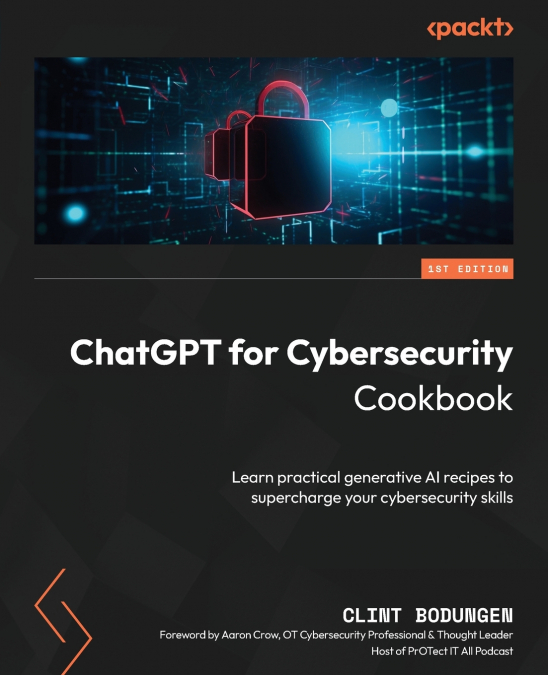
Master ChatGPT and the OpenAI API and harness the power of cutting-edge generative AI and large language models to revolutionize the way you perform penetration testing, threat detection, and risk assessment.Key Features:- Enhance your skills by leveraging ChatGPT to generate complex commands, write code, and create tools- Automate penetration testing, risk assessment, and threat detection tasks using the OpenAI API and Python programming- Revolutionize your approach to cybersecurity with an AI-powered toolkit- Purchase of the print or Kindle book includes a free PDF eBookBook Description:Are you ready to unleash the potential of AI-driven cybersecurity? This cookbook takes you on a journey toward enhancing your cybersecurity skills, whether you’re a novice or a seasoned professional. By leveraging cutting-edge generative AI and large language models such as ChatGPT, you’ll gain a competitive advantage in the ever-evolving cybersecurity landscape.ChatGPT for Cybersecurity Cookbook shows you how to automate and optimize various cybersecurity tasks, including penetration testing, vulnerability assessments, risk assessment, and threat detection. Each recipe demonstrates step by step how to utilize ChatGPT and the OpenAI API to generate complex commands, write code, and even create complete tools. You’ll discover how AI-powered cybersecurity can revolutionize your approach to security, providing you with new strategies and techniques for tackling challenges. As you progress, you’ll dive into detailed recipes covering attack vector automation, vulnerability scanning, GPT-assisted code analysis, and more. By learning to harness the power of generative AI, you’ll not only expand your skillset but also increase your efficiency.By the end of this cybersecurity book, you’ll have the confidence and knowledge you need to stay ahead of the curve, mastering the latest generative AI tools and techniques in cybersecurity.What You Will Learn:- Master ChatGPT prompt engineering for complex cybersecurity tasks- Use the OpenAI API to enhance and automate penetration testing- Implement artificial intelligence-driven vulnerability assessments and risk analyses- Automate threat detection with the OpenAI API- Develop custom AI-enhanced cybersecurity tools and scripts- Perform AI-powered cybersecurity training and exercises- Optimize cybersecurity workflows using generative AI-powered techniquesWho this book is for:This book is for cybersecurity professionals, IT experts, and enthusiasts looking to harness the power of ChatGPT and the OpenAI API in their cybersecurity operations. Whether you’re a red teamer, blue teamer, or security researcher, this book will help you revolutionize your approach to cybersecurity with generative AI-powered techniques. A basic understanding of cybersecurity concepts along with familiarity in Python programming is expected. Experience with command-line tools and basic knowledge of networking concepts and web technologies is also required.Table of Contents- Getting Started: ChatGPT, the OpenAI API, and Prompt Engineering- Vulnerability Assessment- Code Analysis and Secure Development- Governance, Risk, and Compliance (GRC)- Security Awareness and Training- Red Teaming and Penetration Testing- Threat Monitoring and Detection- Incident Response- Using Local Models and Other Frameworks- The Latest OpenAI Features