
Inicio > > Ciencias de la computación > Inteligencia artificial > Chaos Engineering for AI Infrastructure
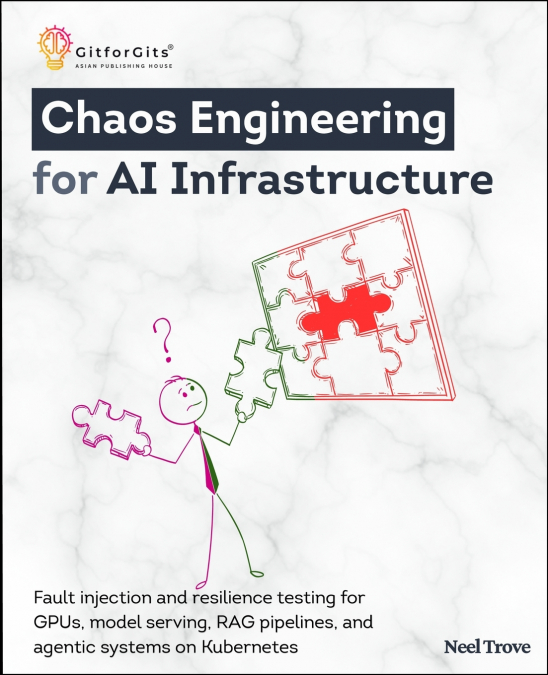
Chaos Engineering for AI Infrastructure

Chaos Engineering for AI Infrastructure

Neel Trove

61,53 €
IVA incluido
Disponible
Editorial:
GitforGits
Año de edición:
2026
Materia
Inteligencia artificial
ISBN:
9789349174771
61,53 €
IVA incluido
Disponible

Selecciona una librería:

  • Librería Samer Atenea

  • Kálamo Books
  • Librería Elías (Asturias)
  • Librería Kolima (Madrid)
  • Librería Proteo (Málaga)

How long do you think it would take you to notice if your AI system started giving worse answers?Honestly, for most teams, it’s weeks, and the news comes from a customer. Chaos engineering answers that question for infrastructure in about thirty seconds, because if a server goes down, it either reroutes or it doesn’t. And language models completely shatter all those assumptions. Their output varies for real, their decay builds up instead of happening straight away, and those failures are confident, plausible, and wrong while latency, error rate, and pod health stay exactly where they should be.This book sets out the new framework for AI infrastructure. You’ll find that, working through one support-assistant application across twelve chapters, everything moves from defining steady state for probabilistic systems to injecting faults at every layer, including accelerators, inference servers, model artefacts, retrieval pipelines, model APIs, autonomous agents, distributed training and the monitoring stack itself.Just to be clear, the toolchain is intentionally kept small. The LitmusChaos orchestrates, the Chaos Mesh reaches the kernel and filesystem, and the mitmproxy handles the content-level faults that neither can touch, extended with custom injectors where nothing suitable exists. So, every experiment comes to one of these four conclusions, and then the last chapter sums them all up as a programme scorecard.Key LearningsWrite down what 'working correctly' means when your system’s output legitimately varies.Break GPUs and inference servers on purpose, with a restore path that always runs.Spot the failures that keep every dashboard green and every alert silent.Check model weights for damage before loading them, not after serving starts.Catch the model release that scores better overall while getting worse where it matters.Find out whether your RAG pipeline is helping, or quietly making answers worse.Corrupt what the model returns, then watch whether your agent notices.Stop your remediation agent from making an incident worse than it was.Prove your training checkpoints actually resume the run they claim to continue.Catch slow decay in hours instead of days by changing how you alert.Table of ContentWhy AI Systems Fail Differently?Steady State for Probabilistic SystemLab and the ToolchainAccelerator and Compute ChaosInference Serving ChaosModel Artifacts, Registries, and Version SkewRetrieval and Context ChaosModel-Boundary ChaosAgentic and Multi-Agent ChaosDistributed Training and Choas Fine-TuningObserving Probabilistic DegradationOperationalizing Chaos

Artículos relacionados

  • Artificial Cognition Systems
    ...
  • Cross-Disciplinary Applications of Artificial Intelligence and Pattern Recognition
    Vijay Kumar Mago
    The need for intelligent machines in areas such as medical diagnostics, biometric security systems, and image processing motivates researchers to develop and explore new techniques, algorithms, and applications in this evolving field. Cross-Disciplinary Applications of Artificial Intelligence and Pattern Recognition: Advancing Technologies provides a common platform for researc...
  • Emerging Applications of Natural Language Processing
    Over the last few years, the area of Natural Language Processing has drastically grown in recognition, not only within the research and development community, but also with industry professionals. As NLP continues to be discussed and researched, certain areas continue to grow and mature. As a result, the need for advanced research and information is in high demand. Emerging App...
  • Androids, Cyborgs, and Robots in Contemporary Culture and Society
    Steven John Thompson
    Mankind’s dependence on artificial intelligence and robotics is increasing rapidly as technology becomes more advanced. Finding a way to seamlessly intertwine these two worlds will help boost productivity in society and aid in a variety of ways in modern civilization. Androids, Cyborgs, and Robots in Contemporary Culture and Society is an essential scholarly resource that delve...
  • Deep Learning Innovations and Their Convergence With Big Data
    The expansion of digital data has transformed various sectors of business such as healthcare, industrial manufacturing, and transportation. A new way of solving business problems has emerged through the use of machine learning techniques in conjunction with big data analytics. Deep Learning Innovations and Their Convergence With Big Data is a pivotal reference for the latest sc...
  • Computational Psychoanalysis and Formal Bi-Logic Frameworks
    Giuseppe Iurato
    Computational psychoanalysis is a new field stemming from Freudian psychoanalysis. The new area aims to understand the primary formal structures and running mechanisms of the unconscious while implementing them into computer sciences. Computational Psychoanalysis and Formal Bi-Logic Frameworks provides emerging information on this new field which uses psychoanalysis and the unc...

Otros libros del autor

  • Reverse Engineering with AI
    Neel Trove
    This book is a no-nonsense, hands-on guide to getting to the bottom of how real software works from the inside out, with an AI assistant there to help you at every step. All of this is done across eleven projects, where you take apart a mystery binary, recover a hidden algorithm, open an undocumented file format, map mobile and web backends, defeat obfuscation and anti-analysis...
    Disponible

    60,49 €