


Inicio > Tecnología, ingeniería, agricultura > Agricultura y explotación agropecuaria > Agricultura sostenible > Can Earth’s and Society’s Systems Meet the Needs of 10 Billion People?
Can Earth’s and Society’s Systems Meet the Needs of 10 Billion People?

Can Earth’s and Society’s Systems Meet the Needs of 10 Billion People?

AA.VV

35,31 €
IVA incluido
Disponible
Editorial:
National Academies Press
Año de edición:
2014
Materia
Agricultura sostenible
ISBN:
9780309306348
35,31 €
IVA incluido
Disponible

Selecciona una librería:

  • Librería Samer Atenea
  • Librería Aciertas (Toledo)
  • Kálamo Books
  • Librería Perelló (Valencia)
  • Librería Elías (Asturias)
  • Donde los libros
  • Librería Kolima (Madrid)
  • Librería Proteo (Málaga)

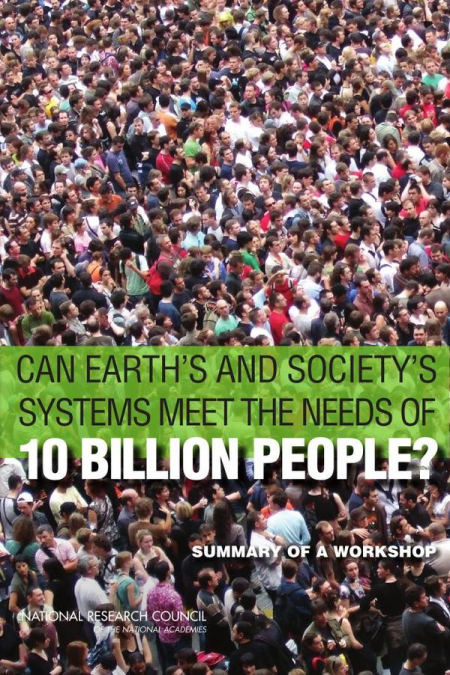
The Earth’s population, currently 7.2 billion, is expected to rise at a rapid rate over the next 40 years. Current projections state that the Earth will need to support 9.6 billion people by the year 2050, a figure that climbs to nearly 11 billion by the year 2100. At the same time, most people envision a future Earth with a greater average standard of living than we currently have - and, as a result, greater consumption of our planetary resources. How do we prepare our planet for a future population of 10 billion? How can this population growth be achieved in a manner that is sustainable from an economic, social, and environmental perspective? Can Earth’s and Society’s Systems Meet the Needs of 10 Billion People? is the summary of a multi-disciplinary workshop convened by the National Academies in October 2013 to explore how to increase the world’s population to 10 billion in a sustainable way while simultaneously increasing the well-being and standard of living for that population. This report examines key issues in the science of sustainability that are related to overall human population size, population growth, aging populations, migration toward cities, differential consumption, and land use change, by different subpopulations, as viewed through the lenses of both social and natural science.
Artículos relacionados

  • Los agronegocios y sus transiciones hacia la sostenibilidad
    Gustavo Correa Assmus
    ’El texto reflexiona en torno a los negocios agropecuarios, sin perder el horizonte de su sostenibilidad. En la primera parte del libro se abarcan los conceptos y la visión de los negocios agrarios, así como el modelo dominante en la economíaagroalimentaria global, que favorece los monocultivos de gran escala, industrializados, subsidiados y controlados por corporaciones transn...
    Disponible

    24,96 €

  • Linking Knowledge with Action for Sustainable Development
    This report summarizes a workshop organized by the National Academies’ Roundtable on Science and Technology for Sustainability. The workshop brought together a select group of program managers from the public and private sectors to discuss specific cases of linking knowledge to action in a diverse set of integrated observation, assessment, and decision support systems. Workshop...
    Disponible

    41,55 €

  • Nutrient Control Actions for Improving Water Quality in the Mississippi River Basin and Northern Gulf of Mexico
    A large area of coastal waters in the northern Gulf of Mexico experiences seasonal conditions of low levels of dissolved oxygen, a condition known as hypoxia. Excess discharge of nutrients into the Gulf of Mexico from the Mississippi and Atchafalaya rivers causes nutrient overenrichment in the gulf’s coastal waters and stimulates the growth of large algae blooms. When these alg...
    Disponible

    26,52 €

  • Implementing the New Biology
    As the second decade of the 21st century begins, the challenge of how to feed a growing world population and provide sustainable, affordable energy to fulfill daily needs, while also improving human health and protecting the environment, is clear and urgent. Increasing demand for food and energy is projected at the same time as the supply of land and other resources decrease. I...
    Disponible

    26,52 €

  • Pathways to Urban Sustainability
    The U.S. population is more than 80 percent urban. Recognizing that many metropolitan areas in the United States have been experimenting with various approaches to sustainability, and that despite the differences among regions, there are likely some core similarities and transferable knowledge, Roundtable members selected the metropolitan Atlanta, Georgia region as a case study...
    Disponible

    19,24 €

  • Challenges and Opportunities in the Hydrologic Sciences
    New research opportunities to advance hydrologic sciences promise a better understanding of the role of water in the Earth system that could help improve human welfare and the health of the environment. Reaching this understanding will require both exploratory research to better understand how the natural environment functions, and problem-driven research, to meet needs such as...
    Disponible

    45,24 €



