Fayssal El Mofatiche / Hanane Dupouy
 Librería Samer Atenea
 Kálamo Books
 Librería Elías (Asturias)
 Librería Kolima (Madrid)
 Librería Proteo (Málaga)
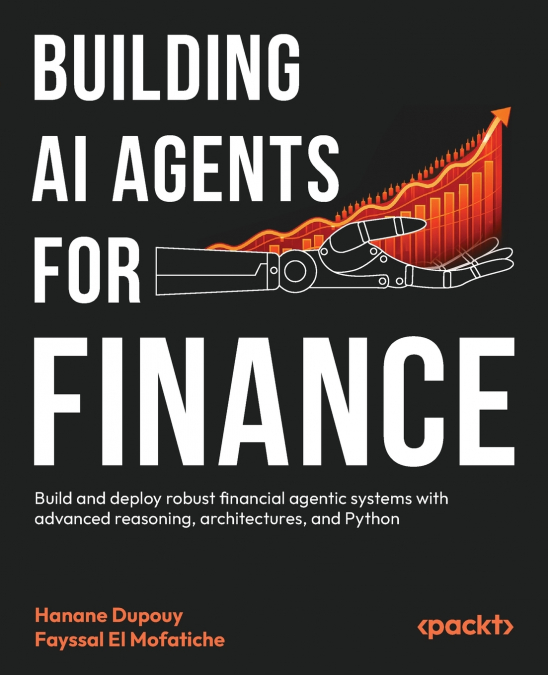
Go beyond simple LLM demos and build production-ready finance AI agents with Python, Claude, agentic RAG, multi-agent architectures, evaluation, guardrails, observability, and operations balancing efficiency, reliability, and costFree with your book: DRM-free PDF version + access to Packt’s next-gen Reader*Key Features:- Build finance-focused agents with Python, Claude, OpenAI models, RAG, and tool use- Apply advanced reasoning and multi-agent architectures to financial workflows- Implement, evaluate, observe, and govern agents, with a focus on reliability and robustnessBook Description:AI agents are rapidly changing how financial systems analyze information, make decisions, and automate complex workflows. While many resources explain agentic AI concepts, few show how to design and deploy AI agents that work reliably in finance. This book fills that gap.You will start by learning what AI agents are, how they differ from non-agentic systems, and when agentic architectures are appropriate. You’ll use Python with Claude and OpenAI models across hands-on labs covering design patterns, memory, agentic RAG, framework selection, reasoning paradigms such as ReAct, reflection, self-consistency, and Language Agent Tree Search, and multi-agent collaboration. You’ll then take a deep dive into financial use cases, including fundamental analysis, deep research, trading, insurance, and compliance, using technologies such as LangGraph, Claude Skills, the OpenAI Agents SDK, and LlamaIndex.You will learn to evaluate agent behavior, calibrate LLM judges, detect drift, and produce model risk reports. Finally, you will focus on operationalizing AI agents responsibly, covering the agent harness and execution loop, observability and tracing, deployment and versioning, guardrails, and governance with human oversight.By the end, you’ll be able to design, evaluate, and deploy financial AI agents that deliver real business value.*Email sign-up and proof of purchase requiredWhat You Will Learn:- Master core AI agent design patterns and apply them to finance- Compare major AI agentic frameworks and learn how to select the right one- Explore reasoning paradigms used in agentic workflows- Design multi-agent orchestration using various architectural styles- Build financial use cases with hands-on Python labs- Evaluate and test AI agent behavior effectively- Implement guardrails, tracing, and observability- Apply AI agents across fundamental analysis, trading, research, and complianceWho this book is for:This book is for finance professionals who want to understand and apply AI agents, and for developers and ML practitioners who want to build agentic systems for financial use cases. Financial analysts, quantitative researchers, and technology teams at financial institutions will find working blueprints they can adapt to their own workflows. A working knowledge of Python is required to get the most out of the hands-on labs. No prior experience with AI agents is assumed: the foundations are built from the first chapter, and financial concepts are explained as they are introduced.Table of Contents- What Are AI Agents?- Exploring Design Patterns for AI Agents- AI Agent Frameworks in Finance- Building a Fundamental Analysis Agentic System- Deep Search - Analyst-Grade Research with AI Agents- Implementing Reasoning Paradigms for Financial Agents- Multi-Agent Systems and Architectural Styles- Designing Multi-Agent Trading Systems: From Investment Committee to Adversarial Debate- Building Multi-Agent Insurance Workflows(N.B. Please use the Read Sample option to see further chapters)